
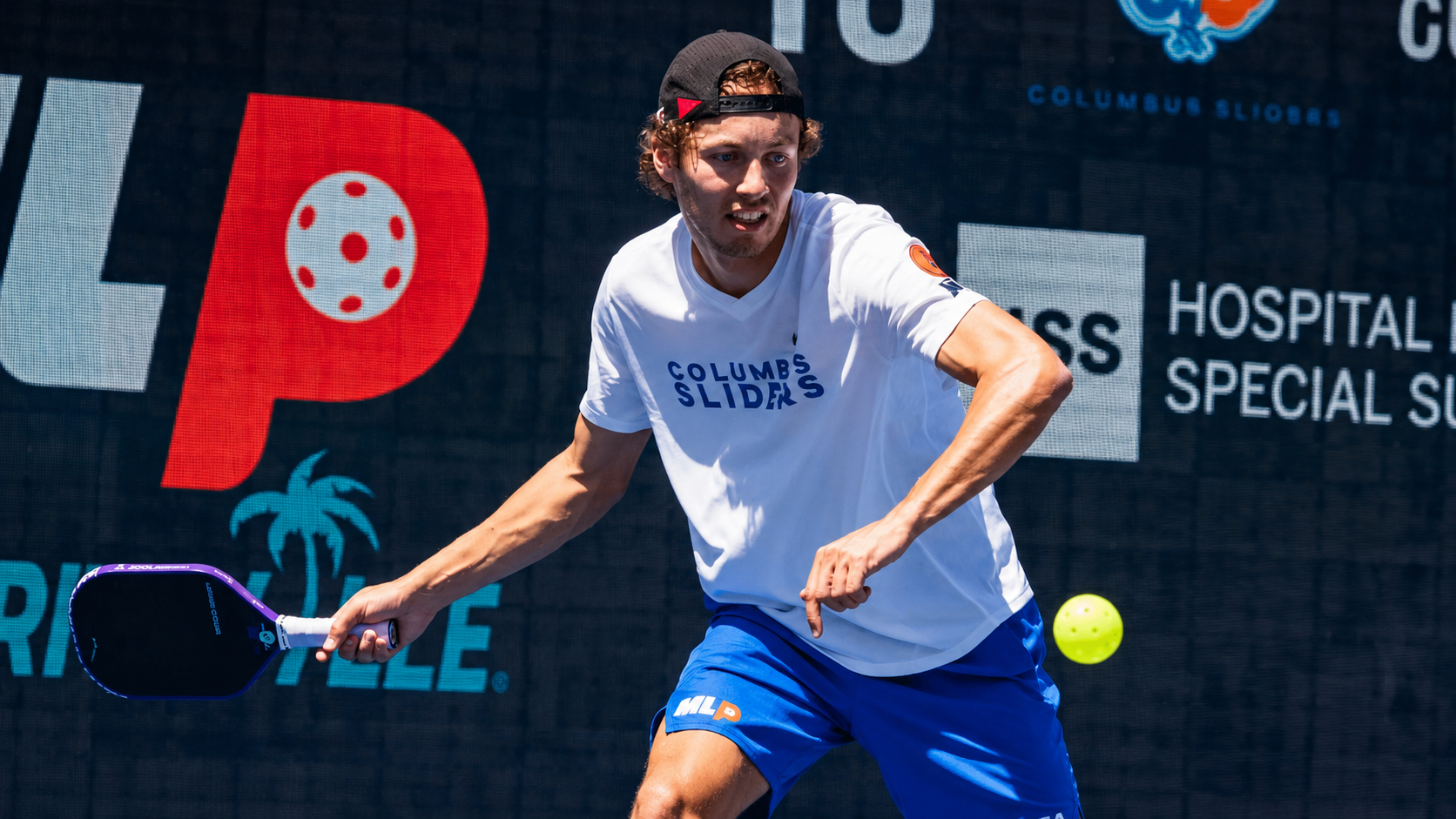
At 6-6 in the deciding game of the Atlanta Open singles final, Connor Garnett understood the tactical problem in front of him. He had spent the match solving it with his feet, his serve and his passing shots. Then, exhausted in the Georgia heat and facing an opponent who had spent three games making those solutions increasingly expensive, Garnett chose something else.
Key Takeaways
- Ben Johns beat Connor Garnett 3-11, 11-9, 11-9 in a gruelling Atlanta singles final in which Garnett actually recorded more clean winners.
- At 6-6 in the deciding game, Garnett later described a low-percentage attacking decision from a defensive position as a “fatigue shot”.
- The point reveals why conditioning at elite singles level is tactical: fatigue changes which correct decisions remain physically affordable.
At 6-6 in the third game, Connor Garnett went for the winner.
There was nothing unusual about that in itself. Garnett had spent much of the Atlanta Open singles final trying to hit through and around Ben Johns, and enough of those passing shots had worked to take the greatest men’s player of his generation deep into a deciding game.
The problem was where Garnett was when he attempted this one.
He was defending, without the balance he wanted beneath him. The percentage play was to keep the point alive, recover his position and wait for another opportunity.
Garnett knew that. Looking back at the match, he described what happened next with unusual precision.
It was a “fatigue shot”.
He tried to end the rally anyway. Johns reached the ball, Garnett was left scrambling and the point disappeared.
The phrase is more interesting than the error.
Elite sport is often analysed as though the body and brain operate independently. There is tactical intelligence and there is fitness. Shot selection and conditioning. Decision-making and endurance.
By 6-6 in Atlanta, those things had become impossible to separate.
Garnett had not forgotten how to play singles. For most of the afternoon, he had demonstrated precisely the opposite. He understood where Johns was dangerous, knew which positions gave his own passing game the best chance and had a clear idea of the margins required to beat him.
But knowing the correct solution and continuing to pay its physical cost are different things.
Johns had spent the match making that cost rise.
The Match Was Being Played Through Garnett’s Feet
Garnett’s own breakdown of the final is revealing because relatively little of it begins with spectacular hitting.
Much of it begins with his feet.
His passing game works best when he can move through the ball. The back leg plants, the front foot comes forward and the contact arrives with enough balance beneath it to combine pace with placement.
Against Johns, creating that position was one of the central battles of the match.
Garnett’s serve helped create it. He wanted enough depth and shape to make Johns work around the return, buying the fraction of time required to organise himself for the next ball. If he could establish his feet and step into the pass, Johns had a problem.
If Johns neutralised the serve, established himself at the kitchen and made Garnett play while moving, reaching or recovering, the percentages changed.
The same principle applied to Garnett’s returns. He was not merely looking for something conventionally “deep”. He wanted balls travelling towards the advertising behind the baseline, taking away enough time to influence everything that followed.
At this level, depth is measured partly by what it prevents the opponent from doing next.
Garnett was thinking about width in much the same way. The obvious temptation against a player occupying the kitchen is to find the widest passing angle available. Yet a wider pass also creates more angle for the volley coming back. If Johns was already balanced, opening the court could improve his options as much as Garnett’s.
Sometimes the ball through the middle was therefore the more aggressive tactical choice because it restricted the geometry Johns could use in response.
This focus on balance also appears throughout Garnett’s wider technical thinking. In his WPM breakdown of the modern two-handed backhand, planting the feet repeatedly appears as the foundation for stability and control rather than an incidental part of the stroke.
This was the match beneath the match.
Garnett wanted to arrive at the ball with choices.
Johns was trying to take them away.
Johns Was Making the Correct Game Harder to Play
That distinction matters when we reach the fatigue.
Johns was not simply standing on the other side of the net waiting for Garnett to tire in roughly 90-degree heat and heavy humidity. The patterns he produced repeatedly changed the physical problem Garnett had to solve.
Once established at the kitchen, Johns could work towards Garnett’s backhand. He could also vary what Garnett’s body was being asked to do.
Some balls arrived with pace. Others dropped shorter, forcing Garnett forward and making him cover additional ground from positions in which planting properly became harder. A ball did not need to produce an immediate winner to be successful. If it left Garnett reaching for the next one, the damage continued into another shot.
That is one of the less obvious qualities of elite singles.
The court looks enormous because of the open space, and the spectacular points tend to involve somebody exploiting it. Much of the tactical contest is really a fight over balance.
Garnett wanted Johns reaching.
Johns wanted Garnett scrambling.
The final ball merely revealed who had won that argument.
By the third game, every one of those exchanges carried accumulated cost. Both players were using walks towards their towels to extend the time between points. The pauses looked slow because the points themselves were becoming increasingly expensive.
This is where Johns’ role in the 6-6 error becomes important.
He did not make Garnett choose the wrong shot.
He helped make the right one harder to keep choosing.
Fatigue Changes the Price of Patience
There is a comforting assumption in sports analysis that elite players make poor decisions because they have misunderstood the situation.
Sometimes they do.
Garnett’s description of the 6-6 point suggests something different.
The low-percentage winner was a bailout. From the position he occupied, continuing the rally offered the better percentage. That meant recovering his feet, defending another ball and perhaps another after that, waiting until the geometry improved.
Earlier in the match, that cost had been acceptable.
Now another four or five shots meant another four or five movements across a singles court in Atlanta heat against Ben Johns.
Suddenly the risky winner offered something the percentage play could not.
An immediate ending.
That changes the way we should think about shot selection under fatigue. A player at full capacity can judge the rally primarily through probability: which option gives me the best chance of eventually winning this point?
As the physical cost rises, another variable enters the calculation.
How much work will the correct choice require?
The athlete does not need to articulate that question consciously. By then the answer is being supplied through heavy legs, slower recovery and the growing attraction of any ball that appears capable of ending the exchange.
The wrong shot can start feeling right.
Fatigue changes the price of patience.
Conditioning Is Part of the Tactics
Pickleball still occasionally carries the residue of its recreational reputation.
One of the game’s great strengths is that it allows players of different ages and physical capacities to compete meaningfully. Particularly in doubles, anticipation, touch and positioning can compensate for physical limitations in ways that make the sport unusually accessible.
Professional singles happens on the same dimensions but asks completely different physical questions.
The Atlanta final showed why conditioning at this level is not merely about surviving until the last point. It determines which tactical options remain available when you get there.
A tired player who can no longer establish his feet before a pass has lost more than explosiveness. A return that begins landing shorter because the legs are fading changes the opponent’s next ball. If exhaustion makes another patient defensive exchange feel too expensive, the player’s decision-making environment has changed too.
The body narrows the playbook.
This is also why fitness cannot be separated neatly from tactical pressure exerted by the opponent. Johns did not need to exhaust Garnett through endless spectacular rallies. Every ball that made Garnett change direction, reach, recover or play without his preferred base added something to the bill.
By the deciding game, Garnett was still capable of producing the shots that had brought him there.
The question was how often he could still create the conditions required to produce them.
Against most players, a slight deterioration might remain hidden.
Johns has spent a career making small losses of discipline visible.
Johns Did Not Need Garnett to Collapse
The match did not run away from Garnett after 6-6.
That is important.
At 6-8 he used his second timeout, interrupting Johns’ momentum and buying time to recover. At 8-10, facing match point, Garnett’s serve was called out. He used his remaining video challenge and was proved correct. The ball had clipped the line.
It became 9-10.
The final remained alive.
Johns eventually needed four match points to finish it, and the last one returned to a tactical pattern both players understood. Johns anticipated Garnett’s preferred backhand pass down the line, moved early and closed the championship 11-9 in the third.
The official PPA Tour statistics underline just how little separated them. Garnett finished with 24 clean winners to Johns’ 23, while the match ended 3-11, 11-9, 11-9.
There was no dramatic physical collapse. Garnett did not stop competing. He was one point away from restoring parity late in the deciding game.
That makes the earlier moment more revealing, not less.
At elite level, an opponent does not always need you to fall apart. Sometimes a small deterioration in the quality of one decision is enough.
The scoreboard records the point in exactly the same way as every other one.
The match has spent much longer creating it.
The Gap Between Knowing and Doing
This is why Garnett’s description of his own mistake is so useful.
“Fatigue shot” sounds simple. It is not.
Inside those two words sit most of the tactical themes of the final: the depth of the serve, the quality of the return, the importance of planting before the pass, Johns’ ability to alter Garnett’s movement, the oppressive conditions and the accumulation of work across three games.
By 6-6, Garnett still understood all of it.
That is what makes the error interesting.
Elite athletes spend years building decisions until they become automatic. The correct response appears almost before the conscious mind has asked the question. Yet those automatisms still depend upon a body capable of carrying them out.
When that body begins to fade, the tactical map does not disappear.
The distances on it change.
A patient option that made perfect sense half an hour earlier can suddenly look very far away. The ambitious winner begins to look closer.
Johns won the Atlanta final 11-9 in the third game on his fourth match point. Garnett left without the trophy, having taken him to the edge.
The revealing moment came earlier.
At 6-6 there was no injury, no obvious breakdown and no sudden loss of understanding. Garnett still knew what the rally required. Johns had simply spent three games making that requirement progressively more expensive.
At the highest level, exhaustion does not always announce itself with a player bent over between points.
Sometimes the feet arrive a fraction late. Sometimes the return loses a few feet of depth.
And sometimes patience suddenly feels expensive.
Further Reading
- The Blueprint: 5 Essential Two-Handed Backhands with Connor Garnett
- Connor Garnett: Why Pickleball’s Fastest Thinkers Refuse to Stand Still
- Ben Johns: Rankings, Results and WPM Coverage
- Tournament coverage and results

Chris Beaumont
Founder and Editor-in-ChiefChris Beaumont is the founder and Editor-in-Chief of World Pickleball Magazine. Chris follows the global game closely, reporting on the latest news, developments, stories and tournaments from all five continents. He also hosts the World Pickleball Podcast, interviewing people at…
View All Articles →

