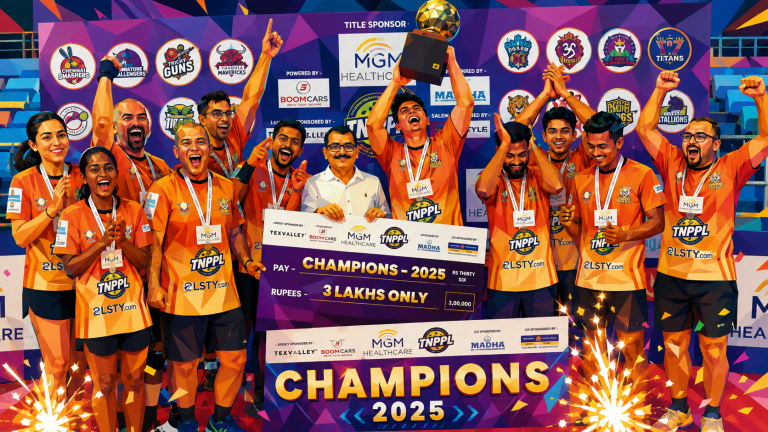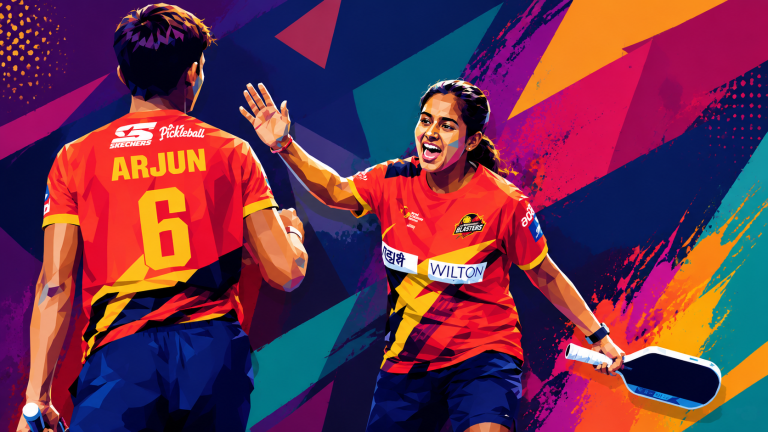
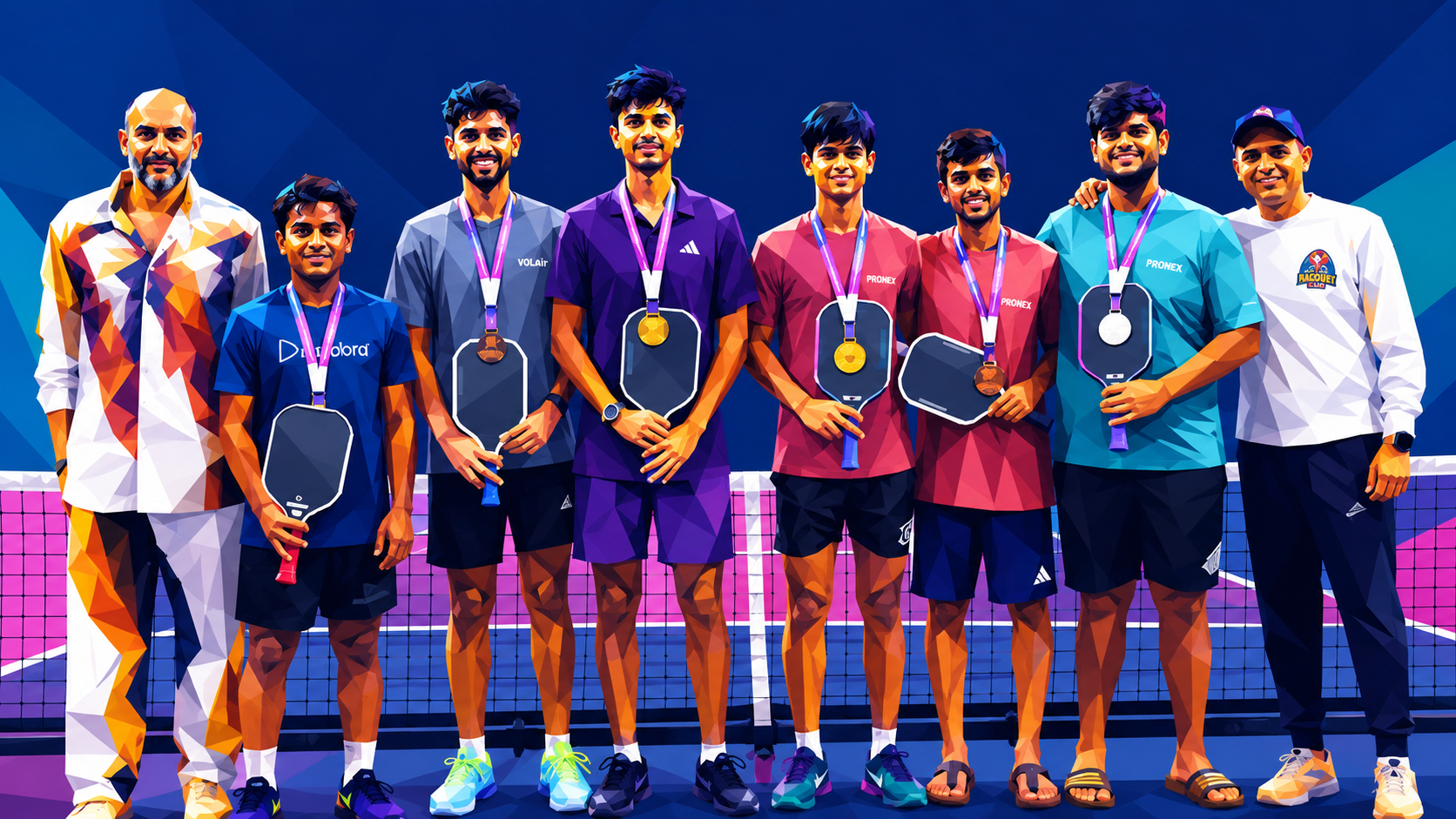
Arjun Singh’s two gold medals were the headline at the Monsoon Pickleball Championship. The more important story may be that one of the world’s largest domestic pickleball tournaments is becoming a proving ground for the Global Pickleball Alliance’s vision of connected international player pathways.
Key Takeaways
- More than 1,200 players competed across 48 categories at the fourth Monsoon Pickleball Championship in Mumbai.
- Arjun Singh won professional men’s doubles and mixed doubles gold, while Diwakar Agarwal denied him a clean sweep by taking the men’s singles title.
- The event offers an early test of whether the Global Pickleball Alliance can connect major domestic tournaments with meaningful international opportunities.
More than 1,200 players entered the Monsoon Pickleball Championship.
Five years ago, that number would have sounded extraordinary.
Today, it may be the least interesting thing about the tournament.
When the fourth edition concluded at Mumbai’s Andheri Sports Complex after five days of competition across 48 categories, the event once again demonstrated India’s ability to stage pickleball on a scale that few countries outside North America can currently match.
Yet participation numbers are no longer the biggest question surrounding Indian and Asian pickleball.
The more revealing question is what happens to the players who emerge from tournaments like these.
Arjun Singh Was the Face of a Bigger Story
Arjun Singh left Mumbai with two gold medals.
Partnering Harsh Mehta, he won the professional men’s doubles title before teaming with Naomi Amalsadiwala to claim mixed doubles gold. Singh and Amalsadiwala edged Pearl Amalsadiwala and Divyanshu Kataria 13-11 in the deciding third game.
His week was not entirely perfect.
Diwakar Agarwal ended Singh’s hopes of a third professional title by defeating him in the men’s singles semi-finals. Agarwal then beat Rashein Samuel 11-9, 11-6 in the final.
On the women’s side, Khushi Desai defeated Shreya Chakraborty 11-9, 11-0 to win singles, while Naomi and Pearl Amalsadiwala continued their success together in women’s doubles.
Those names matter.
Not because one tournament creates stars overnight, but because they are beginning to appear repeatedly across India’s leading competitions.
Every established sporting structure eventually develops recognisable competitors, recurring partnerships and rivalries that continue from one tournament to the next. Spectators stop following isolated brackets and begin following careers.
The Monsoon Championship is increasingly contributing to that process.
India’s Domestic Game Is Developing Competitive Depth
For years, Indian pickleball has been measured through participation figures, court openings and ambitious projections.
Those statistics helped explain how quickly the sport was spreading. They no longer fully explain where it is heading.
The Monsoon Championship suggests the next phase is about competitive depth.
A tournament of this size requires more than enthusiasm. It needs experienced organisers, officials, workable scheduling, suitable venues and a player base capable of sustaining competition across dozens of divisions.
That is sporting infrastructure.
It also gives leading players repeated exposure to one another. Singh, Agarwal, Naomi Amalsadiwala, Pearl Amalsadiwala and Desai are becoming more than names on a results sheet. Their performances can increasingly be measured against previous events and familiar opponents.
WPM examined a related structural change earlier this year when the Indian Open aligned more closely with national governance and ranking systems. The same underlying question applies in Mumbai: can India turn large private tournaments into a coherent competitive pathway?
Where the Global Pickleball Alliance Fits
That domestic structure also sits within a wider international project.
Global Sports Pickleball, the organiser of the Monsoon Championship, is one of the founding members of the Global Pickleball Alliance.
The GPA is not simply Global Sports under another name. It brings together separate organisations from several markets, including the APP in the United States, Australia’s National Pickleball League, the Canadian National Pickleball League, Pickleball England, the European Pickleball Federation and D-Joy Pickleball in Vietnam.
Its stated aim is to connect rankings, tournament results, player profiles and competition opportunities across member organisations. The official GPA platform currently presents itself as a home for international rankings, tournaments and player information. :contentReference[oaicite:0]{index=0}
WPM first covered the alliance when its founding partners proposed a shared calendar, ranking system and international professional pathway. That original ambition was significant because the members were not trying to build identical competitions in every country. They were attempting to connect existing domestic organisations. Readers can revisit our original analysis of how the Global Pickleball Alliance was formed.
That distinction makes Mumbai more important than another successful tournament weekend.
The Monsoon Championship provides the kind of domestic base the GPA model requires. It brings together a large player population, recurring elite competitors and an established organiser capable of running major events.
The unanswered question is whether those ingredients translate into opportunity beyond India.
The GPA Must Be Judged Through Players
The credibility of the GPA will ultimately depend less on the number of organisations it recruits than on what happens to the athletes competing within its network.
Can results earned in India carry genuine weight elsewhere?
Can players move from Mumbai into APP events, GPA tournaments or other international competitions without starting again from the bottom?
Can rankings connect markets with different levels of competition, resources and player depth?
Those are harder questions than building a calendar or announcing an alliance.
The APP’s expansion into Asia offers one possible connection point. Its six-stop regional tour has been framed as part of the wider attempt to link local operators, rankings and international competition. WPM has previously examined how the APP Asia Tour fits within that connected model.
Mumbai now offers another test.
If a player performs consistently in one of India’s largest domestic events, the system should make the next step visible. That does not mean every champion immediately becomes an international professional. It means the route, ranking value and standard required should be understandable.
A Tournament Beginning to Build Its Own History
The Monsoon Championship has now reached its fourth edition.
That matters because sporting events acquire meaning over time.
Players return. Champions defend titles. Partnerships change. Upsets carry greater weight because they can be measured against previous meetings.
Agarwal’s victory over Singh in the singles semi-finals mattered because Singh arrived as one of India’s leading players. Singh’s two doubles titles then added another layer to his standing rather than simply erasing the singles defeat.
Those storylines are signs of an event developing its own competitive identity.
The original tournament report described a small core of players repeatedly finding their way onto the podium. That is not necessarily evidence that the field lacks depth. It can also be the beginning of sporting continuity, where leading names become benchmarks for everybody else. :contentReference[oaicite:1]{index=1}
Why It Matters
Arjun Singh deserved the headlines after winning two professional titles.
But his medals may ultimately become part of a larger story.
The Monsoon Championship demonstrates that India is no longer trying to prove pickleball can attract players. It is showing that it can sustain large, repeatable competition and produce an increasingly recognisable domestic elite.
For the Global Pickleball Alliance, that is where theory meets reality.
A connected international system will not be validated by governance documents alone. It will be validated when players emerging from tournaments in Mumbai, Melbourne, Toronto, London, Vietnam and the United States can see how one level of competition connects to the next.
The fourth Monsoon Championship has supplied the scale.
The GPA now has to show that scale can lead somewhere.
Further Reading
- How the Global Pickleball Alliance was formed
- How the Indian Open’s governance shift changed India’s pathway
- How the APP Asia Tour fits the wider GPA model
- More pickleball coverage from India and across Asia

Chris Beaumont
Founder and Editor-in-ChiefChris Beaumont is the founder and Editor-in-Chief of World Pickleball Magazine. Chris follows the global game closely, reporting on the latest news, developments, stories and tournaments from all five continents. He also hosts the World Pickleball Podcast, interviewing people at…
View All Articles →