
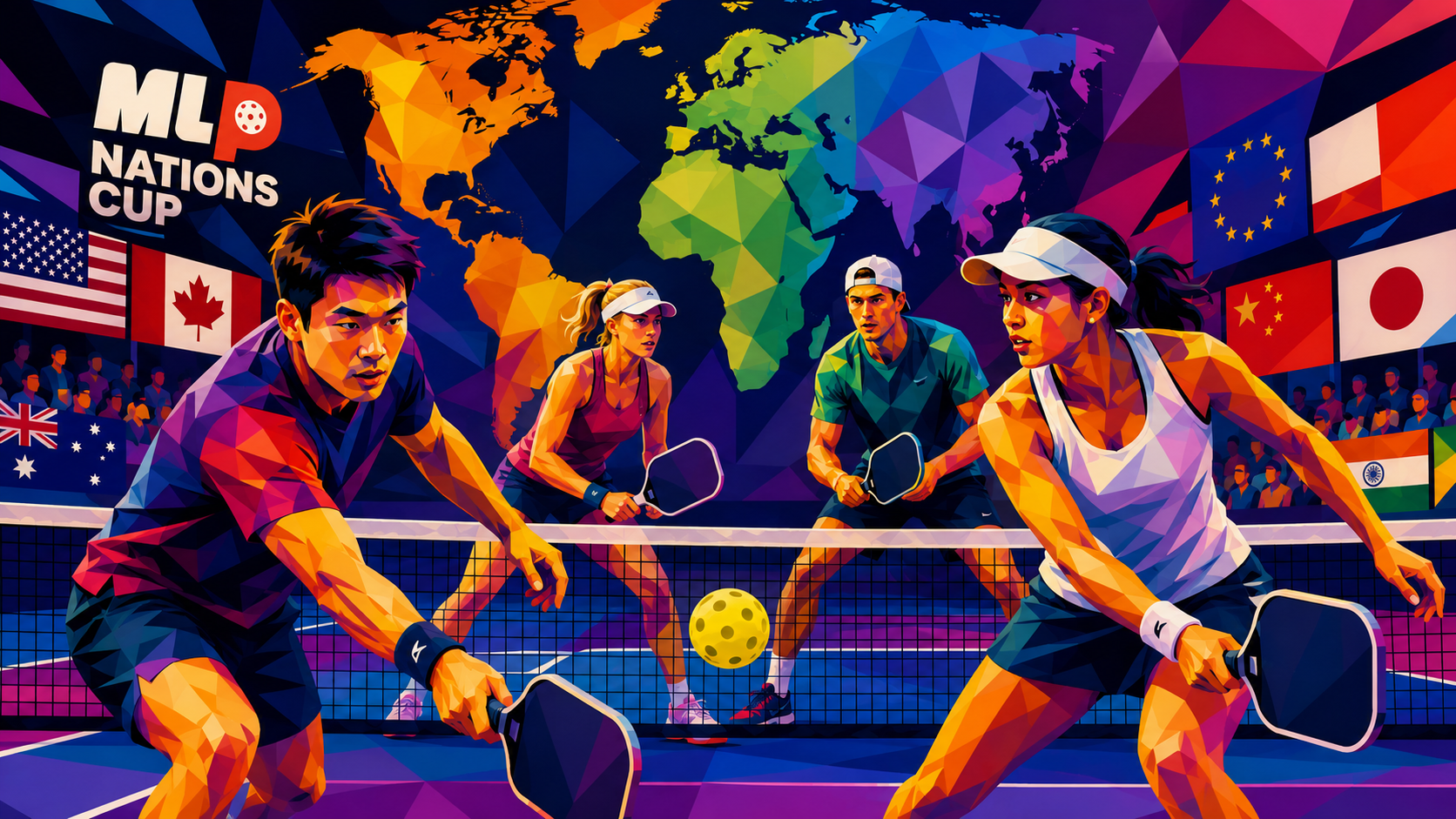
The inaugural MLP Nations Cup will bring eight international teams to Texas this October. Behind the regional rivalries sits a more consequential strategy: Major League Pickleball is testing whether its team format can become a global sports property.
Key Takeaways
- The inaugural MLP Nations Cup will take place at Brookhaven Country Club in Texas from 30 October to 1 November 2026.
- Eight teams will represent the USA, Canada, Australia, South America, Western Europe, Eastern Europe and two regions from Asia.
- The competition will begin with round-robin matches before moving into a single-elimination bracket on Championship Sunday.
- The Nations Cup will officially open the ten-day 2026 Pickleball World Championships.
- The event gives MLP a relatively low-risk way to test international audiences before committing to deeper overseas league expansion.
Major League Pickleball has found a way to stage an international competition without initially asking international audiences to care about Major League Pickleball.
That may sound contradictory.
It is also the strategic logic behind the inaugural MLP Nations Cup.
Eight teams will arrive at Brookhaven Country Club in Farmers Branch, Texas, from 30 October to 1 November. The USA, Canada, Australia and South America will be represented alongside Western Europe, Eastern Europe and two teams from Asia.
Friday and Saturday will be used for round-robin competition. The leading teams will then progress into a single-elimination bracket on Championship Sunday, when the first MLP Nations Cup winner will be crowned.
On the surface, it is another international pickleball event.
Look more closely and it becomes something more important.
The Nations Cup gives MLP a way to test whether the league’s format, players and commercial identity can matter beyond the American cities around which its domestic franchises have been built.
That is the real competition taking place in Texas.
The Flags Make MLP Easier to Enter
Professional leagues face a particular challenge when they expand internationally.
They are not simply asking overseas viewers to enjoy the sport.
They are asking them to care about teams, histories and rivalries created somewhere else.
A supporter in Melbourne, London or Kuala Lumpur may already enjoy pickleball. That does not mean they feel an immediate connection to a franchise representing Columbus, St Louis or New Jersey.
The Nations Cup removes that first obstacle.
People do not need to understand franchise ownership, player drafts, trade windows or the history of the regular season before choosing a side. They can begin with geography and regional identity.
The USA against Canada requires little explanation.
Western Europe against Eastern Europe creates an obvious rivalry.
Two Asian teams recognise that one side could not meaningfully represent a continent containing several of pickleball’s most active emerging markets.
National and regional identities therefore become the entry point.
MLP becomes the product discovered underneath them.
This Is Not Quite a Nations Cup
The title is commercially effective, although the structure is more complicated than the name suggests.
Only some of the eight teams represent individual countries.
The USA, Canada and Australia fit the conventional international model. South America, Western Europe and Eastern Europe are regional selections, while Asia receives two teams whose exact identities and rosters have yet to be announced.
That does not invalidate the event.
It does reveal what MLP is trying to achieve.
This is not a federation-led world championship designed to establish the strongest national team in pickleball. It is an invitational competition built to bring recognisable markets, leading players and international rivalries into the MLP format.
The distinction matters because it keeps expectations honest.
The Nations Cup should not be judged by whether every country possesses a formal qualification route or whether each team has been selected by a recognised national governing body.
That is not what has been announced.
It should be judged as a commercial and competitive experiment: can MLP make its coed team product feel relevant to audiences beyond its existing American franchise system?
Why Now?
The event has not appeared in isolation.
MLP and the wider United Pickleball Association have spent several years extending their reach into international markets.
The UPA previously announced events and operating partnerships across Australia, India, Canada, Asia and Europe. PPA Asia and MLP Asia were subsequently created with plans to take professional events and franchised team competition into markets including China, Vietnam, Japan and Singapore.
The stated plan for MLP Asia was not merely to send American teams abroad for occasional exhibitions. It was to establish domestic leagues capable of developing their own local presence.
The Nations Cup now connects those ambitions to MLP’s largest existing stage.
It will serve as the official opening event of the 2026 Pickleball World Championships, placing international team competition at the beginning of a ten-day festival expected to attract players and supporters from multiple markets.
That gives MLP several things at once.
It gains an international event without immediately constructing a separate overseas league.
It can place players from developing markets alongside established professional names.
It can test which teams generate attention, ticket demand and digital engagement.
And it can do so at Brookhaven, a venue already familiar to the organisation and its audience.
This is international expansion with much of the operational risk contained.
Market Research Disguised as Competition
The Nations Cup will crown a champion.
It will also generate information.
Which regional teams attract the largest online followings?
Which players create interest in markets outside North America?
Do supporters respond more strongly to national identity than to MLP’s existing city franchises?
Can an Asian, European or South American team persuade viewers in those regions to watch an event staged in Texas?
Those answers matter because permanent international expansion is expensive.
A genuine overseas league requires owners, operators, venues, broadcasters, sponsors, player contracts and a calendar capable of surviving beyond its launch season.
A three-day tournament requires far less commitment.
It allows MLP to demonstrate the product before attempting to sell the infrastructure around it.
In that respect, the Nations Cup is market research disguised as elite sport.
The matches will be real. The results will matter to the players involved. The trophy will carry value because it is the first of its kind.
But the larger prize for MLP is knowledge.
The organisation will leave Texas with a clearer idea of where its international brand possesses genuine pull and where enthusiasm for playing pickleball has not yet developed into enthusiasm for watching its professional team format.
Playing Pickleball Is Not the Same as Following MLP
This is the biggest uncertainty surrounding the strategy.
Participation growth does not automatically create professional sports audiences.
Millions of people can enjoy playing a sport without becoming emotionally invested in a league, buying tickets, subscribing to broadcasts or following player transactions.
MLP must therefore achieve something more difficult than exposing international audiences to pickleball.
Those audiences already know the sport.
The task is to persuade them that MLP’s particular version of it deserves their attention.
That means making the coed team format understandable.
It means developing players whose appeal extends beyond the American tour.
It means giving overseas audiences regular reasons to return rather than presenting them with one international weekend and then returning to a largely domestic calendar.
Most importantly, it means avoiding the impression that international teams have been created simply to decorate an American event with flags.
The players and markets involved must eventually influence the product itself.
The Global Sports Comparison Has Limits
There is a familiar strategic playbook here.
The Premier League became more valuable as overseas supporters began treating English clubs as their own. The NBA expanded its influence through international players, broadcasts, merchandise and events. Formula One built new commercial relationships by taking its competition directly into strategically important markets.
MLP is nowhere close to the scale, history or financial power of those properties.
But the underlying lesson remains useful.
A league becomes global when international audiences care about the league itself, not merely when it stages a match containing international players.
The Nations Cup may help MLP begin that transition.
A strong performance from an Asian or European team could introduce unfamiliar players to a wider audience. Regional rivalries could create narratives capable of continuing into future events. International supporters may begin following those players when they return to their MLP franchises or PPA schedules.
That is how the event can create value beyond its final day.
The flags attract attention.
The league must then retain it.
What Success Would Actually Look Like
MLP will naturally promote attendance, match quality and digital reach when the tournament concludes.
Those figures will offer only an early reading.
The more meaningful measures will take longer to emerge.
Are the Nations Cup teams retained for 2027?
Does the competition move into an international market rather than remaining permanently in Texas?
Do participating regions gain defined selection structures?
Does MLP Asia develop into the domestic franchised league originally proposed?
Do international sponsors and broadcasters begin investing in the team product?
And do players from outside North America become central figures within MLP rather than temporary representatives used during one global showcase?
Those questions will determine whether the Nations Cup is the beginning of a strategy or simply an attractive addition to an already crowded championship fortnight.
MLP Is Testing What It Wants to Become
The safest interpretation of the Nations Cup would be to describe it as a new three-day tournament featuring eight international teams.
That description would also miss its significance.
MLP is testing whether regional identity can carry its format into markets where its domestic franchises have little existing meaning.
It is testing whether players developed through expanding Asian, European, Australian and South American ecosystems can become part of a shared professional product.
And it is testing whether the league can eventually generate value outside the country in which it was created.
The experiment may work.
It may also reveal that international pickleball supporters are more interested in their own tours, clubs and national competitions than in adopting an American league.
That is why the Nations Cup matters.
It creates a genuine test rather than merely another expansion announcement.
If the event is remembered as the moment MLP began becoming an international brand, the first weekend of November 2026 will eventually look significant.
If it disappears after one edition, it will be remembered as another tournament carrying ambitious language about the global game.
The answer will not arrive when the first Nations Cup champion raises the trophy.
It will arrive over the following years, when MLP discovers whether international audiences want occasional regional teams or whether they want Major League Pickleball itself.
Further Reading
- PPA Global Expansion Reshapes Pickleball’s International Calendar
- Can UPA-A Become Pickleball’s Global Paddle Authority?
- MLP Mid-Season Tournament Reveals Structural Fragility
- Manny Pacquiao’s Pickleball League Could Reshape Asia

Chris Beaumont
Founder and Editor-in-ChiefChris Beaumont is the founder and Editor-in-Chief of World Pickleball Magazine. Chris follows the global game closely, reporting on the latest news, developments, stories and tournaments from all five continents. He also hosts the World Pickleball Podcast, interviewing people at…
View All Articles →

