
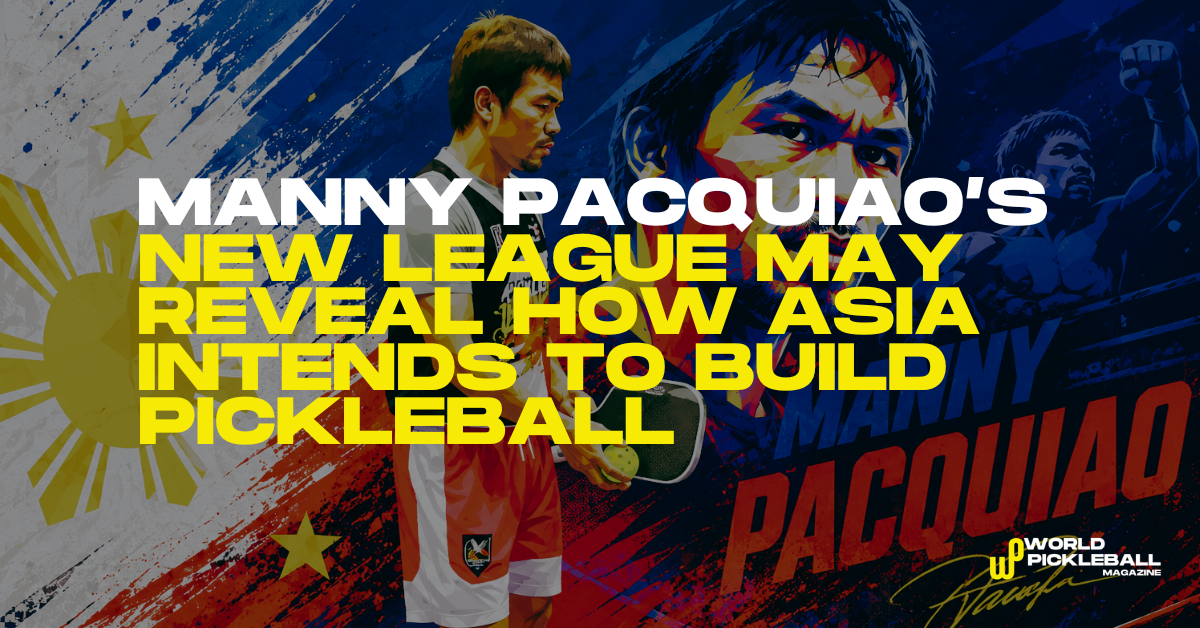
Manny Pacquiao is not just attaching his name to pickleball. He may be helping create a different blueprint for how professional pickleball develops outside the United States.
- Pacquiao has launched the Maharlika Pilipinas Pickleball Tour with a ₱5 million prize pool
- The league is built around regional franchises representing different parts of the Philippines
- Southeast Asia may develop a very different commercial pickleball structure from the American model
For years, the global expansion of professional pickleball has largely carried one assumption underneath it: that the rest of the world would eventually follow the American blueprint.
Tours. Touring pros. Centralised events. Franchise ownership built around investors and personalities. A constant calendar driven mainly by individual star power.
The Philippines may be about to test a different idea entirely.
This week, Pacquiao announced the launch of the Maharlika Pilipinas Pickleball Tour, a new professional league built around regional identity, local representation, and domestic competition rather than a traditional touring structure.
At first glance, it looks like another celebrity-backed pickleball story.
Look closer, and it may become something far more significant.
Pacquiao Is Building Infrastructure, Not Just Interest
Pacquiao is not merely investing in an existing league. He is attempting to build infrastructure from the ground up using a model that already transformed another sport in the Philippines.
The MPPT will launch with a ₱5 million prize pool and plans for eight franchise teams representing Metro Manila, Luzon, Visayas, and Mindanao. Teams will feature three men and three women competing across men’s doubles, women’s doubles, and mixed doubles during a five-leg invitational season in 2026.
Operations are being overseen by CEO Joe Ramos and Commissioner Mark K. Espinosa, with the project sanctioned by the Games and Amusements Board.
But the most important detail may not be the structure itself.
It is who is building it.
Why Pacquiao’s Name Changes The Weight Of The Story
Pacquiao’s influence inside Filipino sport extends far beyond celebrity. In the Philippines, he is viewed not simply as a former athlete but as a figure capable of legitimising entire sporting movements.
When he launched the Maharlika Pilipinas Basketball League in 2018, the concept quickly gained traction because regional identity already sits at the centre of Filipino sports culture.
Provincial loyalty matters deeply there.
Weekend basketball events across the country routinely draw emotionally charged local support tied as much to civic pride as sporting quality. The MPBL succeeded because it understood that communities were not simply buying into teams. They were buying into representation.
The MPPT appears designed around the same principle.
If you’re following how the global game is shifting week by week, the World Pickleball Report breaks this down every day in our morning briefing.
A Different Model From The United States
That matters because Southeast Asia may ultimately prove more receptive to domestic league structures than the constantly travelling tour model that dominates American pickleball.
That does not mean one system is better than the other. It means different sporting cultures may demand different commercial solutions.
In the United States, professional pickleball grew through open tournaments, touring professionals, and eventually team-based ownership layered on top. In the Philippines, the pathway may reverse itself. Regional identity could become the entry point first, with broader professional ecosystems growing around it afterwards.
That distinction could prove commercially powerful.
Local sponsors understand city and provincial allegiance immediately. Weekend event scheduling fits existing Filipino sports habits naturally. Fans are often more willing to support teams representing their region than disconnected touring events arriving briefly before moving elsewhere.
In that sense, Pacquiao may be trying to localise professional pickleball before globalising it.
Why The Format Matters
The structure reflects that ambition.
Group-stage matches are scheduled for Saturdays before knockout rounds conclude on Sundays, creating a format designed as much for spectators and repeat audiences as for the players themselves.
Unlike many emerging international pickleball projects, the MPPT is not positioning itself as a side product orbiting American tours. It is attempting to become a meaningful domestic sports property in its own right.
That is a much more ambitious proposition.
What This Means
For years, much of the international pickleball conversation has centred on participation numbers, expansion announcements, and celebrity involvement.
The Philippines may be pushing the conversation somewhere more important: towards sustainable sports ecosystems.
If the MPPT succeeds, it could challenge one of the sport’s biggest assumptions, namely that professional pickleball everywhere will eventually evolve into some version of the American model.
The global map of professional pickleball may end up looking far more regional, localised, and culturally specific than many currently expect.
And that possibility could reshape the business of the sport just as much as the competition itself.
For a clearer view of where the sport is heading each month, you can download the latest free issue of World Pickleball Magazine.
Further Reading
- Latest pickleball news from around the world
- Tournament coverage and results
- Rankings and player profiles
- Regional pickleball coverage

Chris Beaumont
Founder and Editor-in-ChiefChris Beaumont is the founder and Editor-in-Chief of World Pickleball Magazine. Chris follows the global game closely, reporting on the latest news, developments, stories and tournaments from all five continents. He also hosts the World Pickleball Podcast, interviewing people at…
View All Articles →