
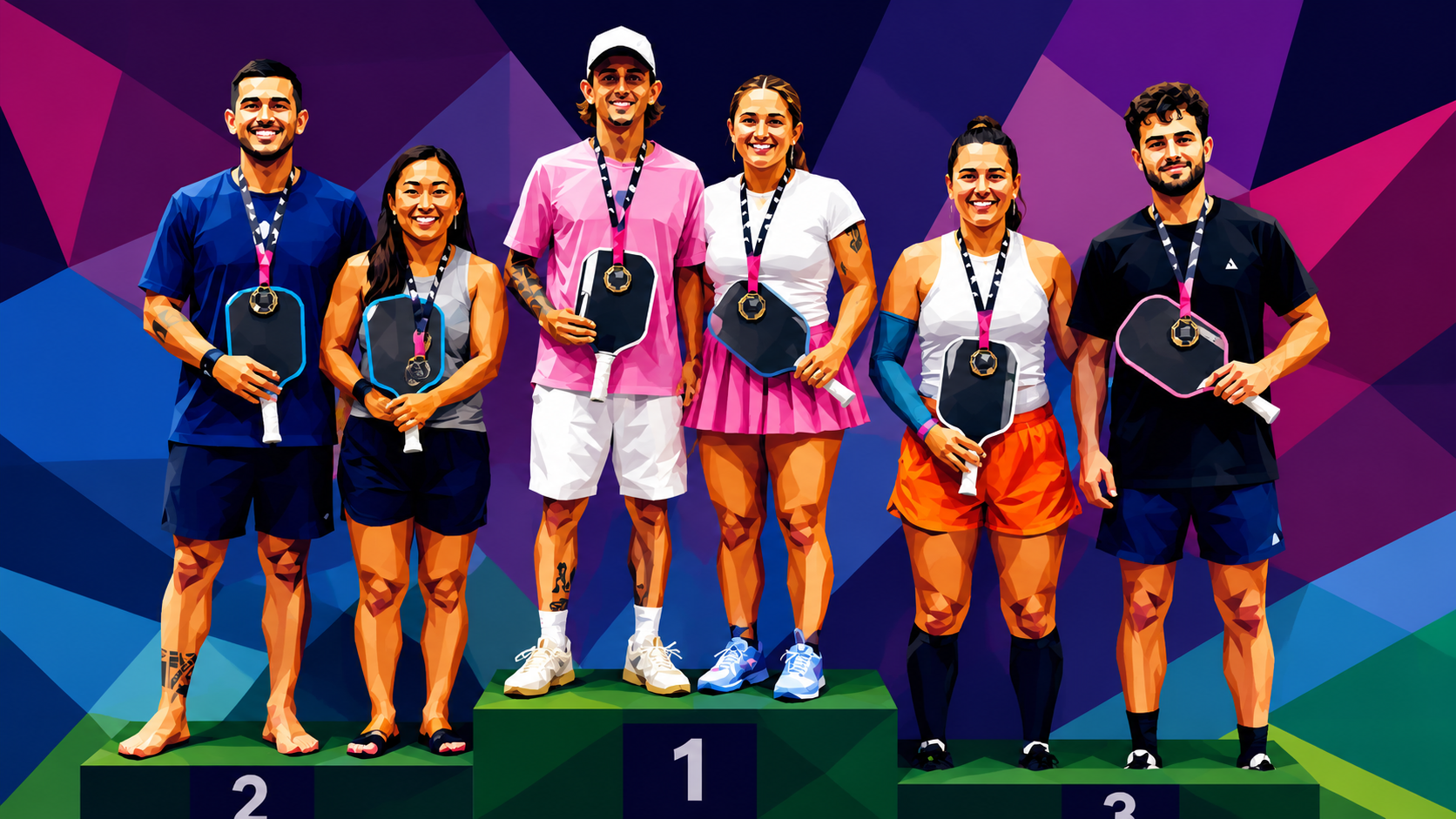
From Tokyo’s late-match chaos to Italy’s depth-driven consistency and Heidelberg’s structured European contesting, this weekend offered a rare, side-by-side view of how differently professional pickleball is developing across regions.
Key takeaways
- Tokyo delivered high-volatility matches defined by momentum swings and late reversals.
- The WPC Italian Open showed depth across categories, with repetition and multi-event consistency.
- Heidelberg reflected a stabilising European circuit increasingly defined by execution over chaos.
Tokyo: matches decided in single momentum shifts
The Sansan Tokyo Open produced the most dramatic tennis-style volatility of the weekend, where matches rarely followed predictable patterns and momentum often collapsed within a single service sequence.
Rika Fujiwara delivered the defining moment of the tournament, recovering from 10–5 down in the deciding game against Pei Chuan Kao. Facing five match points, she produced a seven-point run to secure the title 7–11, 11–7, 12–10 in front of a home crowd fully embedded in the contest.
The victory extended her winning streak to eight matches and reinforced a defining feature of the Asian circuit: elite matches are increasingly decided by short, irreversible swings rather than sustained dominance.
In men’s doubles, Yuta Funemizu and Tama Shimabukuro overcame Collin Johns and Len Yang after dropping the opening game, before completely shifting control of the match in the second and third.
Hong Kit Wong added further momentum for the region with a composed singles win over Mitchell Hargreaves, using controlled absorption of pace rather than raw aggression.
Across draws, Australian involvement remained strong, with Sahra Dennehy and Danni-Elle Townsend contributing to another spread of international medals.
Tokyo’s defining characteristic was not hierarchy, but instability at the top level of matches.
Italy: depth across categories and repeated performance cycles
The WPC Italian Open reflected a different competitive rhythm entirely. Rather than single defining moments, the event was shaped by repetition, endurance across categories, and consistent return of familiar finalists.
In the 19+ 5.0 draws, Sabrina Méndez and Jesús García Garré secured mixed doubles gold, while Bartosz Karbownik and Arwid Dahlin took the men’s doubles title.
The 50+ categories highlighted one of the standout performers of the weekend in Elena Bonilla González, who featured across multiple medal-winning campaigns, including women’s doubles success alongside Monica Ramirez Calvo.
Unlike Tokyo, there were few dramatic reversals or sudden momentum shifts. Instead, outcomes were defined by consistency across repeated match conditions and partner combinations.
This is a different form of competitive pressure: not volatility, but endurance across multiple draws and formats within the same tournament window.
Heidelberg: structured competition and controlled margins
The RTA1000 Heidelberg event offered a more structured version of European competition, where results largely followed seed expectations and matches were defined by execution rather than disruption.
Katie Morris and Jamie Haas continued their strong doubles form, while Ignasi de Rueda and Théo Platel delivered a composed men’s doubles title run.
In singles, Balint Bako added another title to his growing record, reinforcing his consistency across European competition.
The overall pattern in Heidelberg was not unpredictability, but controlled margins. Matches remained competitive, but rarely drifted into chaotic swings of momentum.
This suggests a circuit moving towards tactical maturity, where structure is increasingly overriding volatility.
What this weekend actually showed
Across Tokyo, Italy and Heidelberg, the sport did not behave as a single global system. It operated in distinct regional rhythms.
Tokyo remains defined by volatility and momentum-driven outcomes. Italy is shaped by depth, repetition and multi-category endurance. Heidelberg is consolidating into structured, execution-led competition.
These are not stages of progression. They are parallel systems developing under different competitive conditions.
The result is not convergence, but contrast.
And that contrast is becoming one of the defining features of the modern game.
Further Reading
- Latest pickleball news from around the world
- Tournament coverage and results
- Rankings and player profiles
- Regional pickleball coverage

Chris Beaumont
Founder and Editor-in-ChiefChris Beaumont is the founder and Editor-in-Chief of World Pickleball Magazine. Chris follows the global game closely, reporting on the latest news, developments, stories and tournaments from all five continents. He also hosts the World Pickleball Podcast, interviewing people at…
View All Articles →

