The Rate Las Vegas Open has already started reshaping its five professional draws before many of the tournament’s leading seeds have struck a ball. Donald Young was among Tuesday’s early casualties, several contenders needed three games simply to survive, and Wednesday now brings the strongest layer of the field into play as Las Vegas moves from its undercard towards the matches that can define the week.
Key Takeaways
- Anouar Braham removed Donald Young 11-8, 11-1 as the men’s singles draw began to thin before the leading seeds enter.
- Christopher Haworth, Federico Staksrud, Hunter Johnson and Christian Alshon are the top four men’s singles seeds, while Ben Johns sits unusually low at No.19.
- Christian Alshon and Andrei Daescu begin another important men’s doubles test after winning in Arizona following their switch to Alshon on the left and Daescu on the right.
- Anna Leigh Waters enters Las Vegas on 198 career PPA titles and must win both mixed doubles with Ben Johns and women’s doubles with Anna Bright to reach 200 this week.
- Women’s doubles begins on Wednesday, with Waters/Bright, Tyra Hurricane Black/Catherine Parenteau, Lacy Schneemann/Kate Fahey and Ting Chieh Wei/Meghan Dizon the top four seeds.
There is a point during most large PPA tournaments when the draw stops being a collection of names and starts developing its own logic.
Las Vegas is reaching it quickly.
Tuesday at the Darling Tennis Center belonged largely to the players trying to earn access to the more recognisable names above them. Some moved through comfortably, others needed three games to survive, and several potential threats disappeared before the tournament’s leading seeds had been required to play.
Wednesday changes the equation.
The Rate Las Vegas Open is the second Open of the new PPA season, carrying 1,000 ranking points, and the field is stronger than the one that contested the recent Arizona Open. Anna Bright, Hayden Patriquin and Gabriel Tardio are among those returning after missing Mesa, restoring several partnerships that have shaped the upper reaches of PPA doubles.
There is history in play too. Anna Leigh Waters has arrived in Las Vegas on 198 career PPA titles. She is not contesting singles, meaning there is only one route to 200 this week: win mixed doubles with Ben Johns and women’s doubles with Anna Bright.
That milestone will loom increasingly large if Waters survives Wednesday.
For now, though, Las Vegas has already started asking questions elsewhere.
Braham removes Young as men’s singles begins to take shape
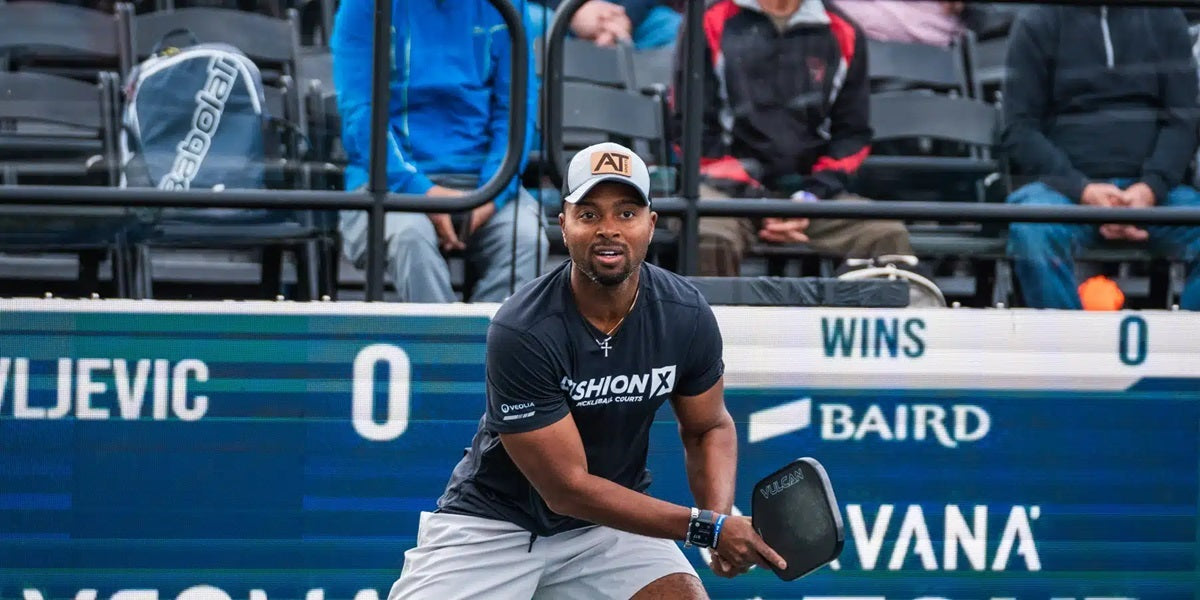
The clearest early casualty in men’s singles was Donald Young, beaten 11-8, 11-1 by Anouar Braham.
The opening game suggested a competitive contest. The second removed any doubt about who had taken control, with Braham conceding only a single point as he closed out the match.
It was part of a wider pattern in which several players were forced to adjust after difficult starts.
Luc Pham dropped his opener 11-7 against Troy Akin before responding 11-8, 11-6. Jace Morris followed an almost identical path against Rafa Hewett, recovering from an 11-8 first-game defeat to win 11-4, 11-3.
Kenta Miyoshi had to overturn a 12-10 opening-game loss against Will MacKinnon before winning 11-6, 11-7, while Miles Hoover recovered from losing 11-4 to Wil Shaffer by conceding only six points across the remaining two games.
Those matches matter less for what they tell us about the eventual champion than for where they send the winners next.
The draw now introduces its leading four seeds: Christopher Haworth, Federico Staksrud, Hunter Johnson and Christian Alshon. Ben Johns is also lurking as the No.19 seed, an unusually low bracket position for the player currently sitting No.1 in the PPA’s overall men’s World Pickleball Rankings.
That creates a draw whose difficulty is not perfectly reflected by the numbers beside the names.
There is danger further down as well. Connor Garnett meets Yates Johnson, Dylan Frazier faces Max Freeman, Tyson McGuffin takes on Zane Ford and Roscoe Bellamy plays Mohaned Alhouni.
Tuesday established who was capable of getting through the first examination. Wednesday begins asking whether any of them can disrupt the hierarchy.
Alshon and Daescu move from theory to evidence
Men’s doubles brings a different storyline because one of its most interesting partnerships already has unfinished business from Arizona.
James Delgado and Tyson McGuffin were convincing on Tuesday, beating Dawson Davis and Bryce Larson 11-3, 11-2. Will Howells and Pablo Tellez were pushed harder in their opening game against Alexander Qi and Garrett Whitehead before pulling away 12-10, 11-2.
Daniel Phillips and Patrick Smith needed three games to beat Jace Morris and Michael Loyd 11-6, 8-11, 12-10, while Christopher Haworth and Camden Chaffin recovered from losing their second game to Gabriel Joseph and Wesley Burrows to take the decider 11-2.
Above them, the leading partnerships now enter.
Gabriel Tardio and Ben Johns are the No.1 seeds, Christian Alshon and Andrei Daescu No.2, Hayden Patriquin and Federico Staksrud No.3, and Eric Oncins and CJ Klinger No.4.
For WPM, Alshon and Daescu are particularly worth following.
As WPM examined in our Las Vegas preview, their recent decision to switch sides has Alshon operating on the left and Daescu on the right. The interesting part is no longer the announcement itself. Las Vegas provides the next body of evidence about whether it works.
There is an added layer after Mesa.
Alshon and Daescu won the Arizona men’s doubles title, surviving a 15-13 deciding game against Nico Acevedo and Yuta Funemizu after saving seven match points. That does not settle the side-switch question, but it changes the context considerably. The experiment has already produced a title. Las Vegas now asks whether the result can become repeatable rather than exceptional.
At this level, changing sides affects far more than starting position. It alters who controls the middle, which forehand is being used to create pressure, who is expected to initiate attacks and how the partnership protects the spaces opponents repeatedly target.
A new configuration can make perfect sense in theory and still unravel once strong opponents identify its uncomfortable patterns.
That makes Las Vegas useful.
Alshon and Daescu no longer need to prove the idea can win. They need to establish whether it can hold up repeatedly against the strongest men’s doubles field available.
Mixed doubles presents the week’s clearest benchmark
If there is one Las Vegas draw where everyone knows exactly where the benchmark sits, it is mixed doubles.
Jack Sock and Lea Jansen progressed from Tuesday’s opening play, as did Dylan Frazier and Alix Truong, Jaume Martinez Vich and Milan Rane, and Ting Chieh Wei and CJ Klinger.
Roscoe Bellamy and Chao Yi Wang also advanced in straight games, while Nicolas Acevedo and Isabella Dunlap moved through Carlota Trevino and Joel Poland.
Surviving that layer merely earns entry into a much more difficult problem.
At No.1 are Anna Leigh Waters and Ben Johns.
The partnership has won mixed doubles at Darling Tennis Center for four consecutive years, while Waters’ pursuit of career title No.200 gives every match an additional consequence. With singles removed from her Las Vegas programme, she must win both doubles competitions to reach the landmark this week.
Behind them, Hayden Patriquin and Anna Bright return to competition after missing Arizona, while Federico Staksrud and Kate Fahey add another dangerous combination to the upper end of the field.
The more interesting question, however, concerns the teams below that first tier.
Arizona was a reminder of what can happen when lower seeds find rhythm. Elliott Schupp and Kiora Kunimoto made a breakthrough mixed run there, one of several performances that demonstrated how quickly a PPA Open can change once an unfancied partnership starts accumulating victories.
That possibility already has candidates in Las Vegas.
Sock and Jansen have obvious attacking power. Frazier’s movement and defensive range make his partnership with Truong difficult to finish against. Wei and Klinger can accelerate rallies quickly enough to make established teams uncomfortable.
None begins the week as the standard.
All have enough ability to force the standard to play well.
Fahey inherits the pressure at the top
Women’s singles offers perhaps the cleanest example of how the absence of one player can change the psychology of an entire draw.
Tuesday produced several straightforward victories, including Maria Ford’s 11-1, 11-3 win over Luana Stanciu and Naomi de Hart’s 11-5, 11-7 victory against Sophia Nhi Huynh.
Others had to find solutions.
Alicia Lai lost the opening game against Zoeya Khan 11-9 before turning the match around 11-2, 11-6. Daria Walczak recovered from an 11-7 opening-game defeat against Polina Libo to win 11-3, 11-6.
Carlota Trevino came even closer to disappearing. Alexandra Valenstein took their opening game 11-2 before Trevino answered 11-4 and then survived the decider 12-10.
Now attention shifts towards Kate Fahey.
With Waters skipping singles, Fahey occupies the No.1 seed position. Kaitlyn Christian is No.2, Lea Jansen No.3 and Chao Yi Wang No.4, while the Las Vegas draw also contains Judit Castillo, Genie Bouchard, Milan Rane and Mary Brascia.
Being No.1 changes the task.
Fahey is no longer simply one of the players attempting to knock down the favourite. The bracket now places her where that favourite would normally stand, and every player in her section gets to measure their tournament against her.
Castillo supplies a different WPM storyline after her triple crown at the PPA Tour Europe Barcelona Open.
That success came in a very different competitive environment and confirmed her position among the strongest players currently competing in Europe. Las Vegas immediately provides the harder follow-up question: how much of that dominance transfers when she returns to a deeper US draw?
That is where the result becomes useful in assessing trajectory rather than simply adding another line to a medal record.
Waters and Bright begin the other half of the 200 equation
Women’s doubles was the one professional draw without completed Tuesday matches in the supplied bracket, so there is nothing to manufacture into a recap.
Its story begins on Wednesday.
Waters and Anna Bright are the No.1 seeds, with Tyra Hurricane Black and Catherine Parenteau at No.2, Lacy Schneemann and Fahey No.3, and Ting Chieh Wei and Meghan Dizon No.4.
The 200-title pursuit connects this draw directly to mixed doubles.
Waters cannot afford to lose either.
That sounds obvious when discussing a title chase, but it gives the early rounds unusual significance. There is no singles competition available later in the week to recover the milestone. One defeat alongside Johns or Bright means No.200 waits for another tournament.
There is enough depth beneath the top seeds to prevent the women’s doubles draw becoming purely a countdown.
Maggie and Mary Brascia are together, Kaitlyn Christian partners Allyce Jones, Kiora Kunimoto plays alongside Castillo, and Lea Jansen teams with Jessie Irvine.
Black and Parenteau represent the obvious seeded threat from the opposite end of the bracket, while Schneemann and Fahey offer another partnership capable of applying pressure in different ways.
Waters and Bright remain the team everyone else ultimately needs to solve.
Wednesday provides the first opportunity to see whether anybody has arrived with an answer.
Wednesday is about more than survival
Tuesday gave Las Vegas its first casualties.
Wednesday should begin giving it direction.
In men’s singles, the leading contenders finally collide with players who have already survived competitive matches. In men’s doubles, Alshon and Daescu begin testing whether their Arizona breakthrough can become something more durable. Mixed doubles places another field in pursuit of Waters and Johns, while women’s singles asks Fahey to carry the pressure normally reserved for someone else.
Running through both doubles draws is Waters’ pursuit of 200.
That gives the Rate Las Vegas Open several stories operating simultaneously rather than one dominant narrative waiting for Championship Sunday.
There is the ranking value of a 1,000-point Open. There are returning players who were absent in Arizona. There are partnerships being tested, lower seeds carrying match rhythm into meetings with rested favourites and a milestone that requires perfection across two separate brackets.
The players who competed on Tuesday were trying to reach the main body of the tournament.
They have.
Now comes the harder part.
Las Vegas is about to find out which of them actually belongs there.
Further Reading
- PPA Las Vegas Open 2026 Preview: Can Mesa’s Challengers Repeat?
- PPA Arizona Open 2026: Haworth, Alshon and Waters Win
- Judit Castillo Wins Barcelona Triple Crown With Zane Navratil
- PPA Cary 2026 Finals: Waters, Johnson and Johns Win Gold

Chris Beaumont
Founder and Editor-in-ChiefChris Beaumont is the founder and Editor-in-Chief of World Pickleball Magazine. Chris follows the global game closely, reporting on the latest news, developments, stories and tournaments from all five continents. He also hosts the World Pickleball Podcast, interviewing people at…
View All Articles →