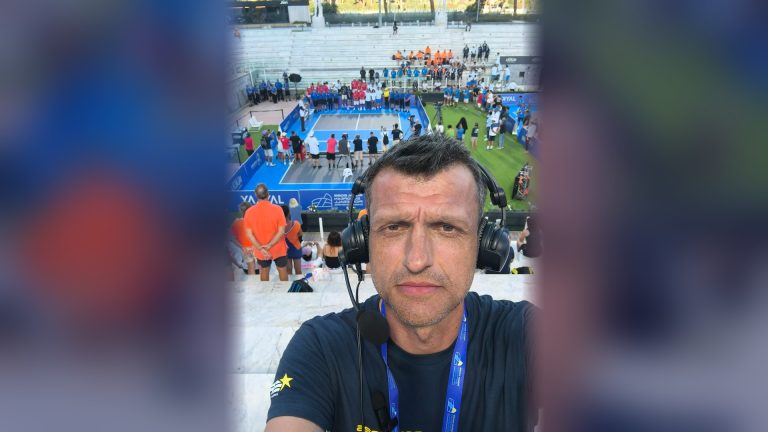

I recently watched a high-profile professional match end after a player asked the referee a question too late.
The player was entitled to ask questions during the match. The problem was that play had already passed the point at which that particular intervention was permitted.
A fault was called. The match was over.
It was a dramatic example of a rule that affects every level of tournament pickleball. Knowing what you can ask is important. Knowing when you can ask it may be even more important.
A Bigger Presence on Court
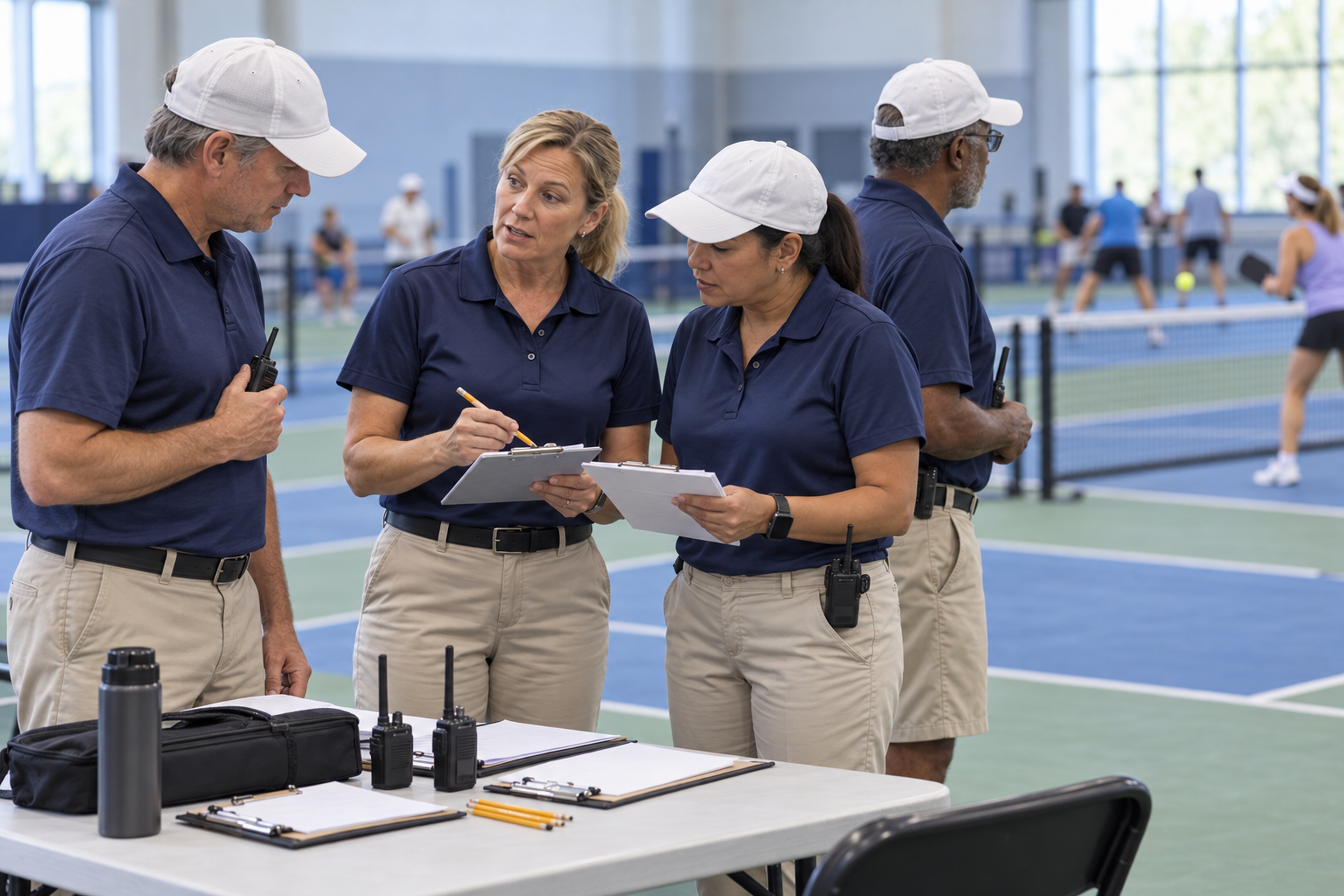
The recent English Open was the best edition yet from a refereeing perspective. Its team of 46 officials represented a significant increase from 2025 and allowed more players to experience matches with a referee on court.
We are seeing the same pattern elsewhere. As the worldwide officiating community grows, referees are becoming a more familiar presence at events such as the US Open, PPA Asia Tour tournaments and RTA competitions in Europe.
That support is valuable, but players need to understand the referee’s role.
A referee manages the match and applies the rules. We cannot coach players by explaining what they should do before every serve or warning them that they are about to make a mistake. That would interrupt the match and could give one side an unfair advantage.
If play is stopped and the reason is unclear, the referee can offer a brief explanation. For a longer discussion, come and speak to us after the match. Referees are usually happy to explain a decision once the competition has finished.
During the match, however, the player remains responsible for knowing the basic procedures.
If you're following how the global game is shifting week by week, the World Pickleball Report breaks this down every day in our morning briefing.
Start With the Player Instructions
Preparation should begin before you reach the venue.
It is easy to assume that one pickleball tournament will operate like another. The rules, format and event procedures can vary. MLP does not necessarily work in the same way as an APP event. Two local tournaments may also have different arrangements because of their venues, schedules, staffing levels or court limitations.
The rules discussed in this column come from the 2026 USA Pickleball Official Rulebook. Players should still read the instructions issued for their particular competition and check which rulebook and event procedures are being used.
Look at the scoring format, time-out allowance, warm-up procedure, appeals process and any local conditions introduced by the organiser.
Those details can feel unimportant when you are packing your bag at home. They feel rather more important at 9-9 in a deciding game.
“The player was entitled to ask questions during the match. The problem was that play had already passed the point at which that question was permitted.”
Certified Tournament Referee Protocol
When There Is No Referee
Many tournament matches are self-officiated, even when referees are present elsewhere in the venue.
If a dispute develops on an unofficiated court, players should first try to resolve it calmly using the rules. If officials are working at the event, you can ask whether a referee is available to come to the court. If no referee is available, seek guidance from the tournament director.
Understanding the rulebook helps in those situations. It allows you to protect your position when an opponent has misunderstood a rule, without turning every disagreement into an argument.
Three areas regularly create confusion: player positions, score challenges and time-outs.

Each has its own deadline.
Checking the Server, Receiver and Positions
Before the serve is hit, a player may ask who the correct server or receiver is, or whether the players are in the correct positions. The opponent must respond with the appropriate information.
This is the safest time to resolve any uncertainty.
Once the rally has begun, the situation changes. Under Rule 5.C.1, a player may stop play to claim that there is an incorrect server, receiver or player position. If that claim is correct, the rally is replayed.
If the claim is wrong, the player who stopped the rally receives the fault.
Stopping play is therefore a decision with consequences. It cannot be used as a free position check once the rally is under way.
There is a further distinction involving the receiver. If the correct server and receiver were in their proper positions when the score was called, but the serve was returned by the wrong receiver, that is a fault against the player who returned it. The fault must be called before the next serve.
If a player or position error is discovered only after a completed rally, the result of that rally stands.
The practical lesson is simple. If you are uncertain before the serve, ask. If you stop a live rally to make a claim, be prepared for a fault if you are wrong.
Challenging the Score
Score challenges operate differently.
Before the serve is hit, a player may ask an opponent for the correct score. Even after the score call has begun, verbal instructions such as “stop” and “wait” are recognised.
Once the serve has been hit, Rule 6.F gives the player a limited opportunity to challenge the score. The rally must be stopped before the return of serve is hit and before the ball becomes dead.
If the wrong score was called and the challenge was made within that window, the rally is replayed with the correct score.
If the original score was correct, the player who stopped the rally receives the fault.
A challenge made after the return of serve has been hit is late. The player who stopped the rally receives the fault.
This is where hesitation becomes costly.
You hear a score that does not sound right. The serve is hit. You return it and then decide to ask the referee.
You have missed the window.
If an incorrect score is identified after the rally has been completed, the result of the rally stands. The score must then be corrected before the next serve.
If the score sounds wrong, raise the question immediately. You cannot continue with the rally, see how it develops and then return to the score call.
Asking for a Time-Out
A time-out must also be requested before play reaches a specific point.
Rule 21.A allows a singles player or doubles team two standard time-outs in an 11-point or 15-point game, and three in a 21-point game. A standard time-out cannot be called before the match begins.
During a match, any player may request a time-out between rallies before the next serve occurs, or between games.
The request must be clear. It can be made audibly, with a visible hand signal, or through both. It must be directed towards the opposing player or team and the referee.
If a player calls a time-out after the serve has been hit, the request is late and the player receives a fault.
A vague gesture or quiet comment can also create a problem. If the request is neither audible nor visible, the referee may issue a verbal warning or technical warning for delaying the game.
Do not assume the referee knows what you intended. Make the request clearly, direct it towards the right people and do it before the serve.
Three Different Windows
The easiest way to remember these situations is to separate them.
Before the serve is hit: Ask who should serve or receive, check the positions, ask for the correct score or request a time-out.
During the rally: You may stop play to claim a server, receiver or position error. An incorrect claim results in a fault.
Before the return of serve is hit: You may stop play to challenge the score that was called. Once the return has been hit, the challenge is late.
Those differences may appear unnecessarily technical. They exist because every rally needs a clear beginning and every objection needs a deadline.
Without those limits, a player could wait to see how the point was developing before deciding whether to stop it. A referee would have no consistent way to separate an immediate concern from a tactical interruption.
The rulebook removes that uncertainty.
You do not need to know every section by heart before playing in a tournament. You should know the procedures most likely to affect your match, especially when getting them wrong can cost you a rally.
Be curious. Read the player instructions. Look up the relevant rule when something puzzles you. Speak to referees after matches and ask us to explain what happened.
Then, when you have a question on court, make sure you ask it while the answer can still help you.
For a clearer view of where the sport is heading each week, you can join the World Pickleball Report here.

Chris Beaumont
Founder and Editor-in-ChiefChris Beaumont is the founder and Editor-in-Chief of World Pickleball Magazine. Chris follows the global game closely, reporting on the latest news, developments, stories and tournaments from all five continents. He also hosts the World Pickleball Podcast, interviewing people at…
View All Articles →