
The Report
Pickleball’s institutional era has arrived
World Pickleball Report
Pickleball’s Institutional Era Has ArrivedElite academies, global power shifts, governance crises, acoustic engineering and the cultural spaces now forming around the sport.
This is the World Pickleball Report.
Pickleball is no longer just spreading. It is starting to build institutions.
That is the thread running through today’s briefing.
In China, Asia’s first full-residence elite academy is preparing to house junior players inside a tennis-style performance environment. In India, the sport’s leadership is openly discussing a future where the centre of gravity moves away from the United States. In Malaysia, rapid growth has already placed federation governance under serious strain.
Even the quieter stories point the same way. Paddle and ball noise is becoming an engineering problem. Tinder is using pickleball as real-world social infrastructure. MLP is still redesigning the structure of professional competition.
The sport is moving out of its informal phase. What comes next will be built by systems, not just enthusiasm.
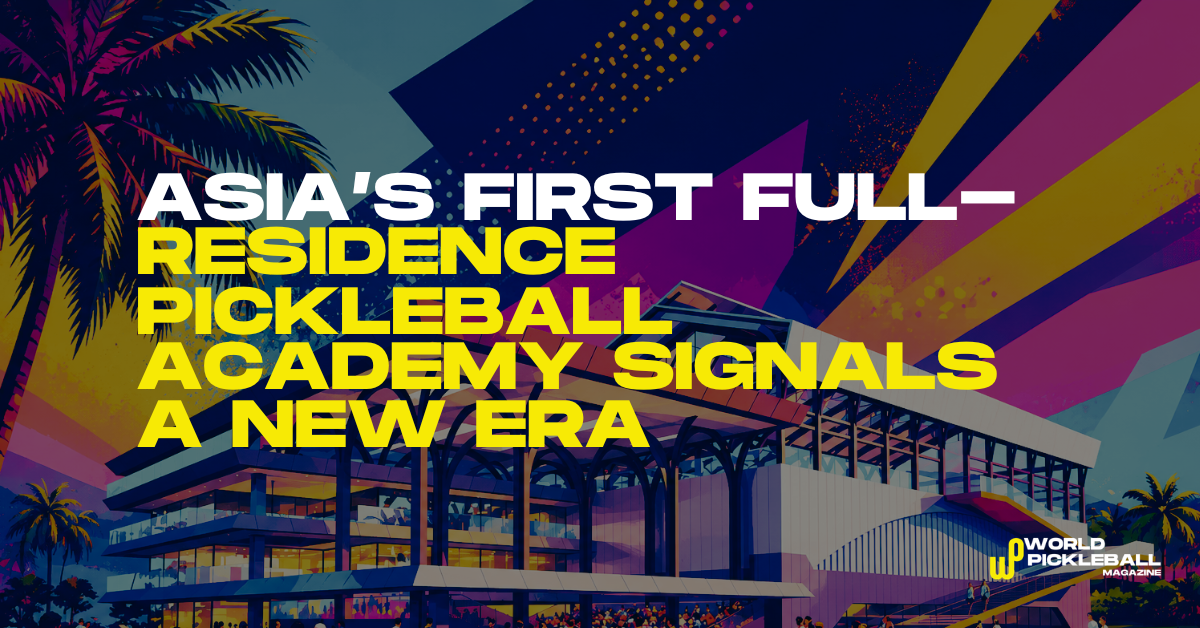
Lead feature: Asia’s first full-residence academy changes the pathway conversation
A few years ago, the idea of a teenager leaving home to pursue pickleball professionally would have sounded faintly absurd.
Now the infrastructure for exactly that future is beginning to appear.
The Asia Elite Pickleball Academy will open in Hainan, China, as Asia’s first full-residence pickleball academy. It is not being positioned as a camp. It is being positioned as a pipeline.
That matters because residential academies change sports culturally as much as competitively. They create earlier specialisation, greater family investment, more intense junior expectations and a very different relationship between childhood and performance.
What matters: pickleball is beginning to copy the development machinery of tennis and football. The generation that discovered the sport casually may hand it to a generation raised inside systems built to professionalise it.
Read the Asia Elite Academy feature

Pressure Points: India’s rise is no longer just about participation
India’s junior World Cup trials matter because they show structure beginning to form around the country’s pickleball ambitions.
The Sports Authority of India and the Indian Pickleball Association are now helping shape junior pathways. Global Pickleball Federation president Javier Regalado has gone further, saying he believes India can become the sport’s dominant global force.
The important word here is not growth.
It is power.
What matters: sports rarely stay where they started. Once infrastructure, youth systems and investment begin forming elsewhere, influence starts moving too.
Read the India power-shift analysis
Beyond the Score: Malaysia shows the cost of weak institutions
Malaysia’s federation crisis is not simply an administrative dispute.
It is a warning about what happens when a sport grows faster than the structures designed to govern it.
Participation can rise quickly. Courts can appear quickly. Sponsorship can arrive quickly. Stable governance usually takes longer.
That gap is now visible in Malaysia, where government intervention has followed leadership disputes, constitutional complaints and federation suspension.
What matters: the next phase of global pickleball may depend less on building courts and more on building institutions capable of surviving success.
Read the Malaysia governance analysis
The Reset: pickleball is starting to engineer its own sound
Pickleball’s noise problem is usually treated as a neighbourhood dispute.
That is now too small a frame.
Engineers and independent testers are beginning to treat sound as a technical frontier. Balls are being redesigned. Paddle frequencies are being measured. Acoustic profiles may eventually become part of equipment identity, regulation and product marketing.
What matters: the next equipment battle may not be about power. It may be about who controls the sound of the game.
Read the acoustic engineering feature

One Thing to Watch: Tinder is treating pickleball as social infrastructure
Tinder’s pickleball events are not really about sport.
They are about low-pressure real-world interaction in a culture increasingly tired of digital socialising.
Pickleball works because it gives adults permission to interact repeatedly without requiring immediate intimacy. Players rotate, talk between points, laugh at mistakes and build familiarity without the strange pressure of a formal first date.
What matters: the sport’s cultural value may not sit only in competition. It may sit in the rare social spaces it creates.
Read the Tinder culture feature

The human layer: Road to the English Open reaches week two
While the global game builds institutions, the player journey still comes down to something much more personal.
Week two of Road to the English Open is where ambition starts meeting evidence. Preparation becomes more honest. Technical weaknesses surface. Confidence becomes less theoretical. The gap between wanting to compete seriously and actually preparing seriously becomes visible.
What matters: the sport’s systems may be growing quickly, but every serious player still has to confront the same question: what does readiness actually look like?
Read Road to the English Open week two
What matters most
The defining pickleball stories today are not simply about expansion.
They are about permanence.
Academies make development permanent. Governance makes growth legitimate. Engineering makes equipment conflicts measurable. Culture makes participation repeatable. Player pathways make ambition visible.
Pickleball is beginning to build the structures that separate a trend from a sport with a long future.

The May issue gives the deeper read
Daily news tells you what moved.
The magazine explains the forces underneath it.
Across player development, governance, global pathways, culture and the changing demands of the modern game, the May issue connects the stories shaping where pickleball goes next.