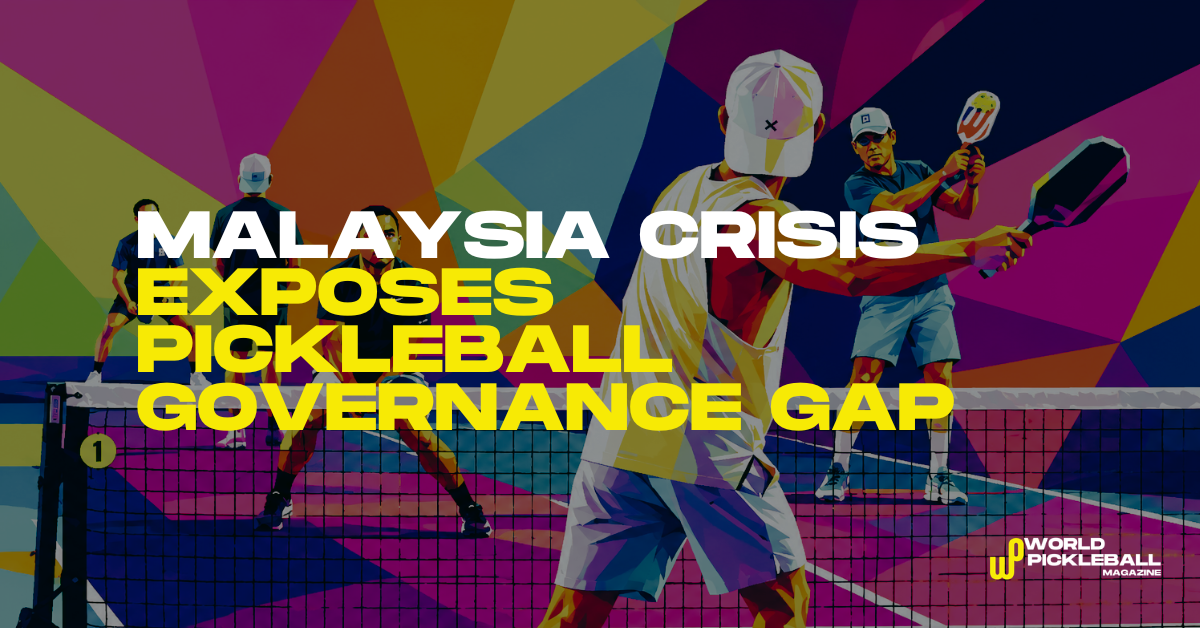
Malaysia’s government intervention into the country’s suspended pickleball federation is not simply an isolated administrative dispute. It may be an early warning sign of what happens when a rapidly growing sport outpaces the systems designed to govern it.
- Malaysia’s Youth and Sports Ministry has installed an ad hoc committee to oversee the suspended Malaysia Pickleball Association.
- The crisis exposes how quickly growing sports can overwhelm informal governance structures.
- The deeper issue extends beyond Malaysia: pickleball globally is still institutionally immature in many emerging markets.
Pickleball is now growing quickly enough to break its own institutions.
That may be the real significance behind Malaysia’s escalating federation crisis.
This week, the country’s Youth and Sports Ministry confirmed the appointment of a six-member ad hoc committee to temporarily oversee the suspended Malaysia Pickleball Association (MPA), following months of constitutional disputes, leadership conflict, and regulatory intervention.
On the surface, the story appears procedural: disputed authority, constitutional complaints, governance breaches, emergency oversight.
But underneath the administration sits a more important reality.
Pickleball’s global expansion is beginning to outpace the maturity of the structures attempting to govern it.
The sport’s systems are now under pressure
The MPA was officially suspended on 27 February 2026 under Malaysia’s Sports Development Act after regulators identified governance concerns linked to leadership succession and organisational procedure.
The conflict intensified following the resignation of founding president Farrell Choo in 2025. Treasurer Delima Ibrahim stepped into the acting president role, bypassing deputy president Harmeet Singh and triggering constitutional complaints to the Sports Commissioner’s Office.
Subsequent reviews reportedly identified procedural irregularities and concerns surrounding affiliate transparency.
The newly appointed committee, chaired by Datuk Seri Dr Jahaberdeen Mohamed Yunoos, has now been tasked with stabilising the organisation and preparing fresh elections within the next year.
On one level, this is a national governance dispute.
On another, it reflects a broader pattern emerging across rapidly developing sports ecosystems.
Because sports rarely begin with fully formed institutions.
They usually begin informally: volunteers organising competitions, local leaders building communities, fragmented regional structures, and enthusiasm compensating for limited governance capacity.
That model can function while a sport remains relatively small.
It becomes much harder once money, rankings, sponsorships, and international legitimacy begin entering the equation.
Southeast Asia’s pickleball acceleration is creating new pressure points
Malaysia’s crisis arrives during a period of major pickleball expansion across Southeast Asia.
Participation numbers are climbing rapidly. Regional tournaments are growing larger. Cross-border competition is increasing. Commercial sponsors are entering the market. International tours and leagues are beginning to pay greater attention to the region.
Malaysia itself recently hosted the Skechers International Championship, attracting more than 1,200 players from 14 countries.
That level of growth changes expectations quickly.
Federations are suddenly expected to manage rankings, event sanctioning, sponsorship relationships, athlete selection, international representation, financial oversight, and governance compliance.
Many organisations were never originally built for that scale.
Volunteer-era administration suddenly finds itself operating inside a semi-professional environment carrying commercial consequences and political pressure.
The transition is rarely smooth.
Governance failures become expensive very quickly
The danger with governance crises is that they are often dismissed as internal politics.
In reality, they directly affect the wider ecosystem around a sport.
Suspended federations can disrupt international recognition. Tournament sanctioning becomes uncertain. Sponsors become cautious. Athlete pathways become unstable. Rankings legitimacy can come into question. Investors hesitate when governance structures appear unreliable.
Bad governance eventually becomes a commercial problem.
That matters because pickleball is now entering the stage where institutional trust becomes increasingly important.
A sport can grow quickly through energy and participation alone.
It cannot sustain international credibility indefinitely without stable governance underneath it.
That is not unique to pickleball. Football, cricket, boxing, and numerous Olympic sports have all experienced periods where explosive commercial growth exposed weak institutional structures.
The difference is that pickleball is encountering these pressures at extraordinary speed.
Malaysia may not be an isolated case
This is also why the story matters beyond one federation dispute.
Pickleball globally still lacks mature governance systems in many territories. In several emerging markets, the sport remains structurally young despite rapidly accelerating participation and investment.
That creates vulnerabilities: unclear constitutions, contested leadership authority, inconsistent oversight, fragmented regional control, weak dispute mechanisms, and blurred commercial relationships.
Those problems often remain hidden while a sport is small.
Growth exposes them.
And once commercial stakes increase, governance battles become far harder to contain quietly.
The challenge for pickleball now is that institutional development rarely moves as quickly as participation growth.
Courts can appear almost overnight.
Stable governance usually takes far longer.
The next phase of pickleball may depend on institution-building
Malaysia’s situation does not mean pickleball is failing.
If anything, it may indicate the opposite.
Sports usually encounter governance pressure precisely when they begin becoming economically and politically significant enough to matter.
But significance alone is not enough.
The next phase of global pickleball growth may depend less on building courts and more on building institutions capable of surviving success.
Because eventually, every sport reaches the point where enthusiasm is no longer sufficient.
Structure becomes the real infrastructure.
Further Reading
- Latest pickleball news from around the world
- Tournament coverage and results
- Rankings and player profiles
- Regional pickleball coverage

Chris Beaumont
Founder and Editor-in-ChiefChris Beaumont is the founder and Editor-in-Chief of World Pickleball Magazine. Chris follows the global game closely, reporting on the latest news, developments, stories and tournaments from all five continents. He also hosts the World Pickleball Podcast, interviewing people at…
View All Articles →