For years, pickleball’s development pathway has largely been informal, local, and community-driven. The launch of Asia’s first full-residence elite academy in China suggests the sport may now be entering a far more institutional future.
- The Asia Elite Pickleball Academy will open in Hainan on 31 August 2026 as Asia’s first full-residential pickleball academy.
- The project mirrors elite tennis and football academy systems with boarding, full-time training, and academic integration.
- The deeper significance may be cultural: pickleball is beginning to create professional athlete pathways at increasingly younger ages.
Somewhere in the next few years, a teenager may leave home for pickleball in the same way young tennis prospects once disappeared into academy systems in Florida, Barcelona, or the south of France.
That sentence would have sounded faintly absurd not long ago.
Now the infrastructure for exactly that future is beginning to appear.
Pickleball’s academy era has arrived
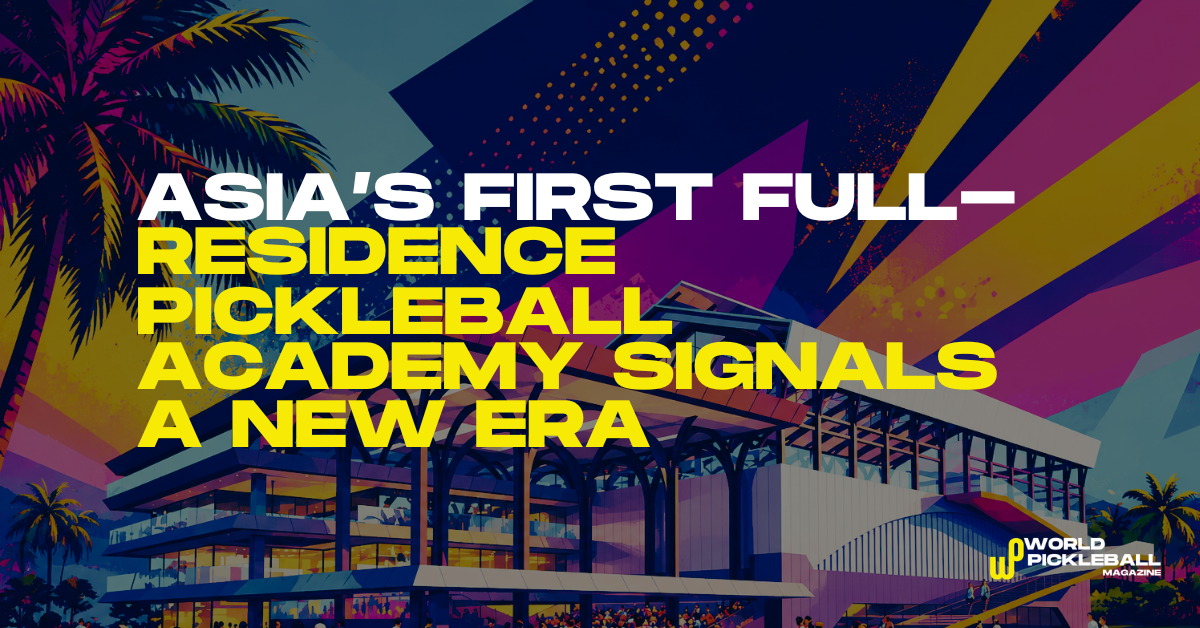
On 31 August 2026, the Asia Elite Pickleball Academy will officially open at the Hainan Campus of Beijing Haidian Foreign Language Academy in Qionghai, China.
Billed as Asia’s first full-residence pickleball academy, the project represents one of the clearest signs yet that the sport is entering a new developmental phase.
Not simply bigger. More organised, more professional, and potentially far more demanding.
The academy will house Under-19 athletes inside a fully integrated performance environment combining daily court training, strength and conditioning, video analysis, tournament preparation, and optional bilingual academic education.
The site includes 26 climate-controlled indoor courts built to International Pickleball Teaching Professional Association standards, allowing year-round training regardless of weather conditions.
The coaching structure signals the scale of the ambition. The programme will be led by IPTPA founder Seymour Rifkind alongside Australian national coach Mike Newell, while guest mentors include Roos Van Reek and Nicola Schoeman.
This is not being positioned as a development camp.
It is being positioned as a pipeline.
Pickleball is starting to copy elite tennis
That distinction matters because elite residential academies change sports culturally as much as competitively.
Tennis experienced that transformation decades ago through IMG Academy, the Bollettieri system, and later European high-performance centres. Football built entire global talent ecosystems through academy recruitment and residential development structures.
Pickleball, until now, largely has not.
The sport’s rise has been unusually decentralised. Public courts, local clubs, crossover athletes, retired players, and recreational communities all helped shape its early identity.
Much of pickleball’s appeal came from its openness. Players could arrive late, improve quickly, and remain connected to the same broad ecosystem regardless of age or ambition.
Elite academies inevitably alter some of that dynamic.
Teenagers training twice daily. Video review sessions at night. Strength programmes before schoolwork. Families discussing relocation plans and long-term development schedules. Young players building professional routines before adulthood.
That is a very different version of pickleball from the one most people still recognise.
The economics of elite development are arriving too
The academy’s reported cost also deserves attention.
At $10,000 USD per 10-week session, AEPA immediately raises questions around access, affordability, and who gets to participate in elite development systems as pickleball professionalises further.
That does not make the project inherently negative. High-performance training has always required resources in almost every major global sport.
But it does signal a shift.
For much of pickleball’s modern rise, the sport positioned itself as relatively accessible compared with tennis or golf. Residential academies introduce a more expensive layer to the pathway structure.
That creates a new reality for ambitious junior players and their families, just like in tennis – and with the pathways into the pro game that are developing and the rewards that are starting to follow, projects like this do make a lot of sense.
The question is no longer simply: can my child play pickleball seriously?
It increasingly becomes: how far are we willing to invest in it?
A regional talent battle may be beginning
The academy also matters because of where it sits geographically.
Hainan’s Free Trade Port status and increasing visa accessibility position the project as more than a domestic Chinese initiative. The long-term ambition appears regional.
That means recruitment.
Not only of players, but eventually coaches, support staff, sports scientists, and international prospects looking for structured development opportunities within Asia-Pacific.
Elite academies rarely remain isolated facilities for long. Over time, they become talent magnets.
Once one serious institution emerges, others tend to follow. Scholarship systems appear. Coaching networks deepen. Families compare pathways. Leagues begin watching where the best juniors are being trained.
North America and Europe may still dominate professional visibility inside pickleball today, but Asia is increasingly investing in the developmental infrastructure underneath the sport.
That distinction could become hugely important over the next decade.
The next generation may experience pickleball differently
The opening of AEPA does not transform pickleball overnight.
But it does feel symbolic of something larger.
The sport is moving away from its entirely informal phase and into an era of systems, institutions, pathways, and long-term athlete production.
That shift will create opportunities.
It may also create pressures the sport has not fully confronted yet: earlier specialisation, higher financial barriers, greater competitive intensity, wider gaps between elite and recreational environments, and increasing professional expectations for juniors.
None of those dynamics are unique to pickleball. Most global sports eventually encounter them once infrastructure deepens and investment accelerates.
The difference is that pickleball has reached this point remarkably quickly.
The generation that discovered pickleball casually may ultimately hand the sport to a generation raised inside systems built to professionalise it.
Further Reading
- Latest pickleball news from around the world
- Tournament coverage and results
- Rankings and player profiles
- Regional pickleball coverage

Chris Beaumont
Founder and Editor-in-ChiefChris Beaumont is the founder and Editor-in-Chief of World Pickleball Magazine. Chris follows the global game closely, reporting on the latest news, developments, stories and tournaments from all five continents. He also hosts the World Pickleball Podcast, interviewing people at…
View All Articles →