
The Pickleball Court That Couldn’t Hold the Tournament In A Coruña, Spain’sPickle Pro Tour built a court on the sea. Then the Galician weather revealed the uneasy relationship between sporting spectacle and the sport itself. The plan was irresistible.
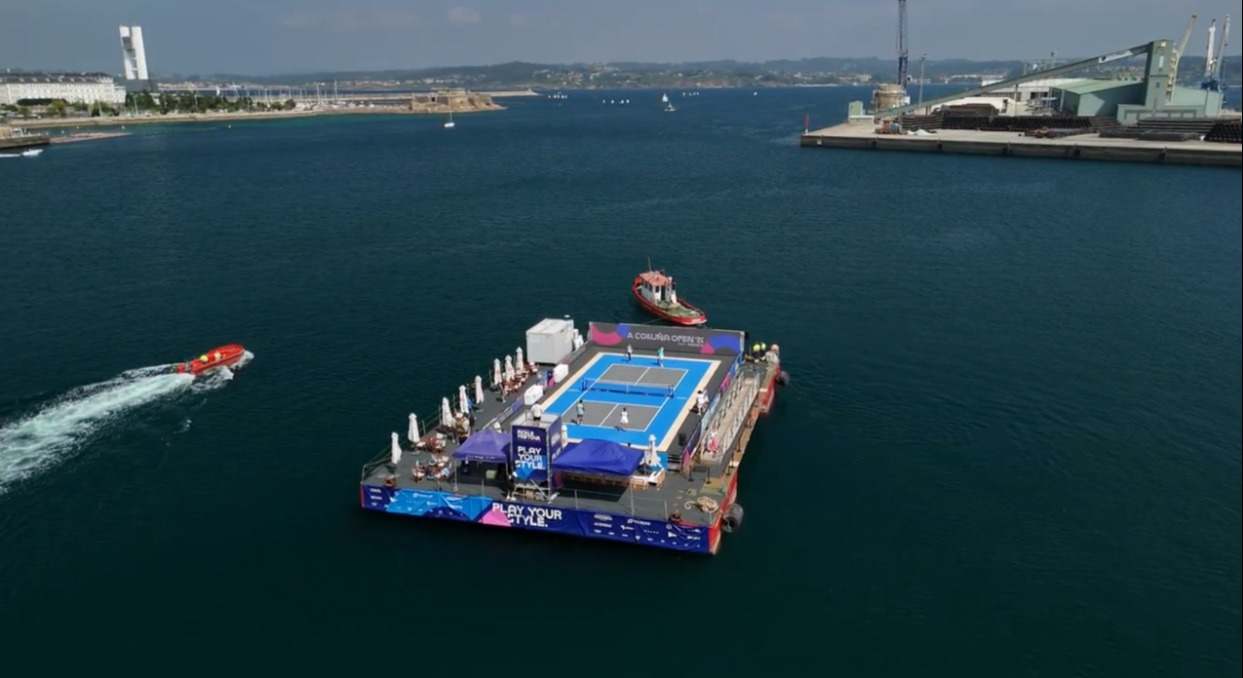
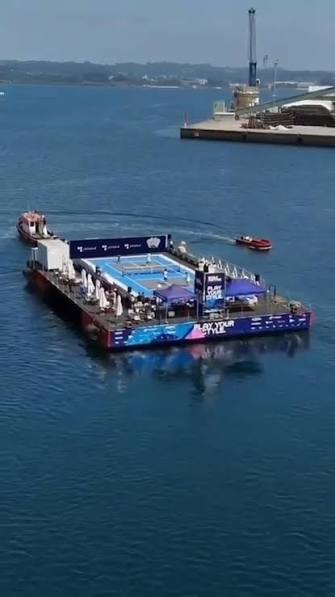
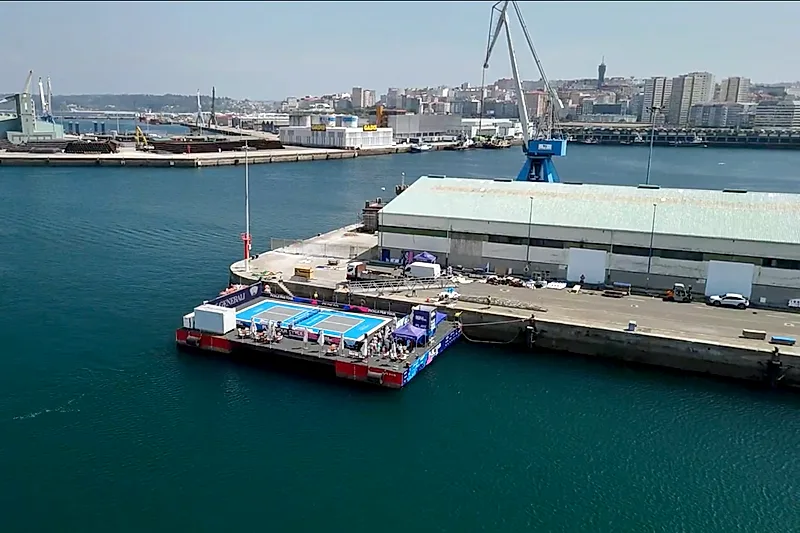
A professional pickleball court would be built on a 600-square-metre floating platform, towed through the harbour at A Coruña and positioned beside the historic waterfront at El Parrote. The best players at the A Coruña Open would then contest the tournament’s official finals on the sea. Television cameras would carry the pictures across Spain.
Photographs of the blue court against the Galician coast would travel much further. Pickleball, a sport still introducing itself to much of Europe, would gain the kind of image no conventional sports hall could produce. For awhile, everything worked.
Once construction was complete, the pontoon travelled from its assembly point in the Port of A Coruña towards El Parrote. During the journey, players connected with the circuit’s sponsors stepped onto the court and exchanged points while the platformmoved across the bay. They became, according to the organisers, the first people to play pickleball on a court travelling over the sea.
The footage delivered exactly what had been im agined. A portable game had escaped the club, crossed the harbour and turned the city itself into part of the event. Then the wind arrived.
The court remained afloat. The tournament moved indoors. A Sport Looking for Its Stage The A Coruña Open, held from 10 to 12 July, was the fourth event of the 2026 Cervezas Victoria Pickle Pro Tour.
More than 500 entries were received from players representing 13 nationalities, with close to 800 matches played across the weekend. Those numbers made it a substantial tournament. Yet the event was never prom oted principally through its entry list or competitive field.
The court was the story. That was deliberate. The Pickle Pro Tour has built part of its identity around taking pickleball into recognisable public settings.
Finals have previously been staged beside Las Canteras beach in Gran Canaria, at Plaza de la Marina in M álaga and in Madrid’s Plaza de España. The reasoning is easy to understand. Put a new sport behind thew alls of a specialist club and it remains largely visible to people who have already found it.
Place a court in the middle of a city and curiosity does some of the promotional work. Passers-by stop. Phones appear.
A crowd can form without having planned to attend a pickleball tournament. In A Coruña, B3 Sportainment took that strategy onto the water. The company had previously staged an international climbing competition on a floating platformin the city’s harbour.
Pickleball offered another opportunity to turn maritim e engineering into sporting theatre. The early announcement prom ised the first official pickleball finals to be played on the sea. Coverage was planned across Teledeporte, RTVE Play, TelePickleball.com and the Pickle Pro Tour’s YouTube channel.
This was not simply a court built for those attending the tournament. It was an image built to travel. When the Picture Meets the Game Pickleball is unusually cooperative for event promoters.
A court is compact. The equipment is portable. The rules are easy for an unfamiliar audience to follow.
It can appear in shopping centres, public squares, beside beaches, on rooftops and inside converted industrial buildings. That flexibility has helped it enter places where building a permanent sports complex would be expensive or unnecessary. The ball, however, has ideas of its own.
A pickleball is light, perforated and acutely vulnerable to wind. Even on an ordinary outdoor court, a strong breeze changes its flight, disrupts the drop and rewards whichever player adapts most quickly to conditions that may differ from one end to the other. Place the same game on an exposed platformbeside the Atlantic and the visual possibilities increase alongside the competitive risks.
By Saturday afternoon, forecasts and wind conditions persuaded organisers to transfer the matches scheduled for the floating centre court to the indoor venue at FIM Oin Ferrol. More than 300 matches were played there that day. Rain then affected Sunday’s plans.
The professional finals were moved to Club PicklePoint in Ferrol, where Sabrina M éndez won thew om en’s singles title and Jorge Rodríguez Agudo took the men’scrow n. M éndez later partnered María Constantino to win thew om en’s doubles. Rodríguez Agudo and Ignasi de Rueda won the men’s doubles, while Brandon Lane and Glauka Carvajal claimed the mixed title.

The official competition had survived. The floating finals had not. That distinction matters.
The decision to move the matches was sensible. Once the weather threatened the quality and fairness of the competition, the organisers protected the sport. The leading players contested their titles on a stable indoor court instead of being asked to carry on because the pictures were too appealing to surrender.
Yet the move also revealed the tension at the centre of the project. The floating court had been created to host the tournament’s defining matches. When it could no longer fulfil that purpose, it became something else.
In some respects, it became something more interesting. The Court Everybody Else Inherited The platformdid not sit empty at El Parrote. While the formal tournament continued in Ferrol, amateur players, professionals and members of the public were invited onto the water.
They played recreational games, took part in exhibitions and experienced the peculiar sensation of hitting a pickleball while surrounded by the harbour. A centre court intended for a small group of finalists became an open attraction for many more people. There is an irony in that transformation.
The original concept was built around exclusivity. Elite players would contest official finals in a setting nobody had seen before. Broadcasters and sponsors would gain an unforgettable picture.
The weather removed the elite competition, but it did not destroy the experience. It changed who could take part in it. Players who might otherwise have watched from the side were able to step onto the platform.
The sporting stakes became lower, but the opportunity to experience the court became wider. Nobody needed conditions suitable for a national-circuit final. They only needed enough time to strike a few balls, take in the waterfront and enjoy the improbability of playing pickleball on the sea.
The court could not reliably contain the tournament. It could still create a memory. That difference reaches beyond A Coruña.
If you're following how the global game is shifting week by week, the World Pickleball Report breaks this down every day in our morning briefing.
As pickleball attracts more commercial investment, its promoters face a familiar problem. Competition alone does not always generate the attention required to attract broadcasters, sponsors or new audiences. Events are therefore asked to produce moments that can be photographed, filmed and shared.
Som etim es the setting begins to compete with the competition. A court on a pontoon can be understood in a single image. The work required to win a professional doubles match takes longer to appreciate.
One sells the idea of pickleball immediately. The other rewards those willing to watch closely. A Coruña showed how difficult it can be to accom modate both.
A Successful Failure It would be too simple to describe the floating court as a failed experiment. The prom ised official finals never took place there, and any honest account of the weekend must acknowledge that. The weather defeated the central competitive idea.
Yet the organisers responded properly. They did not pretend the conditions were acceptable or sacrifice the quality of the finals to preserve the television image. The professional event moved, the court remained open and two different versions of the weekend continued in parallel.
In Ferrol, the titles were decided. At El Parrote, pickleball became part of the city’s waterfront. One provided the competition.
The other provided spectacle, participation and public theatre. A mature event should be able to distinguish between them. The floating court therefore leaves pickleball with a more useful lesson than an uncomplicated promotional success might have provided.
The sport should continue entering unusual places. Its ability to travel is one of its strengths. A court in a public square, beside a beach or even on the sea can reach people who would never consider walking into a conventional club.
But the setting must remain capable of serving the game taking place upon it. When competitive integrity and the desired image pull in opposite directions, organisers have to know which one matters more. In A Coruña, they made the right choice.
The champions lifted their titles indoors. Outside at El Parrote, the floating court found a different purpose. It was no longer responsible for deciding the tournament.
It was simply there to be played on, photographed and rem em bered. The weather had taken away the final. It had not taken away the story.
Pickleball Has Gone Professional. Its Body-Shot Etiquette Hasn’t. The rules allow players to attack the body.
The culture still expects them to apologise. Jay Devilliers’ approach to the shot reveals a professional game caught between competitive logic and the manners of the courts on which it grew up. Jay Devilliers did not need to hit James Ignatow ich.
By his own account, he came close. The ball missed by centim etres after Devilliers sent it towards himas hard as he could during a Major League Pickleball match. Yet accuracy was not really the point.
Ignatow ich had already struck Devilliers several times and had also targeted his Utah Black Diamonds partner, Tyler Loong. Devilliers believed those shots were intended less to win rallies than to hit the men standing across the net. Eventually, he answered.
“Iwas just tired of getting hit every time,” he recalled during an appearance on the Pickleballers Podcast. “I’mlike, ‘If you want to play like that, I can too.’” When asked whether he had managed to catch Ignatow ich, Devilliers explained why themiss had still achieved its purpose. “It was to send a message.” That is the point at which a body shot becomes something more than shot selection.
Professional pickleball permits players to attack an opponent’s body. Often, it is the correct tactical decision. The chest, dominant shoulder and paddle-side hip can be difficult to defend at kitchen-line speed.
A well-directed ball jams the swing, removes reaction time and may create uncertainty between partners.
For a clearer view of where the sport is heading each week, you can join the World Pickleball Report here.

Chris Beaumont
Founder and Editor-in-ChiefChris Beaumont is the founder and Editor-in-Chief of World Pickleball Magazine. Chris follows the global game closely, reporting on the latest news, developments, stories and tournaments from all five continents. He also hosts the World Pickleball Podcast, interviewing people at…
View All Articles →