In Rondonópolis, Brazil, pickleball is being used far beyond the conventional boundaries of sport. Therapists, educators and families are exploring how a simple game can create opportunities for children and young people to practise movement, communication, independence and participation, with success sometimes measured not by the score, but by what happens before the first ball is struck.
Key Takeaways
- Professionals in Rondonópolis, Brazil, are using adapted pickleball activities within psychomotor, educational and inclusive settings for children and adolescents.
- The objective can extend beyond sporting technique to skills including waiting, communication, decision-making, participation and interaction.
- Pickleball’s adjustable space, pace, equipment and rules allow activities to be adapted around individual participants.
- The Brazilian Paralympic Committee has independently documented pickleball being offered at its Loterias Caixa Paralympic Festival in Rondonópolis.
- The guiding principle behind the work is simple: the individual comes before the sport.
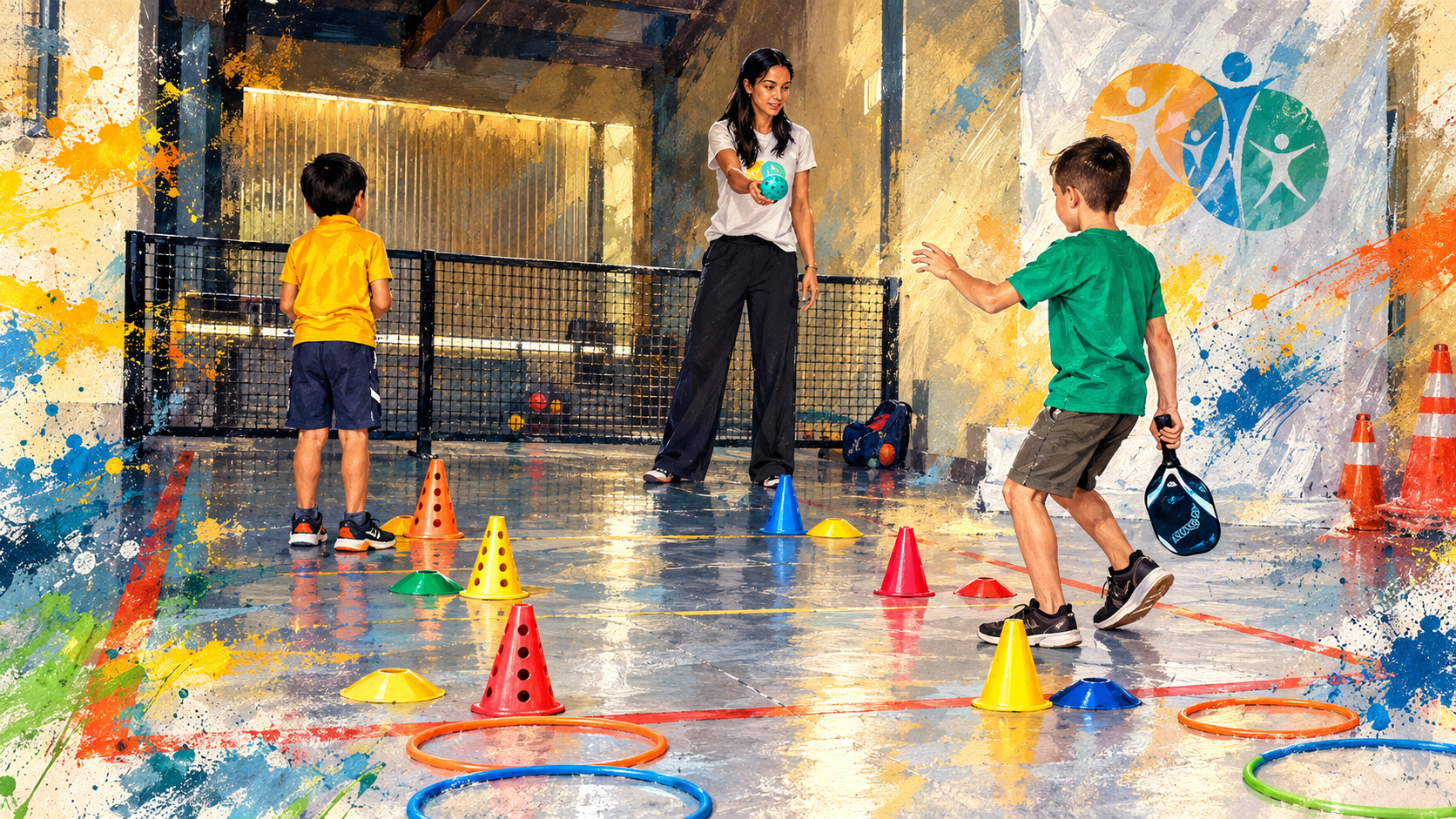
A child stands inside a makeshift court in Rondonópolis, paddle in hand.
Coloured cones mark positions across the floor. Hoops provide targets and reference points. Another child waits nearby while an adult watches, ready to guide the next part of the activity.

It looks like the beginning of a pickleball lesson, and in one sense it is.
Yet the most important thing the child learns that day may have nothing to do with hitting the ball.
Perhaps it is waiting for a turn without walking away. Perhaps it is asking for the ball rather than taking it. Perhaps it is following an instruction, making a choice, accepting a mistake or remaining part of an activity involving other people.
A forehand might simply provide the opportunity for something else to happen.
In Rondonópolis, a city in Mato Grosso in Brazil’s Central-West region, that idea is driving an unusual application of pickleball. Physical education specialist and psychomotor therapist Geanne Marques, through MoviMente, is among the professionals using the sport with children and adolescents across clinical, sporting and community settings.
Their work begins with a question that sounds simple but fundamentally changes how the game is approached.
What are we really developing when we put a paddle in a child’s hand?
When the Goal Is Bigger Than the Shot
The obvious answers are physical.
Pickleball requires a player to track a moving ball, judge distance and speed, position the body and coordinate the paddle with the ball’s trajectory. Balance, spatial awareness, motor planning and hand-eye coordination are naturally involved.
But psychomotricity looks beyond the mechanics of movement towards its relationship with cognitive, emotional and social development. The European Forum of Psychomotricity describes the discipline through a holistic understanding of the relationship between cognition, emotion and movement within human development.
Instead of starting with a sporting skill and asking how a child can perform it correctly, the approach described by Marques starts with the individual and asks what they need in order to become more autonomous and able to participate in everyday life.
That can transform the purpose of a pickleball session.
For one child, the challenge might genuinely be coordinating paddle and ball. For another, success might mean staying in line until their turn arrives. Somebody else might be working towards communicating a choice, asking for the ball, calling to another player or understanding an instruction.
Then there are the less visible challenges familiar to anyone who has taught sport: making a mistake without becoming overwhelmed by it, staying engaged when something is difficult, sharing space, following rules and making decisions while other things are happening around you.
The sport has not changed.
The intention has.

Ingrid Priscilla Cajango, a psychopedagogue and co-owner of the clinics Ponto de Equilíbrio and Aprimora Formação Avançada, sees that possibility from both a professional and personal perspective.
As the mother of a child with special needs, she views pickleball as an opportunity to encourage autonomy, interaction and quality of life.
There is an important boundary here.
The work in Rondonópolis should not be read as evidence that pickleball itself is a treatment, nor that simply playing the sport will produce particular therapeutic or developmental outcomes. Those are claims this experience does not establish.
What it demonstrates is more interesting and more precise: practitioners are finding ways to use the structure of pickleball intentionally, adapting the activity around the person rather than asking the person to conform immediately to the sport.
Why Pickleball Works in This Setting
There are many sports that involve movement, coordination and interaction, so why reach for a pickleball paddle?
Part of the answer is adaptability.
The distance between participants can be shortened. The ball can travel more slowly. Playing areas can be changed. Rules can be simplified. Equipment, duration, stimuli and the amount of support offered can all be adjusted according to the person taking part.
Nobody has to begin with an 11-point game on a regulation court.
A participant can begin with a ball, paddle and achievable task.
That flexibility allows practitioners to start with what someone can already do and gradually change the challenge, rather than using the finished sport as the entry requirement.
Adriane Didyk, a relational psychomotor therapist, educational psychologist and director of Espaço PsicoBrincar, describes pickleball as a bridge between psychomotor therapy and the real-world experience of sport.
She was particularly struck by the combination of a wide range of physical and cognitive demands with rules that can remain relatively simple and a format that feels playful.
That matters because an activity can be constructed in which several things are happening at once.
A child who finds waiting difficult encounters repeated opportunities to stand back while somebody else participates. Communication can become necessary because somebody has to ask, respond, choose or call to another person. Motor skills are being used, but they are no longer isolated from the cognitive and social demands surrounding them.
The lesson becomes an experience rather than a sequence of separate exercises.
And sometimes the significance of that experience only becomes clear away from the court.
The Paddle Lara Wanted for Herself
One of the most revealing stories from Rondonópolis concerns Lara, a 16-year-old autistic teenager.
Her mother, Gislaine Marcucci, says Lara began therapies when she was two and a half and subsequently tried several therapies and sports. The difficulty was sustaining her interest.
She would move between activities and lose engagement.
Then came pickleball.
Marcucci says her daughter began participating actively and found something in the sport that held her attention. The sessions also sparked a desire to be physically active that her mother had struggled to find through previous activities.
Eventually Lara wanted what thousands of people want once a sport begins to feel like their sport.
She wanted her own paddle.
Lara participated in a raffle to raise the money to buy one.
It would be easy to treat that as a minor detail. A teenager liked a sport, wanted some equipment and eventually got it.
But viewed through the approach being used in Rondonópolis, the journey towards that paddle contained many of the things practitioners were trying to encourage.
Lara wanted something for herself. She had a goal. Reaching it required participation, communication with other people and patience. At the end of that process was an object that was unmistakably hers.
The paddle therefore acquired a significance beyond its function in the game. It represented choice, ownership, agency and belonging.
And that is perhaps the point at which this project is easiest to understand.
Pickleball does not always have to be the destination. Sometimes the game provides the route towards something else.
Crossing the Clinic Door
There is another reason the court matters.
Eventually, it changes the environment.
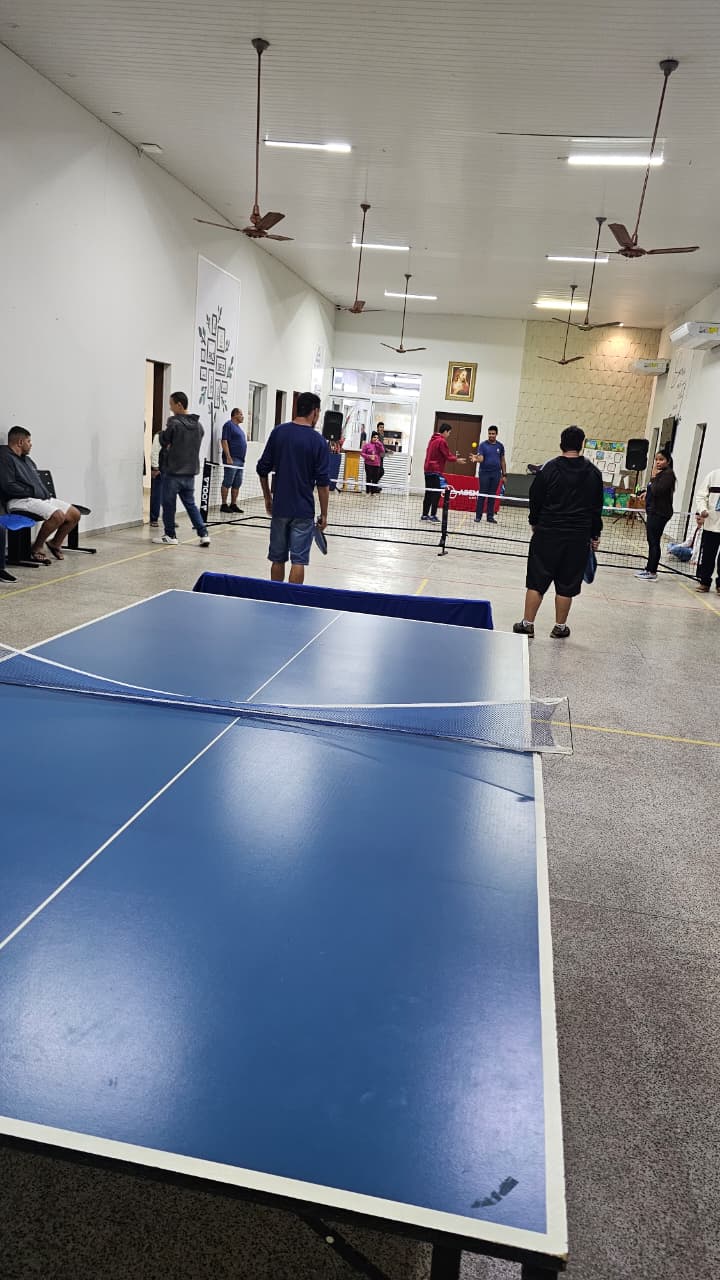
Children and adolescents initially introduced to pickleball-related activities within clinical settings have begun moving beyond those spaces and into sports arenas and pickleball courts.
That transition introduces variables that are difficult to recreate inside a controlled setting.
There are unfamiliar people. Different sounds. More movement. New spaces and stimuli. Different expectations about where to stand, when to move and how to behave within a group.
A participant has to orient themselves in that environment, wait while other people are involved, communicate when necessary and gradually understand where they fit within everything happening around them.
Suddenly the court is doing something beyond providing dimensions for a game. It is providing a piece of the outside world, where skills encouraged in a structured environment have to operate somewhere less predictable.

From there, the possibilities become broader again.
A simple exchange of a ball can eventually become playing with a sibling. Learning how to participate in one activity can lead to sharing a court with a parent. Understanding how to wait, communicate and participate in a group can create experiences that extend beyond pickleball altogether.
Marcelo Abelheira’s account of the work describes that progression neatly:
“From the clinic to the court, from the court to the family, and from the family to the community.”
It is difficult to find a better description of what those involved are trying to achieve.
Beyond One Programme
The work has already reached beyond its original setting.
Adapted pickleball is being incorporated into activities at APAE Rondonópolis, which works with people with intellectual and multiple disabilities.
Pickleball has also appeared within inclusive sporting environments connected with the Festival Paralímpico Loterias Caixa. The Brazilian Paralympic Committee independently reported that pickleball was one of six activities available to participants in Rondonópolis at its September 2025 festival.
The reason given for bringing it back was particularly telling. Festival organisers said the sport had received strong engagement during the previous edition, with children reluctant to leave the activity.
Wagner Tavares, president of APAE Rondonópolis, similarly describes an immediate reaction among participants, particularly a desire to interact with and challenge peers, teachers and volunteers.
It is a useful reminder of what inclusion in sport can actually mean.
It is easy to reduce accessibility to whether somebody can physically take part. The work being done here asks a broader question about whether sport can create a place in which somebody wants to participate, interact and return.
That means the measure of progress cannot be identical for everybody.
There may never be a tournament at the end of this process. There does not have to be a rating, and nobody needs to master a third-shot drop.
Success for one participant might be staying for the entire session. For another it could be initiating communication. For somebody else it might simply be returning next week because they have found a physical activity they want to do.

A Different Kind of Pickleball Expansion
Pickleball’s international story is increasingly told through numbers.
Countries. Courts. Clubs. Tournaments. Registrations. Prize money.
Those figures tell us where the sport has reached, but they do not always tell us what happens after it arrives.
That is why the experience in Rondonópolis is worth noticing.
It is a local example of pickleball taking on a role that has little to do with professional tours or participation statistics. The same characteristics that make the sport approachable for many new recreational players, including an adjustable pace and relatively simple entry point, are being deliberately used by professionals working with children and adolescents whose needs may be very different.
It also forms part of a broader story WPM has been following in Brazil. Earlier this year, World Pickleball Magazine examined another Brazilian programme using adapted equipment and coaching to make pickleball more accessible to players with disabilities.
Bárbara Ivo, a psychopedagogue and inclusive education specialist, has been particularly interested in what she describes as the cognitive demands of the game. She points to the combination of visual-motor coordination and planning involved in pickleball and the way those demands can engage executive functions that may present particular challenges for neurodivergent children.
Again, observation should not be confused with clinical proof.
But neither should the experience be dismissed because nobody is keeping score.
What is happening in Rondonópolis is an exploration of what a sport can become when winning the game is not necessarily the objective.
And its guiding principle may be the most important part of the whole project:
The individual comes before the sport.
Before deciding which skill to teach, understand the person. Before choosing the exercise, understand the need. Before asking somebody to fit into pickleball, ask how pickleball can be shaped around them.
Because development does not always mean striking the ball harder or moving around the court more efficiently.
Sometimes it means waiting. Sometimes communicating. Sometimes making a choice, tolerating frustration or joining a group.
Sometimes it is a 16-year-old deciding that she wants a paddle of her own.
And sometimes the most important thing that happens on a pickleball court has nothing to do with the final score.
Further Reading

Marcelo Abelheira
Founder and Editor-in-ChiefMarcelo Abelheira is a contributor to World Pickleball Magazine.
View All Articles →