By Marcelo Abelheira
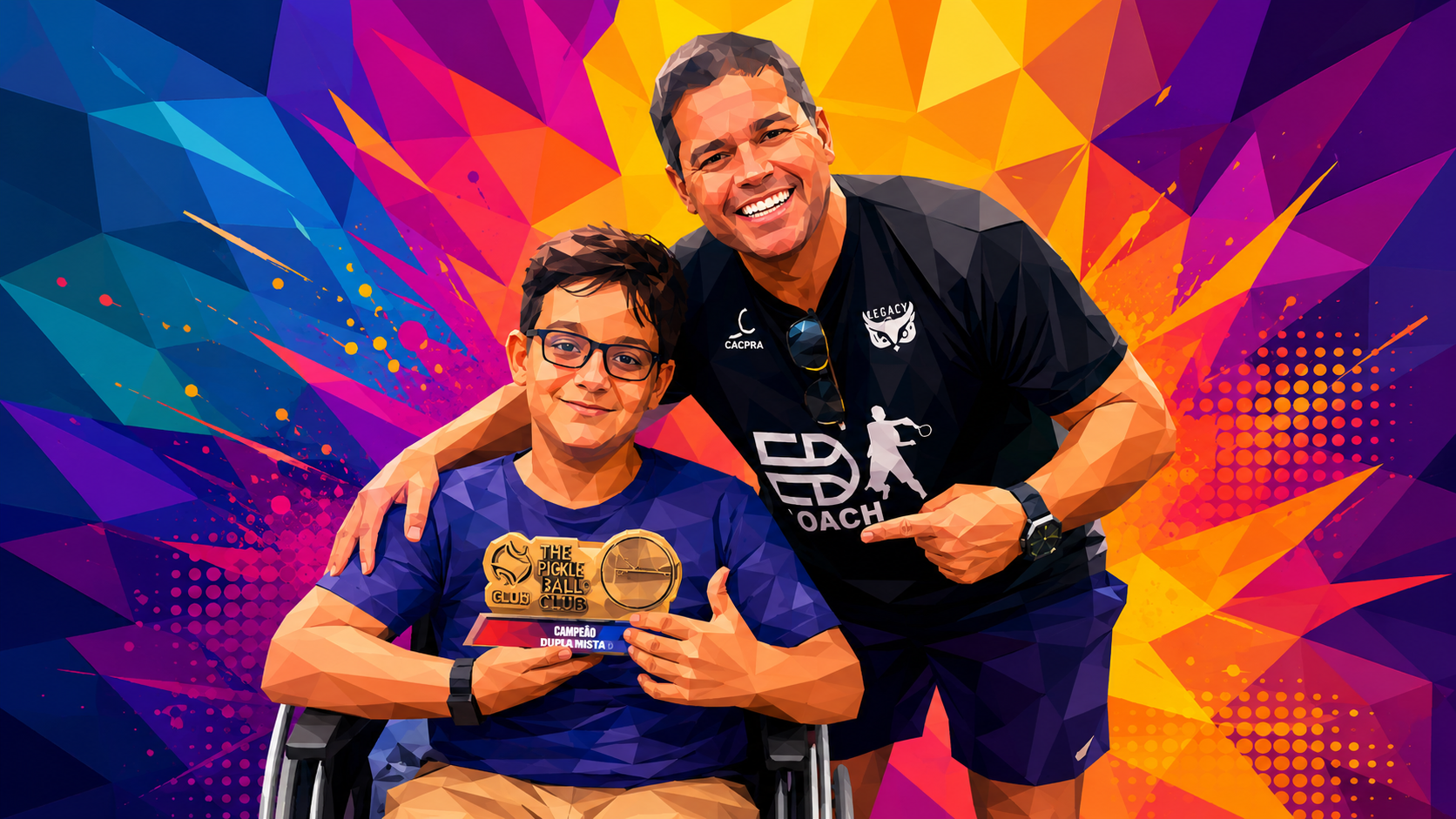
Seven-year-old Théo steps onto the pickleball court carrying a racket that seems almost too large for him.
A few years ago, organised racket sports might have felt out of reach. Today, through a combination of adapted equipment, patient coaching, and an inclusive environment, the court has become a place of confidence, friendship, and development.
Using a lighter racket alongside larger and slower balls, Théo has made remarkable progress. What once appeared challenging has become an opportunity for movement, learning, social interaction, and self-belief.
His smile at the end of a session tells a story that statistics never can.
And for those behind the EdCoach methodology, it is exactly why they do what they do.
Using Sport as a Tool for Transformation
The EdCoach methodology was created by Ednardo Oliveira, an adaptive sports specialist trained by the Brazilian Paralympic Committee, the Brazilian Tennis Confederation, and the International Tennis Federation.
Its purpose is simple: to use racket sports as a tool for human development.
For years, Oliveira worked extensively within adaptive sport, witnessing first-hand how access to physical activity could transform lives. Through his work in wheelchair tennis and other adaptive programmes, he saw athletes gain confidence, independence, and a renewed sense of purpose.
Those experiences became the foundation of the EdCoach approach.
As pickleball has grown across Brazil, the methodology has found a natural home within the sport.
If you're following how the global game is shifting week by week, the World Pickleball Report breaks this down every day in our morning briefing.
Why Pickleball Works
Few sports are as naturally inclusive as pickleball.
The court is smaller. The equipment is lighter. The pace is manageable for beginners while still providing enough challenge for experienced athletes.
Children, older adults, and people with disabilities can often play together in ways that are difficult in many other sports.
Within the EdCoach philosophy, that accessibility becomes more than a practical advantage.
It becomes a way of creating connection.
The focus extends beyond competition and performance. The court becomes a space where participants build confidence, develop social skills, and discover new possibilities for themselves.
For many players, the greatest victories have little to do with scoreboards.
Breaking Barriers
The growth of adaptive pickleball in Brazil reflects a broader shift in how inclusion is being approached within sport.
Every session presents an opportunity to challenge assumptions about what people can achieve.
Physical barriers are addressed through adaptation. Emotional barriers are tackled through encouragement, support, and opportunity.
The result is often transformative.
Participants who arrive unsure of their abilities gradually discover new confidence. Families find shared experiences. Communities become more welcoming and connected.
What emerges is not simply a sporting programme but an environment where people feel valued and included.
Expanding Possibilities
A core principle of the EdCoach methodology is that adaptation does not mean reducing expectations.
Instead, it means creating pathways.
Each player arrives with different abilities, goals, and challenges. The coach’s role is not to focus on limitations but to identify opportunities for growth.
That approach has proven particularly effective in pickleball because the sport lends itself so naturally to modification. Equipment, pace, drills, and teaching methods can all be adjusted to meet players where they are.
As a result, more people are able to participate, improve, and enjoy the game.
The court becomes a place where potential is recognised rather than restricted.
Lessons Beyond Sport
The impact extends well beyond pickleball itself.
Participants learn cooperation, communication, and resilience. They learn how to support teammates and respect differences. They experience environments where age, physical condition, or previous sporting experience matter far less than enthusiasm and effort.
These lessons often prove just as valuable as any technical skill.
Families become involved. Friendships form. New communities emerge.
In many cases, the social benefits become as important as the physical ones.
That may be pickleball’s greatest strength.
It brings people together.
Looking Ahead
As pickleball continues to grow throughout Brazil, inclusion is becoming an increasingly important part of its identity.
Programmes such as EdCoach demonstrate what is possible when accessibility is viewed not as an afterthought, but as a central principle.
The goal is not simply to create better players.
It is to create opportunities.
Opportunities for children like Théo. Opportunities for people with disabilities. Opportunities for families and communities to experience the positive impact that sport can have on everyday life.
The trophies and medals may attract attention.
But the real success stories are often found elsewhere.
They are found in the confidence gained, the friendships formed, and the lives changed through a simple paddle, a plastic ball, and the chance to belong.
For EdCoach and the growing adaptive pickleball community in Brazil, that is the victory that matters most.
Further Reading
- Latest pickleball news from around the world
- Tournament coverage and results
- Rankings and player profiles
- Regional pickleball coverage
Did you enjoy this June magazine article? You can download the whole issue to read at your own leisure here.

Chris Beaumont
Founder and Editor-in-ChiefChris Beaumont is the founder and Editor-in-Chief of World Pickleball Magazine. Chris follows the global game closely, reporting on the latest news, developments, stories and tournaments from all five continents. He also hosts the World Pickleball Podcast, interviewing people at…
View All Articles →