
The Report
The final that never started may matter most
World Pickleball Report
Professional Pickleball’s New RealityThis week’s stories were not really about results. They were about systems beginning to feel professional pressure.
This is the World Pickleball Report.
A men’s final in the Philippines collapsed because of competing sponsorship obligations. Major League Pickleball teams immediately began exploiting tactical loopholes inside a new review system. At Roland-Garros, the French Tennis Federation quietly framed pickleball as part of its long-term infrastructure future.
Three different continents. Three very different stories.
But all pointing toward the same reality.
Professional pickleball is entering a stage where commercial pressure, institutional strategy and competitive optimisation are beginning to reshape the sport underneath the surface.
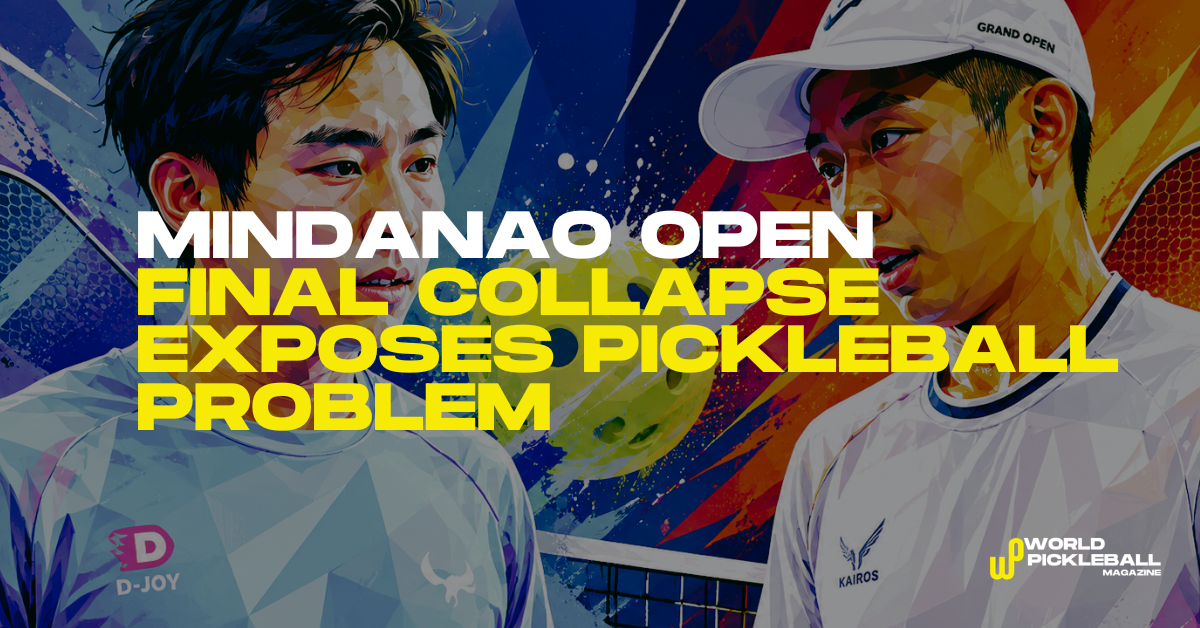
Lead Feature: the final that never started
The most important story in global pickleball this week may be the match that never happened.
The Mindanao Open men’s singles final collapsed after both finalists refused to play using their opponent’s sponsored ball. Organisers eventually named joint champions after hours of confusion and negotiation.
On the surface, it sounded bizarre. Underneath, it exposed something much bigger: professional pickleball’s commercial ecosystem is now evolving faster than some tournaments can govern properly.
Players are no longer simply entering events independently. Sponsors now influence equipment visibility, appearances and competitive conditions directly. The sport is beginning to inherit elite-level pressures before many international structures are fully prepared for them.
What matters: Davao was not just an embarrassing controversy. It was an early governance stress test for a rapidly professionalising global sport.
Read the full Mindanao Open analysis
Pressure Points: MLP’s new incentives changed behaviour immediately
The Los Angeles Mad Drops won the opening MLP event of 2026 in Dallas.
But the bigger takeaway was how quickly the league itself felt different.
Teams immediately began using the new Owl AI review system tactically to interrupt momentum and manufacture unofficial timeouts. Group-stage matches carried playoff-level tension because the revised standings model dramatically increased the cost of falling behind early.
Professional sports ecosystems always evolve this way eventually. Players and coaches stop simply competing emotionally and start optimising around incentives.
What matters: Dallas suggested Major League Pickleball is becoming sharper, less forgiving and strategically smarter very quickly.
Beyond the Score: Europe may adopt pickleball differently
At Roland-Garros this month, the French Tennis Federation installed a public pickleball court beside Philippe-Chatrier.
But the real story was not symbolism.
It was economics.
The FFT is increasingly presenting pickleball as part of a wider racket-sports infrastructure strategy built around court density, participation flexibility and facility utilisation. Four pickleball courts inside one tennis footprint has become more than a selling point. In some places, it is becoming a survival argument.
What matters: America embraced pickleball culturally first. Europe may embrace it institutionally first.
Read the Roland-Garros analysis
The Reset: the sport is becoming harder to improvise
For years, one of pickleball’s advantages was flexibility.
Flexible tournament models. Flexible governance. Flexible scheduling. Flexible infrastructure.
But this week’s stories all hinted at the same tension beginning to emerge across the sport: professionalism eventually punishes improvisation.
Sponsors want consistency. Players optimise for margins. Federations start thinking about facility economics. Tours become structurally competitive rather than emotionally competitive.
What matters: the global game is beginning to move beyond enthusiasm and into systems management.
One Thing to Watch
Watch how quickly governing structures begin tightening around the professional game over the next 12 months.
Equipment standardisation. Challenge-review rules. Facility integration. Calendar hierarchy. Sponsorship frameworks.
Those conversations are no longer theoretical.
The sport’s next stage may not be defined by expansion. It may be defined by regulation.
What matters most
This week’s stories were not connected geographically.
But structurally, they were saying the same thing.
Professional pickleball is becoming sophisticated enough that decisions around governance, incentives and infrastructure now shape the sport almost as much as results themselves.
That is how sports stop feeling emerging and start feeling established.
The deeper read
The daily stories explain what happened this week.
The bigger question is what those stories reveal about where the sport is actually heading underneath the headlines.
That is where World Pickleball Magazine goes deeper, connecting the structural, tactical and institutional forces reshaping the global game.