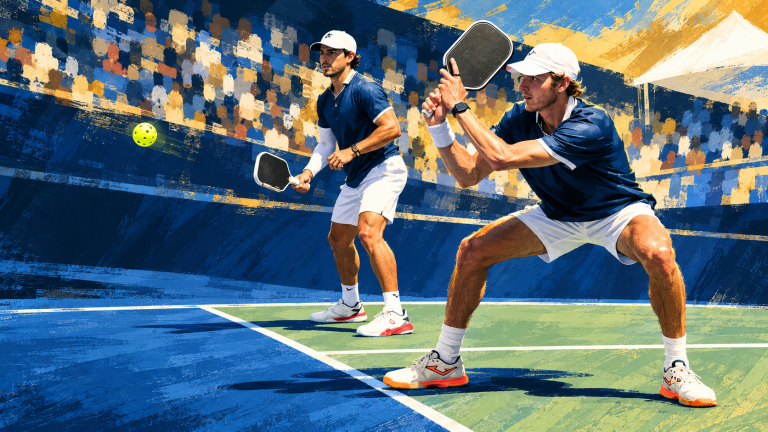

The cancellation of the Mindanao Open men’s singles final was not simply an awkward equipment dispute. It exposed a deeper problem inside professional pickleball: commercial sponsorships are beginning to outgrow the sport’s tournament governance.
- The Mindanao Open final was cancelled after both finalists refused to play with their opponent’s sponsored ball
- Tournament organisers had accepted competing official ball sponsors without establishing a final-round protocol
- The incident exposed how equipment sponsorships are now directly affecting competitive integrity in professional pickleball
The court was ready long before the players were.
By mid-afternoon in Davao on 22 May, officials at the Mindanao Open were no longer discussing tactics, scheduling or warm-up times. Instead, they were trying to negotiate which type of pickleball would be used in the men’s singles final.
Spectators drifted around the venue waiting for clarity. Players remained off court. Coaches and organisers moved between conversations trying to salvage a championship match that increasingly looked impossible to stage.
Eventually, the final never happened.
Quang Duong and Phuc Huynh both refused to play under the proposed ball conditions, forcing organisers into one of the most awkward public standoffs the professional game has faced so far.
A Problem Bigger Than One Final
On the surface, the dispute sounded faintly ridiculous.
One player was aligned with a 40-hole ball sponsor. The other represented a 48-hole manufacturer. Neither wanted to use the rival product in the final.
But dismissing the controversy as simple sponsorship stubbornness misses the larger story entirely.
What happened in Davao was not an isolated moment of chaos. In many ways, it felt inevitable.
Professional pickleball has expanded commercially at extraordinary speed over the past two years, particularly across emerging Asian circuits where tournaments are growing faster than the systems governing them. Events increasingly rely on multiple sponsorship agreements to fund prize money, livestream production, travel support and venue costs.
Equipment manufacturers, meanwhile, are aggressively competing for regional market share and visibility through player partnerships.
That combination creates pressure points.
Players are no longer simply entering tournaments independently. Increasingly, they are arriving with contractual obligations tied to equipment visibility, brand representation and commercial appearances. Manufacturers want their products visible deep into tournaments because finals are where broadcast exposure and social distribution peak.
The problem is that international pickleball still lacks universal equipment standards robust enough to absorb those competing interests cleanly.
The Mindanao Open exposed what happens when those commercial realities collide directly with match conditions.
Tournament organisers had accepted two official ball sponsors inside the same event structure. Matches on 21 May used the 40-hole ball. Matches on 22 May switched to the 48-hole version. The arrangement survived until the finalists themselves became the point of conflict.
At that stage, the tournament had effectively created competing professional obligations inside the same championship match.
That is where the situation collapsed.
Organisers initially awarded the title to Huynh after Duong declined to play. Duong then refused to accept the decision. Hours later, officials reversed course and named both men joint gold medallists instead.
Third place went to Nguyen Huu Hung Anh.
The clearest explanation of the dispute came from Quang’s father, Duc Duong.
“We didn’t fly from the US to the Philippines to advertise for another company,” he said.
Why The Ball Differences Matter
The quote cut through the carefully managed language usually surrounding sponsorship agreements in emerging sports.
At elite level, these are no longer symbolic partnerships. They are business arrangements with expectations attached.
And unlike tennis, where ball usage is tightly standardised across professional events through governing structures such as the International Tennis Federation, pickleball still operates with significant variation between tournaments, brands and regional tours.
Those differences matter far more than casual players often realise.
Elite players will immediately notice changes in:
- skid speed through humidity
- bounce consistency
- trajectory off the bounce
- softness during resets
- defensive timing in hand exchanges
- pace through transition zones
A 40-hole ball can travel flatter and faster in certain conditions. A 48-hole model may produce a slightly more controlled bounce profile or different feel during extended hand battles. Temperature, altitude and surface type can exaggerate those differences further.
This was not simply a disagreement over branding.
It was a disagreement over competitive conditions.
That distinction is critical because the professional side of pickleball is now evolving faster than many tournament structures can realistically handle.
Across Asia especially, the tournament ecosystem remains fragmented. Different federations, tours, private organisers and sponsors are often operating without a single unified framework governing equipment standards internationally.
Flexibility has helped the sport grow quickly, but flexibility becomes harder to maintain once rankings, prize money, sponsor obligations and broadcast visibility begin colliding at elite events.
Davao became the public version of a problem that has likely been building privately for some time.
And the optics were deeply uncomfortable.
For a sport pushing aggressively toward mainstream legitimacy, watching a professional final collapse because organisers lacked a framework sophisticated enough to manage competing commercial interests made pickleball look underprepared for the level it now wants to occupy globally.
The Questions Now Facing The Sport
Following the controversy, Philippines Pickleball Federation founder Aldus Corel Dela Cruz announced that only 40-hole balls would be used during the final two days of competition, while alternating brands daily.
But by then, the damage had already moved beyond the tournament itself.
The bigger questions now sit above the Mindanao Open entirely.
Who ultimately controls equipment standards in professional pickleball?
How much influence should sponsors have over match conditions?
Should international tours move toward mandatory single-ball systems?
And what happens when commercial obligations directly conflict with tournament operations?
Those questions are no longer theoretical.
Davao showed they are already here.
What This Means
The Mindanao Open controversy was not an isolated embarrassment. It was an early warning from inside a rapidly professionalising sport.
Professional pickleball has entered a stage where equipment regulation, sponsorship integration and competitive governance can no longer operate separately. The commercial side of the game is becoming too influential for informal solutions and improvised protocols.
The sport now has elite-level pressures whether its structures are ready for them or not.
Closing Line
The final in Davao never started, but it may still become one of the clearest signs yet that professional pickleball is entering a far more complicated era than the sport’s governance systems were built for.
Further Reading
- Latest pickleball news from around the world
- Tournament coverage and results
- Rankings and player profiles
- Regional pickleball coverage

Chris Beaumont
Founder and Editor-in-ChiefChris Beaumont is the founder and Editor-in-Chief of World Pickleball Magazine. Chris follows the global game closely, reporting on the latest news, developments, stories and tournaments from all five continents. He also hosts the World Pickleball Podcast, interviewing people at…
View All Articles →