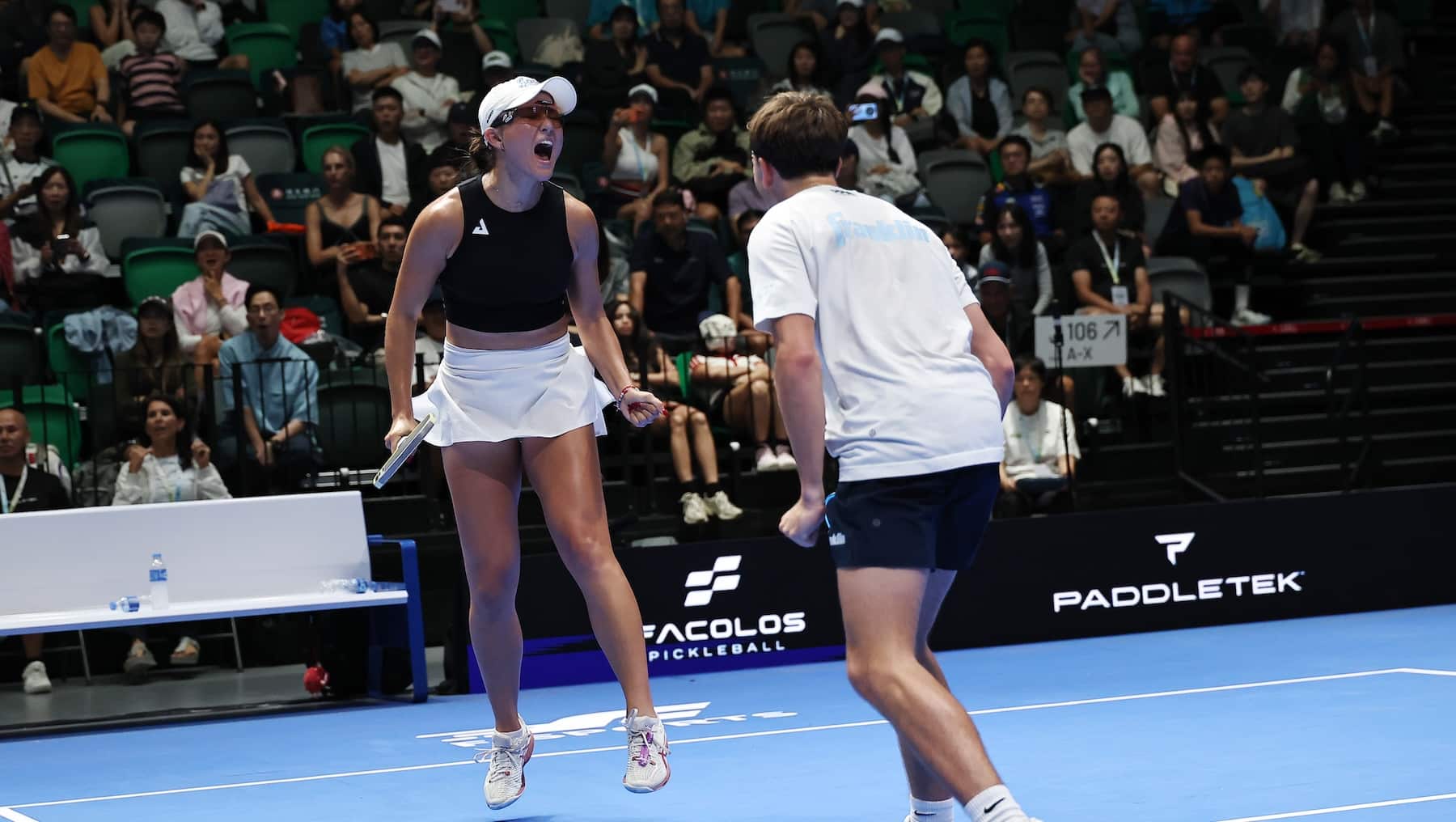
Main image: Anna Bright and Hayden Patriquin at the Hong Kong Slam. Photo: PPA Tour Asia
The short answer: To come back after losing the first game heavily, change one thing that matters, not everything. Slow the pace, target the weaker player or the weaker side, make the opponents hit more third shots, and protect your serve with deeper, safer serving. Use a timeout early in the second game, not when you are 2-9 down.
Tyra Black and Jorja Johnson lost the first game of their Hong Kong Slam women’s doubles semi-final 4-11. Against Rachel Rohrabacher and Parris Todd, that is not a scoreline that happens by accident. Something structural was going wrong. They won the second 11-9 and the third 11-2, according to PPA Tour Asia‘s results, confirmed by ThePickleBase and ThePickleHub.
That 11-2 is the telling number. Teams that scramble back into a match usually win the decider narrowly, if at all. Teams that have changed the shape of the match win it easily, because by the third game the opponents are trying to solve a different problem from the one they solved in the first. Black and Johnson had done the second thing. So did Gabe Tardio and Hayden Patriquin in the Brisbane men’s doubles final, losing the first game 3-11 to JW Johnson and Tama Shimabukuro before winning 11-6, 11-7.
Club players mostly do the first. Here is how to do the second.
What should you change after losing the first game 11-3?
Start with a diagnosis, and be honest about which of three games you lost. Most heavy defeats fall into one of them.
You lost the kitchen line. The opponents got to the net first and you spent the game hitting up from the transition zone. The fix is not to hit harder. It is to drop more and drive less, and to accept that you will spend two or three extra shots getting forward. A third-shot drop that lands short of perfect but lets you take two steps is worth more than a drive that gets countered at your feet.
You lost the hands battle. You reached the net but got beaten in speed-ups and firefights. The fix is to take the pace out: dink lower and further from the opponent’s dominant hand, and stop speeding up from below the net. Every attack from a ball at knee height is an invitation to the counter that beat you in game one.
You beat yourselves. Unforced errors on serve, return and simple dinks. This is the most fixable, and the one players most often misdiagnose as the opponent being “too good”. Count them. If more than four of the opponents’ eleven points came from your errors, the answer is margin, not tactics.
Who should you target?
Most club pairs spread the ball evenly when they are behind because it feels fair. It is a mistake. Pick a target and commit to it for at least six or seven rallies before judging the result.
The obvious target is the weaker player. Less obvious, and often better, is the stronger player’s backhand side or the middle between partners. A strong player forced to hit backhand dinks from the middle for five shots in a row is less dangerous than the same player taking a forehand on the line. In mixed, aiming everything at one player can backfire if that player is simply waiting for a speed-up; the smarter route is often to target the stronger player’s feet with deep returns and then dink to the partner.
Watch what the first game told you. If one opponent hit every winner, do not give them the ball in the positions where they hit those winners. If one opponent’s errors kept you in the rallies you did win, find them again.
How should you change the pace?
When you are losing heavily, the opponent is usually setting the rhythm. Break it. Take your full time before serving. Walk to retrieve the ball. Talk to your partner between every point, even briefly. These are not tricks; they are how you stop a run of points becoming one continuous passage of play that the leading team is enjoying.
On court, the same principle applies. If the opponents are winning fast exchanges, become the resetter rather than the rusher: more dinks, more resets, fewer attacks. If they are winning long dinking rallies with patience, be the first to change direction with a controlled speed-up to the body, chosen in advance rather than in panic. The goal is to make the second game feel unlike the first.
What about serve and return?
The serve is the only shot nobody can force you to hit badly, and it is also where rattled players start trying too hard. In game two, serve deep and to the middle, and remove every serve error you can. A team that has lost 11-3 cannot afford to give away free points.
The return is your best weapon for regaining the kitchen line. Hit it deep and high enough to buy time, and follow it in all the way. The returning team in doubles starts at an advantage, because the serving team must let the return bounce before coming forward. Waste that, and you have conceded the first race to the net.
When should you call a timeout?
Earlier than you think. Most club players save a timeout until they are 2-8 down in the second game, when the match is effectively gone. The best moment is after the first two or three points of game two if the pattern from game one is repeating. A timeout at 1-3 is a tactical reset. At 2-9 it is a ritual. Allowances vary by event and format, so check the tournament’s rules before you play and know how many you have.
Use the time for one decision, not five. “We dink to her backhand and stop speeding up” is a plan. “Let’s just play better” is not.
The warning from the other side of the net
The best evidence that a heavy first game guarantees nothing came from the Hong Kong mixed doubles semi-final. Anna Bright and Patriquin beat Jorja Johnson and JW Johnson, the third seeds, 11-2 in the first game. The Johnsons took the second 11-9 and pushed the decider to 11-9 before losing. A team that had been routed for a game was two points from the final.
The lesson for anyone leading is not to change a winning pattern because the second game feels harder. The lesson for anyone trailing is that the scoreline of game one is information, not a verdict. Hunter Johnson came from a game down twice on his way to titles this autumn, beating Federico Staksrud 5-11, 11-8, 11-6 at the Rate Las Vegas Open and 3-11, 11-8, 11-5 in Hong Kong. Neither was a scramble. Each was a match in which the second game looked different from the first.
For club players, the hardest part is psychological, and it is where the mid-game trap catches leading teams as often as it catches trailing ones. Pick one change, commit to it for long enough to judge it, and make the opponents prove they can beat a different version of you.
After a heavy first-game defeat: the checklist
- Diagnose: kitchen line, hands battle, or your own errors?
- Pick one target and stay with it for six or seven rallies
- Change the pace in the opposite direction from game one
- Serve deep to the middle; no free points
- Deep return, follow it all the way in
- Timeout early in game two if the pattern repeats
Frequently asked questions
Diagnose why you lost it, then change one thing that matters: the target, the pace or how you reach the kitchen line. Cut serve and return errors and use a timeout early in game two if the same pattern repeats.
Early in the second game if the first game’s pattern is repeating, for example at 1-3, rather than when the game is already lost.
Yes. At the 2026 Hong Kong Slam, Tyra Black and Jorja Johnson lost the first game of their women’s doubles semi-final 4-11 and won 11-9, 11-2.

Chris Beaumont
Founder and Editor-in-ChiefChris Beaumont is the founder and Editor-in-Chief of World Pickleball Magazine. Chris follows the global game closely, reporting on the latest news, developments, stories and tournaments from all five continents. He also hosts the World Pickleball Podcast, interviewing people at…
View All Articles →