
The Report
The English Open dream meets reality
World Pickleball Report
The English Open dream meets realityRoad to the English Open reaches the point where ambition has to become work. Elsewhere today: McEnroe on tennis’s pickleball problem, Brick Wall’s professional middle class warning, APP Asia’s connected model and the latest World Pickleball Podcast.
This is the World Pickleball Report.
The English Open is still months away. That is exactly why this part matters.
The easy version of a preparation story is the promise: the target, the ambition, the idea of arriving at Birmingham ready.
The more useful version starts when the gap becomes visible.
In week two of Road to the English Open, that is where the series begins to move. It is no longer simply about who wants to improve. It is about what needs fixing, what needs repeating, what needs surviving and what will decide whether the destination becomes something serious.
That same theme runs through the rest of today’s edition. Tennis is being forced to think harder about why pickleball connected so quickly. Regional circuits are exposing the economics underneath the pro game. APP Asia is trying to build connected structure before the international map fully settles.
Growth is the easy headline. Readiness is the harder story.
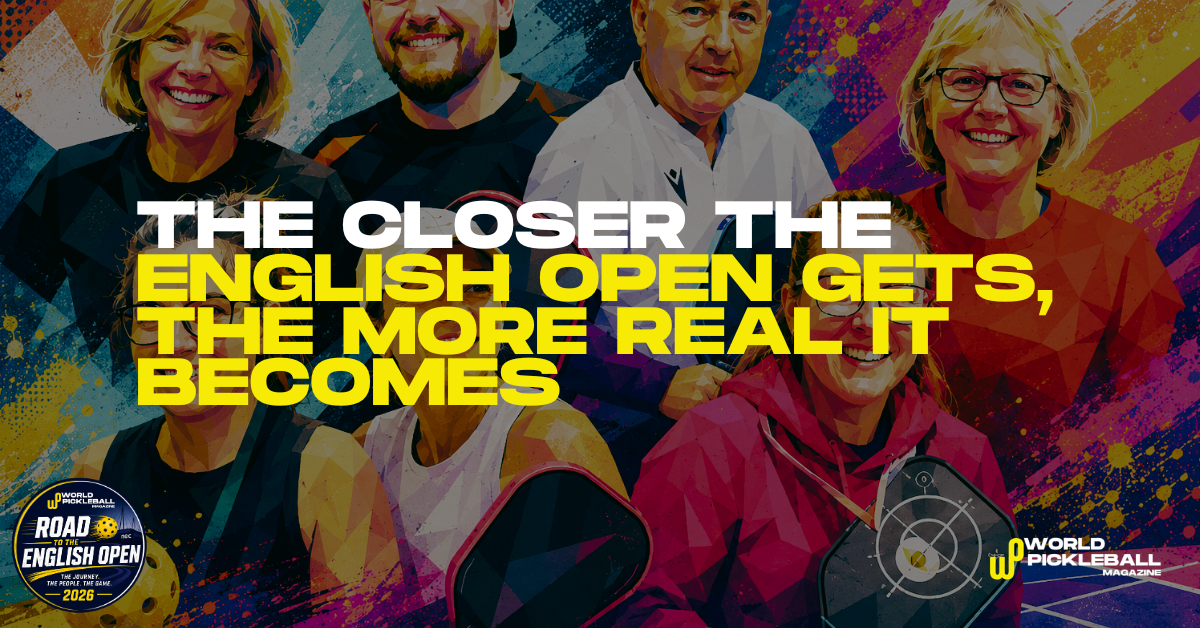
Lead feature: Road to the English Open enters the honest stage
The second week of Road to the English Open is where the project starts to show its teeth.
Week one introduced the players, the ambition and the idea. Week two begins to reveal something more valuable: the honest distance between where players are now and where they want to be by the time they reach the NEC in Birmingham.
That is where the series becomes more than a countdown. It starts to become a record of preparation in public, with all the awkward details that usually sit behind tournament entries and hopeful targets.
The technical habits. The fitness questions. The confidence gaps. The difference between playing often and training with a clear purpose.
What matters: serious competition is rarely decided by ambition alone. It is decided by whether players are willing to look clearly at the gap between wanting it and being ready for it.
Read Road to the English Open week two

McEnroe and tennis’s pickleball problem
John McEnroe, Andre Agassi, Andy Roddick and Michael Chang give this conversation a different weight.
The sharper point is not that pickleball is replacing tennis. It is that pickleball exposed something tennis had gradually stopped serving well: the recreational player who wants quick competence, lower embarrassment, easier rallies and immediate social reward.
For decades, tennis treated difficulty as part of its identity. Pickleball reduced friction almost everywhere new players felt it most strongly.
What matters: this is not really a tennis-versus-pickleball story. It is a story about how modern people choose recreational sport.

The May issue gives the deeper read
Daily news tells you what moved.
The magazine explains the forces underneath it.
Across player stories, pro tours, global pathways, tactics and the business of the sport, the May issue gives you the bigger picture in one place.
Download the free May 2026 issue

The missing professional middle class
Brick Wall Pickleball is not just another regional circuit.
Its rise points to a more serious question beneath the professional game: what happens to the players good enough to compete seriously, but not financially secure enough to absorb constant travel, entry fees and inconsistent payouts?
The sport has built elite visibility quickly. It has not yet fully solved the economics beneath that top layer.
What matters: the long-term health of pro pickleball may depend less on how wealthy the top becomes and more on whether enough players beneath them can still afford to keep chasing it.

APP Asia is building around connection
The APP’s new six-stop Asia Tour is not just a calendar announcement.
With regional leadership hires, local operator partnerships and the wider Global Pickleball Alliance framework, the more interesting story is how international pickleball structure is being built before the map fully settles.
Asia remains one of the sport’s most fluid regions: huge participation potential, younger demographics, uneven infrastructure and pathways still taking shape.
What matters: the next phase of international pickleball may not be decided purely by who stages the biggest events, but by who builds the most connected ecosystem around them.

Podcast: the pressure is spreading
This week’s World Pickleball Podcast moved from Kuala Lumpur to Dallas, from Canadian league parity to Anna Bright’s travel chaos.
The deeper theme was clear: professional pickleball is becoming more demanding in every direction.
Players are managing heavier workloads. MLP teams are facing sharper front-office pressure. Asian circuits are producing deeper competitive fields. Domestic leagues are beginning to reveal what sustainable structure might look like.
What matters: the questions around pickleball are getting more sophisticated now. Can leagues sustain parity? Can players handle expanding workloads? Can tours build viable ecosystems? Can pathways produce elite talent?
One thing to watch
The most revealing pickleball stories right now are not always the biggest announcements.
They are the gaps opening underneath them.
The gap between wanting to peak for the English Open and actually being ready. The gap between elite tennis tradition and modern recreational behaviour. The gap between top-tier pro contracts and the players underneath. The gap between international events and connected global structure.
That is where the sport is becoming most honest about itself.