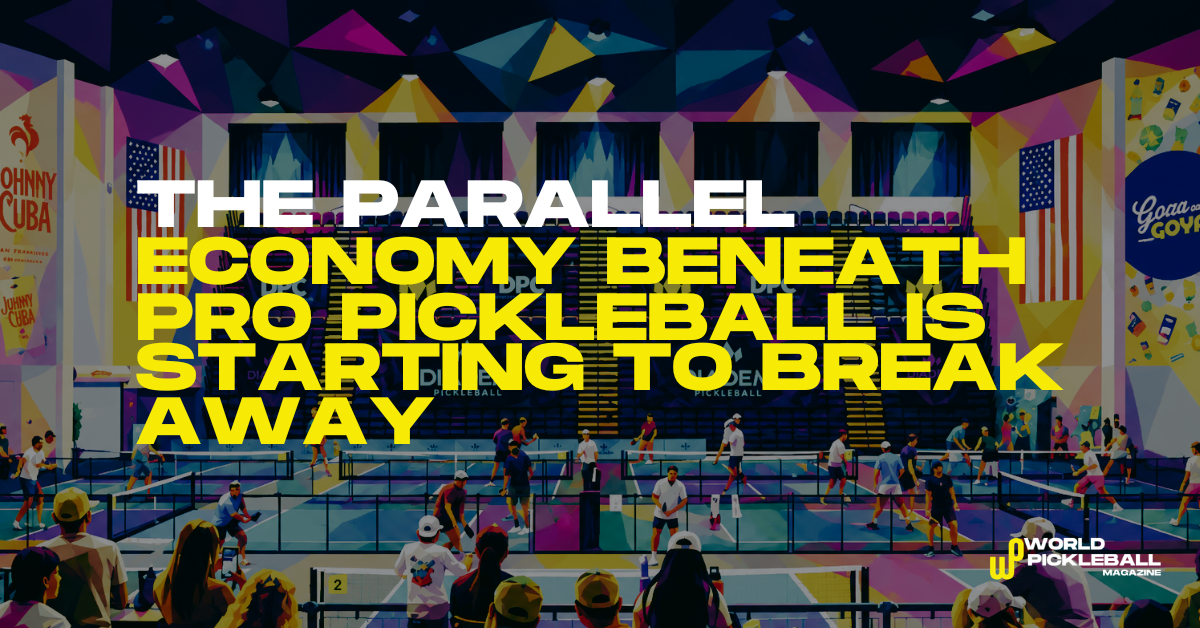
Brick Wall Pickleball is not just another regional tour. Its rapid rise exposes growing strain beneath the professional game, where many aspiring players are searching for a competitive system they can realistically afford to stay inside.
- Brick Wall Pickleball is on pace to distribute up to $500,000 in prize money during 2026.
- The circuit’s growth reflects mounting pressure on the professional middle class of pickleball.
- Regional tours are beginning to expose structural gaps beneath the sport’s elite layer.
Professional pickleball increasingly looks polished at the top.
Packed championship courts. Streaming deals. Team owners. Six-figure contracts. Growing sponsor investment.
Beneath that surface, though, a different financial reality exists for much of the player base trying to build careers in the sport.
Flights, hotels, registration fees, coaching costs, and inconsistent payouts have created an environment where even strong competitive results do not always translate into financial stability.
That tension is one of the reasons Brick Wall Pickleball has expanded so aggressively over the past 18 months.
Founded by Cody Savon in South Florida, the regional circuit has positioned itself as an alternative to the economics surrounding the major tours, particularly for players outside the small elite contract tier.
A Simple Model With A Clear Message
The model itself is deliberately simple.
Players pay a flat $100 entry fee and receive a guaranteed four matches. Roughly $60 to $65 from each entry goes directly into event payouts, while another 15 per cent helps fund a free-to-play national championship later in the season.
The transparency matters almost as much as the payouts themselves.
Brick Wall distributed more than $90,000 across 36 events in 2025. By May 2026, the circuit had already paid out over $88,000 and is projecting between $400,000 and $500,000 in total payouts this year.
Those numbers push the circuit well beyond local-tour territory.
Importantly, the circuit is not presenting itself as anti-competition. It still uses rankings. It still leans into merit-based progression. Its growing partnership with DUPR adds further credibility and operational legitimacy.
What changes is the economic philosophy underneath it.
The Missing Professional Middle Class
To some extent, the major tours were always likely to prioritise concentration at the top.
Recognisable stars are easier to market. Broadcast products become cleaner when elite names consistently appear late in tournaments. Sponsors prefer stability and visibility over unpredictability.
From a business perspective, that approach makes sense.
But it has also created growing pressure beneath the top layer of the sport.
A large group of highly skilled players now sits in an awkward middle ground: good enough to compete seriously, but not financially secure enough to absorb constant travel and tournament costs comfortably.
That is the gap Brick Wall appears to be targeting.
Savon has openly criticised aspects of the current professional system, particularly exclusivity structures and the concentration of investment around a relatively small group of players.
Whether one agrees fully with that criticism or not, the wider economic pressure underneath professional pickleball’s expansion is becoming increasingly difficult to ignore.
Most mature professional sports develop layered financial ecosystems over decades.
Pickleball is attempting to build elite visibility, broadcast legitimacy, amateur participation, sponsorship growth, and professional depth almost simultaneously. That compression naturally creates strain underneath the surface.
Brick Wall’s rise may be one of the clearest visible examples of that strain beginning to show.
A Different Kind Of Sustainability
What makes the circuit particularly interesting is that it does not necessarily need to replace the major tours to become influential.
It simply needs to become sustainable enough for players to view it as a viable competitive pathway alongside them.
That possibility could reshape parts of the professional ecosystem over the next few years.
Not because regional tours suddenly overtake the PPA or APP in prestige or visibility, but because they begin serving a different economic function inside the sport.
A function the current structure may not yet fully provide on its own.
There is also a broader question quietly emerging beneath all this.
What happens if secondary tours become financially stable independently rather than operating purely as feeders into larger systems?
That could eventually influence player scheduling, sponsorship models, regional development, ranking relevance, tournament density, and professional career planning.
Right now, the major tours still control the largest audiences, the biggest stages, and the strongest commercial visibility.
But Brick Wall’s growth suggests there is increasing demand for a competitive structure that feels economically survivable to more than just the elite few.
The long-term health of professional pickleball may ultimately depend less on how wealthy the top becomes, and more on whether enough players beneath them can still afford to keep chasing it.
Further Reading
- Latest pickleball news from around the world
- Tournament coverage and results
- Rankings and player profiles
- Regional pickleball coverage

Chris Beaumont
Founder and Editor-in-ChiefChris Beaumont is the founder and Editor-in-Chief of World Pickleball Magazine. Chris follows the global game closely, reporting on the latest news, developments, stories and tournaments from all five continents. He also hosts the World Pickleball Podcast, interviewing people at…
View All Articles →