
This week’s World Pickleball Podcast moved from Kuala Lumpur to Dallas, from Canadian league parity to Anna Bright’s travel chaos, but the deeper theme underneath almost every discussion was the same: professional pickleball is becoming more demanding in every direction.
- The Panas PPA Asia event in Kuala Lumpur produced breakthrough performances and further evidence of Asia’s growing competitive depth.
- Major League Pickleball enters 2026 with front-office pressure, roster scrutiny and tactical changes reshaping the league.
- Anna Bright’s latest behind-the-scenes vlog highlighted the increasingly heavy off-court workload facing professional players.
A busier, heavier version of professional pickleball
There was a point during this week’s World Pickleball Podcast when the conversation stopped being about results altogether.
Instead, it became about workload.
Not only the physical workload of tournament schedules and training blocks, but the wider pressure now surrounding professional pickleball players, leagues, sponsors and teams as the sport continues to professionalise at remarkable speed.
That theme surfaced repeatedly throughout Chris Beaumont and Gordon Watson’s latest weekly roundup, whether they were discussing the Panas PPA Asia tournament in Kuala Lumpur, Major League Pickleball’s looming return in Dallas, or Anna Bright’s increasingly revealing behind-the-scenes content.
Professional pickleball is becoming more layered.
And more demanding.
Kuala Lumpur showed Asia’s depth is becoming harder to ignore
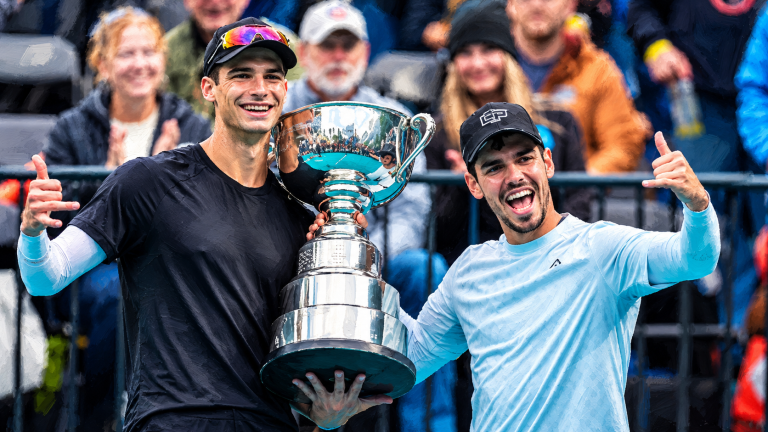
The Panas PPA Asia event in Malaysia produced some of the strongest fields and highest-level matches seen on the Asian circuit so far this year.
Watson highlighted the women’s doubles final as one of the standout performances of the tournament, praising Eu Long and Jamie Wei for their dominant display against Xiao Yi Wang and Alex Chuang.
“They really didn’t let Xiao Yi or Alex Trong into that match at all,” Watson said during the episode. “They just led from the front.”
The conversation also focused heavily on Japan’s growing influence in the region, particularly after qualifier Nasa Hatakeyama reached the men’s singles final following wins over Hong Kit Wong, Zane Navratil and Will Schaefer.
That run mattered.
Not simply because Hatakeyama reached the final, but because it reinforced the idea that Asia’s competitive landscape is broadening quickly beyond the names already familiar to North American audiences.
The hosts also pointed to teenage prospect Tama Shimabukuro as another player accelerating rapidly into wider prominence following strong performances across both PPA Asia and recent US events.
MLP’s next phase may be decided away from the court
As the discussion moved toward Major League Pickleball’s return this weekend, the focus quickly shifted from pure talent to roster construction and organisational pressure.
Watson identified St. Louis Shock as his early title favourite thanks to the depth of the roster, while Beaumont questioned whether franchises are fully prepared for the increasingly professional environment surrounding MLP.
That observation felt particularly relevant when discussing Dallas Flash’s controversial offseason decisions and Miami’s reported valuation of Nicolas Acevedo.
The league’s new six-player rule also adds another tactical layer.
Singles specialists may suddenly become more important.
Depth may matter differently.
And poor roster decisions may become more exposed over a long season.
MLP may currently represent the clearest example of the pressure now building around professional pickleball.
Anna Bright’s vlog revealed the hidden side of the job
One of the most interesting sections of the podcast centred around Anna Bright’s recent travel vlog, which documented sponsor obligations, appearances in Canada, travel problems and the off-court reality of life as a professional pickleball player.
At one point, Bright forgot her passport, forcing her mother to fly out with it so the trip could continue.
The moment became a useful entry point into a wider discussion about the hidden demands increasingly attached to professional pickleball life.
“There’s so much going on,” Beaumont explained. “It’s not just that the on-court workload is growing because there’s so many tournaments and so much travel. It’s the off-court stuff as well.”
The hosts discussed how modern players are increasingly expected to balance tournament performance, sponsor obligations, content creation, social media visibility, audience building and travel schedules simultaneously.
That balancing act may now be one of the defining realities of the professional game.
Canada and Australia continue building from underneath
Away from the major headlines, the episode also explored the importance of regional growth stories.
The Canadian National Pickleball League drew praise for its competitive balance after 10 Dreambreakers were played across 24 matches during opening weekend, while Watson also described major facility expansion plans underway across northern and central Queensland.
Dedicated pickleball venues, league structures and formal competition systems continue appearing in markets that, only a few years ago, barely existed inside the sport.
The result is a game that increasingly feels less temporary and more institutional.
That does not necessarily mean the sport is finished growing.
Far from it.
But it does mean the conversations around pickleball are changing.
The questions are becoming more sophisticated now: can leagues sustain parity, can players handle expanding workloads, can tours build viable ecosystems, can brands maintain identity while scaling, and can pathways consistently develop elite talent?
Those are the kinds of questions established professional sports eventually face.
Pickleball is beginning to face them too.
Why this episode mattered
What made this week’s podcast particularly strong was not simply the breadth of topics covered.
It was the connective tissue between them.
From Kuala Lumpur to Dallas to Toronto to Townsville, the same underlying reality kept emerging: pickleball is no longer only adding courts and tournaments.
It is building systems, expectations and pressures around the people inside it.
And increasingly, that may be where the sport’s most important stories now live.

Chris Beaumont
Founder and Editor-in-ChiefChris Beaumont is the founder and Editor-in-Chief of World Pickleball Magazine. Chris follows the global game closely, reporting on the latest news, developments, stories and tournaments from all five continents. He also hosts the World Pickleball Podcast, interviewing people at…
View All Articles →