Vietnamese authorities have fined a trader after finding 310 counterfeit JOOLA paddles among 450 pickleball paddles at a business in Hung Yen. The seizure is more than an enforcement story. It exposes the challenge of building consumer trust around a pickleball economy developing almost as quickly as the sport itself.
Key Takeaways
- Authorities in Hung Yen found 310 JOOLA-branded pickleball paddles which were subsequently determined to be counterfeit, alongside 140 unbranded paddles of unclear origin.
- The trader was fined VND102.5 million on September 17 following an inspection carried out on July 24.
- The counterfeit JOOLA paddles were listed at VND330,000 each, creating an obvious consumer-trust issue in a market attracting large numbers of relatively new players.
- Separate Vietnamese enforcement cases involving pickleball equipment were reported in Vung Tau in 2024 and Quang Ninh in 2025, although there is no evidence that the latest Hung Yen paddles followed the same supply route.
- The wider challenge for Vietnam is increasingly about the market surrounding pickleball: trusted retailers, authentic equipment and consumer education alongside courts, tournaments and players.
Vietnam’s pickleball boom has been visible through packed courts, international tournaments, an increasingly sophisticated professional scene and a domestic player base now capable of challenging some of the best players arriving from overseas.
Now another, less welcome indicator of the sport’s commercial development has appeared.
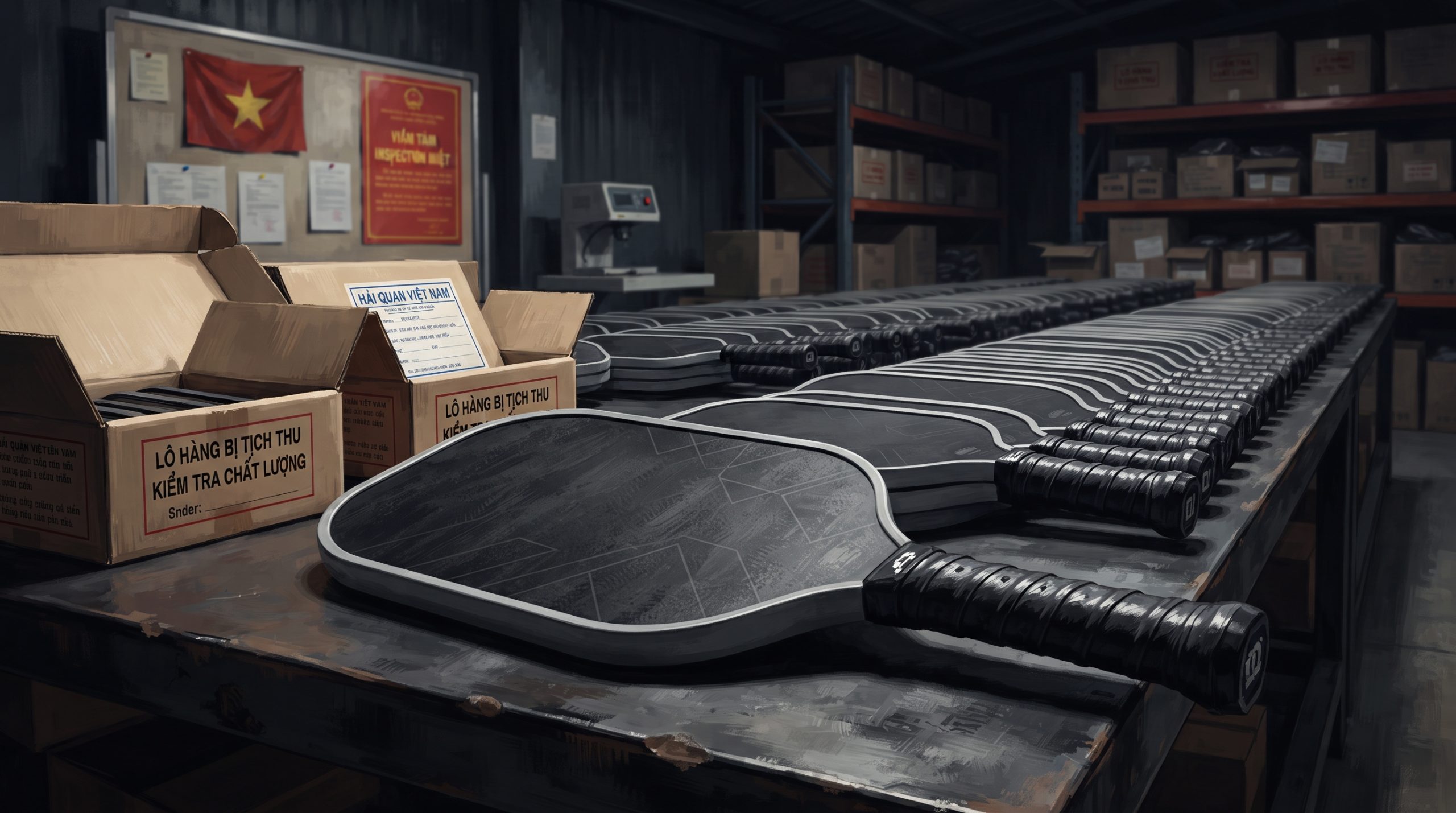
Authorities in Hung Yen province have fined a trader VND102.5 million after discovering hundreds of counterfeit and unverified pickleball paddles during an inspection in July. Among them were 310 paddles carrying the JOOLA trademark, all subsequently determined to be counterfeit, alongside another 140 unbranded paddles without information identifying their manufacturer or place of origin.
The JOOLA-branded paddles were being offered for VND330,000 each, giving the stock a listed value of VND99.33 million. The additional unbranded paddles were listed at VND100,000 each, producing another VND14 million in stock value.
According to Hung Yen Provincial Police, the inspection took place on July 24 before a formal administrative violation report was drawn up on July 31. On September 17, the provincial Market Management Sub-Department imposed the VND102.5 million fine for three violations: failing to register a household business where registration was required, trading counterfeit trademarked goods and selling goods of unclear origin.
The immediate story is straightforward. Counterfeit goods were found, investigated and sanctioned.
The more interesting question is why hundreds of fake pickleball paddles carrying a premium international brand are appearing in Vietnam at all.
The answer takes us into the next phase of the country’s pickleball development, because participation has grown sufficiently quickly to create something much bigger around it: a consumer economy.
And consumer economies depend on trust.
The market behind the playing boom
Vietnam has become one of Asia’s most important competitive pickleball markets, with the sport moving rapidly from recreational participation towards organised competition, major events and a domestic playing group capable of influencing results at international level.
That progression has been particularly visible throughout 2026. PPA Tour Asia opened its season in Hanoi, while Ho Chi Minh City later produced one of the year’s clearest demonstrations of Vietnamese competitive depth when Hien Truong and Quan Do defeated Ly Hoang Nam and Collin Johns in the men’s doubles final.
At the Pickleball World Cup in Da Nang, the evidence became harder to dismiss. Vietnam supplied three of the four men’s singles semi-finalists, adding another layer to a competitive scene WPM has followed throughout the season.
Yet every new court and every new player creates demand away from competition too.
Paddles have to be bought. So do balls, shoes, bags, clothing and accessories. Players who initially borrow equipment begin buying their own, while those who remain in the sport often move from inexpensive entry-level paddles towards more expensive performance models.
That is where the economics become interesting.
Premium paddle brands have built recognition through professional players, sponsorship and international competition, while the difference between the cost of an entry-level paddle and a high-end performance model can be considerable. Once enough consumers want the expensive product, an obvious opportunity appears for someone willing to imitate it.
The Hung Yen paddles illustrate that gap particularly well.
At VND330,000 each, the counterfeit JOOLA paddles were positioned at a price point far below that associated with many genuine premium performance paddles from major international manufacturers.
For an experienced player, such a disparity should invite scrutiny. A new player may see something else entirely: a recognisable international brand at a price they can afford.
That distinction matters in a market where large numbers of people are encountering pickleball equipment for the first time.
What exactly is the player buying?
The problem with counterfeit equipment is not simply that a logo has been copied.
A legitimate performance paddle is sold with specifications covering its construction, dimensions, materials and intended characteristics. Depending on the manufacturer and product, the buyer may also have access to warranty coverage, customer support and information about the model’s status for sanctioned competition.
With a counterfeit paddle, the brand printed on the surface cannot establish what is actually underneath it.
There is no basis for assuming that a counterfeit uses the same core, face material, manufacturing process or quality controls as the authentic product it imitates. Nor should a buyer assume that the genuine manufacturer’s warranty or product support applies merely because its trademark appears on the paddle.
That creates a particularly awkward problem in pickleball because paddles are becoming technologically more complicated at the same time as the sport is recruiting large numbers of inexperienced consumers.
Thickness, core construction, surface material, foam, weighting and manufacturing methods increasingly form part of how paddles are marketed and regulated. A player buying counterfeit equipment may have no reliable way of knowing whether the characteristics associated with the genuine model correspond with the product in their hand.
There is also a competitive distinction. An imitation of an approved model should not simply be assumed to carry the approval of the genuine paddle it resembles. Players intending to use equipment in sanctioned competition need to establish the status of the actual paddle they are using rather than relying on the logo printed on it.
For somebody playing recreationally, that distinction may initially feel remote. For somebody progressing into organised competition, it can become considerably more important.
Vietnam has seen questionable pickleball equipment before
The Hung Yen seizure becomes more significant when placed alongside previous enforcement cases.
In November 2024, market-management authorities inspected four sporting-goods businesses in Vung Tau and temporarily seized 103 pickleball paddles and 100 balls. Authorities collectively described the goods as being of unclear origin or illegally imported and valued them at more than VND100 million.
Then, in 2025, authorities in Quang Ninh investigated a wider counterfeit sporting-goods operation which specifically included paddles carrying the JOOLA trademark.
That case provides an unusually clear example of how counterfeit sports equipment can enter the market. Quang Ninh provincial authorities said three Chinese nationals bought counterfeit goods in Dongxing, China, including fake JOOLA pickleball paddles and YONEX badminton racquets, brought them to Mong Cai in Vietnam and stored products in rented kiosks before selling them.
The wider investigation also involved counterfeit footballs and volleyballs and led to criminal proceedings.
There is an important factual boundary here.
Hung Yen authorities have not publicly established where the 310 counterfeit paddles discovered in July were manufactured or how they reached the business that was inspected.
The earlier Quang Ninh case therefore cannot be used to explain the origin of the latest seizure.
What the separate cases show instead is a sequence of enforcement encounters involving pickleball equipment. In 2024 there were paddles and balls of unclear origin or illegally imported in Vung Tau. In 2025 there were counterfeit JOOLA paddles within a cross-border operation uncovered in Quang Ninh. Now, in 2026, another 310 counterfeit JOOLA-branded paddles have been identified in Hung Yen.
That does not tell us what proportion of Vietnam’s overall pickleball equipment market is counterfeit, and the available evidence provides no basis for estimating it.
It does tell us that counterfeit and questionable pickleball equipment is no longer merely a hypothetical consumer risk.
Why a brand like JOOLA becomes a target
There is a reason counterfeiters use recognised trademarks rather than inventing their own paddle brands.
The trademark is part of what they are selling.
JOOLA has become one of the most recognisable names in professional pickleball, with its equipment visible at the highest levels of the sport and its paddle technology occupying an increasingly prominent place in the industry’s commercial conversation.
Vietnam’s increasing connection with elite pickleball potentially magnifies that effect. When international professionals compete in Hanoi, Ho Chi Minh City or elsewhere in Asia, players do not only watch how they play. They see their paddles, shoes and clothing. Equipment brands become part of the visual language of the professional sport.
The aspiration flows downwards.
A recreational player may not be able to reproduce a professional’s forehand, but they can buy the paddle associated with elite competition.
Or believe they have.
That is the commercial value a counterfeit product exploits. It does not need to reproduce the engineering of the authentic paddle to exploit the trademark. It needs to persuade a buyer that the product carrying that identity is genuine.
Not every paddle dispute is the same
The Hung Yen case also arrives at a moment when JOOLA and other manufacturers are increasingly involved in wider arguments about paddle technology and intellectual property.
Those issues should not be confused.
As WPM examined earlier this month in The Paddle Arms Race Has Entered a New Phase, JOOLA filed an International Trade Commission complaint in April against 11 paddle brands concerning patents associated with its Propulsion Core technology.
Since that article was published, JOOLA and Friday have announced a settlement. JOOLA says Friday became the ninth of the 11 original respondents to settle, consent to relief or fail to respond to the litigation, while the ITC proceedings continue against the remaining respondents.
Those proceedings concern alleged infringement of patent rights covering paddle technology.
Hung Yen is different.
Vietnamese authorities determined that the 310 paddles were counterfeit goods carrying the JOOLA trademark. The issue is therefore not whether another manufacturer produced a competing paddle whose construction allegedly infringed a patent. It is whether products bearing JOOLA’s brand identity were authentic.
As the paddle industry becomes larger and more technologically sophisticated, that distinction will matter increasingly to players.
Patent disputes concern rights over an invention.
Counterfeiting asks whether the product is what it claims to be.
How does a player protect themselves?
For consumers, there are several practical warning signs even if policing the wider market is considerably more complicated.
An unusually low price is an obvious reason to investigate further, particularly when a product claims to be a current premium model. Price alone does not prove that something is counterfeit, but a high-end paddle offered for a small fraction of its expected retail price deserves scrutiny.
The seller matters too.
Buying through a manufacturer’s official channels, an authorised distributor or an established specialist retailer provides a clearer route back to the seller if something is wrong. An unfamiliar marketplace or social-media seller is not automatically illegitimate, but the appearance of a familiar logo should not by itself be treated as proof of authenticity.
Product details provide another check. Model names, graphics, packaging and specifications can be compared with information published by the manufacturer, while any authentication or registration system provided by a brand offers an additional route for verification.
Players intending to compete should separately check whether their specific equipment meets the requirements of the tournament or governing body concerned.
The wider principle is uncomplicated: a logo is not proof of authenticity.
That lesson becomes more important as pickleball reaches consumers who have never previously had reason to understand its equipment market.
Counterfeiting is an awkward measure of demand
There is an uncomfortable contradiction at the centre of the Hung Yen story.
Counterfeit paddles can undermine legitimate manufacturers and retailers, mislead consumers and introduce products into the market whose construction and provenance may be difficult to establish.
Yet counterfeiters generally need demand to exploit.
The existence of hundreds of paddles carrying a premium pickleball trademark does not tell us the size of Vietnam’s counterfeit market, but it does demonstrate that someone believed there was a market for products presented under that name.
That makes the latest seizure a distinctly unwanted indicator of how far Vietnam’s pickleball economy has developed.
Hung Yen Provincial Police made the connection themselves when publicising the case, warning that the rapid development of popular sports, particularly pickleball, was being accompanied by an increasing risk of counterfeit and untraceable sporting equipment appearing in the market.
Pickleball has become commercially meaningful enough for authenticity to matter.
Growth creates responsibilities too
That is the larger lesson for a market developing as quickly as Vietnam.
The first challenge was access: create places to play, introduce people to the sport and build communities.
The next was competition: develop tournaments, player pathways and opportunities to connect the domestic game with international pickleball. Vietnam has moved particularly quickly on that front, with players such as Phuc Huynh emerging as significant figures on PPA Tour Asia and the country’s wider men’s depth becoming one of the major competitive stories of 2026.
The equipment economy creates another challenge.
Players need to know which sellers they can trust. Legitimate distributors need ways to demonstrate authenticity. Brands entering fast-developing Asian markets have an interest in education and brand protection as well as sales. Tournament organisers increasingly need to make equipment requirements understandable to competitors moving from recreational play into sanctioned competition.
Authorities, meanwhile, are dealing with a market capable of developing faster than formal enforcement structures can necessarily follow.
None of that means counterfeit paddles are defining Vietnamese pickleball. The available evidence does not support a claim of that scale.
The more precise conclusion is also the more interesting one.
Three separate enforcement cases across three years have now brought questionable or counterfeit pickleball equipment into view. The latest involved 450 paddles at a single business, including 310 carrying the trademark of one of the sport’s most recognisable manufacturers.
Vietnam has already proved that it can create players, tournaments and demand.
The next challenge for the market surrounding them is equally important.
Trust.
Further Reading
- The Paddle Arms Race Has Entered a New Phase
- Vietnam’s Biggest Name Brought Collin Johns. Its Best Partnership Beat Them
- Vietnam Dominates World Cup Men’s Singles in Da Nang
- The Rest of Asia Has a Vietnam Problem
- Spotlight on Phuc Huynh: Vietnam’s Breakout Star of the PPA Asia Tour

Chris Beaumont
Founder and Editor-in-ChiefChris Beaumont is the founder and Editor-in-Chief of World Pickleball Magazine. Chris follows the global game closely, reporting on the latest news, developments, stories and tournaments from all five continents. He also hosts the World Pickleball Podcast, interviewing people at…
View All Articles →