

The short answer: At the PPA Asia 125 in Jinan (4–7 October), half of every 32-player pro draw was reserved for Chinese players who entered on domestic CPC points or Chinese Tennis Association wildcards. Chinese players then won three of the five titles, two of them as all-Chinese teams. Nanjing (28–31 October) is the fifth PPA event in China since December 2025 and again lets home players in on CPC points. Nobody has yet said whether the half-draw quota applies there. It is a pathway, not yet a protected market, but the evidence so far is only one tournament deep.
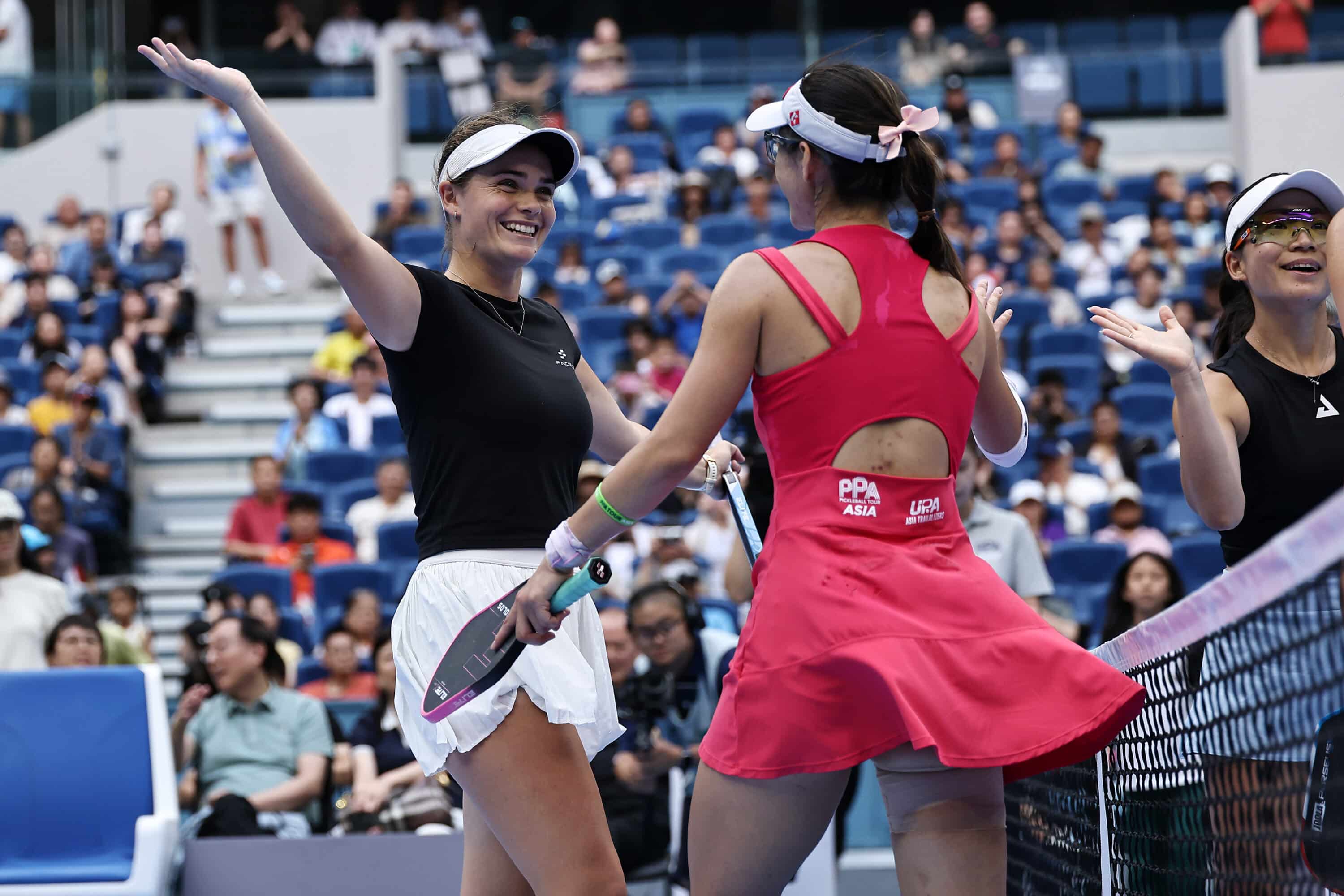
The last match in Jinan was the one the organisers would have chosen. On 7 October, in the mixed doubles final at the Shandong Provincial Sports Centre, Long Yufei and Li Zefeng of China beat Kim Eunggwon and Kwon Mihae of South Korea, Qilu Evening News reported, after “a fierce battle”. Kim had already won the men’s singles. Earlier the same day Li and Miao Yaxuan won the men’s doubles, an all-Chinese pair, and Long won the women’s doubles with Hong Kong’s Tang Nok Yiu.
Three titles out of five, at the first PPA 125 event ever played in mainland China. It is a good headline, and it raises an awkward question. Half the places in those draws had been set aside for Chinese players before a ball was hit.
What exactly is the rule?
It is simpler than it sounds. Ahead of Jinan, Shandong’s sdnews set out the mechanism. Domestic players did not need PPA points earned abroad. They could enter the pro draw on CPC points (the China Pickleball points system certified by the national association) and be seeded according to their CPC ranking. Each pro event had a 32-player main draw, and “the places available via CPC points and CTA wildcards account for half the draw”. In other words, 16 of 32. According to sdnews’s results report, the format was a 32-player main draw and a 16-player qualifying draw, single elimination, with bronze-medal matches.
The stated reason is cost. “Previously, domestic athletes taking part in international professional pickleball events had to go overseas to accumulate points, at considerable expense,” the report said. The goal is a route the association summarises in four steps: train at home, compete at home, convert the points, progress internationally. A PPA 125 champion earns 125 world-ranking points like anyone else.
The body behind it is the Chinese Tennis Association, which runs pickleball in China. It approves the events, allocates the places and handles what sdnews calls “points linkage” between CPC and PPA.
Does the half-draw rule apply in Nanjing?
Not on the published evidence, at least not explicitly, and that distinction matters. The Yangtse Evening Post’s opening-day report from Nanjing says domestic players can enter the pro draw directly on CPC points, and that “CPC and PPA points are equally valid and together form the core basis for pro-draw entry”. It does not mention a 50% allocation or CTA wildcards. CRI’s preview sets out the prize money and age groups but says nothing about the draw split. The CTA’s own notice was unavailable when we tried it (the site returned an error), and the PPA Tour Asia event page still shows placeholder matches rather than a draw.
So the fair statement is this. In Jinan, half the draw was reserved. In Nanjing, CPC points count the same as PPA points, and whether a fixed quota sits on top of that has not been published. I’d expect it does, because the two events were announced together as a pair. But I can’t show it, so I won’t claim it.
Notice the change in wording, though. “Half the draw” is a quota. “Equally valid points” is an exchange rate. The first protects home players. The second treats a CPC point as worth a PPA point. That is a far bigger claim about the strength of Chinese domestic pickleball, and one the rest of the tour has never been asked to accept.
Is Nanjing really the fifth?
Yes. The count adds up. The Yangtse Evening Post calls Nanjing “the fifth PPA event held in China since the CTA brought in PPA events in December 2025”. Sdnews gives the list: Hangzhou in 2025 (the first, in December), then PPA 500 events in Beijing and Shenzhen this year, then the two PPA 125 Challengers in Jinan and Nanjing. Hangzhou, Beijing, Shenzhen, Jinan, Nanjing makes five in eleven months.
That is a fast build. Sdnews adds that 2027 applications are under way and, citing the association’s website, that the plan is to bring in “a higher-level PPA 1000 event” next year. “Planned” is the honest word. No city or date has been announced.
Is this a pathway or a protected market?
The conventional view outside China will be that reserving half a draw for home players is a protected market: easier points for locals, fewer places for the travelling pros who make PPA Asia a tour. That view deserves a fair hearing, and then a test.
The case for “protected” is real. A 125 event’s points count on the same world ranking as everyone else’s. If 16 of 32 places go to players who might not have made the draw on PPA points, some ranking points will be easier to earn in China than in Singapore or Manila. Over a season, that adds up.
The case for “pathway” rests on two points. First, the rule only covers entry. Once in the draw, a CPC entrant still has to beat whoever is across the net, and the Korean and Hong Kong winners in Jinan show that the visitors were not filler. Kim took the singles title and two silvers, as Times Now recorded, and Tang won the women’s singles.
Second, the level is limited. These are 125 events, the bottom of the PPA ladder, with a US$15,000 pro purse in Nanjing according to CRI. The rule does not reach Beijing or Shenzhen, where the published reports describe no quota.
My verdict: on the evidence of Jinan, it’s a pathway. Chinese players won three titles out of five. But neither singles title went to a mainland player, and that is where the point-for-point strength of a domestic system is most exposed. Doubles rewards understanding with a partner you know. Singles shows whether the ranking points were earned against the right level of opponent.
Did the CPC entrants actually win matches?
This is the question that settles the argument, and the honest answer is that nobody can show it yet. We wanted to count the CPC and wildcard entrants in Jinan and Nanjing and compare their win rate with PPA-ranked entrants. The published reports name winners, not entry routes. No draw we could find marks which players came in on CPC points, and the Nanjing results feed is not yet live.
We can be precise about what we do know. Long Yufei, Li Zefeng and Miao Yaxuan won titles in Jinan. Long had already played at the PPA Asia level; she appears in PPA Tour Asia’s own Beijing Open photographs. So the Chinese winners in Jinan were not obviously first-timers who used the quota. That cuts both ways. It suggests the best Chinese players don’t need the shortcut, which makes you ask who it is for.
One correction to the publicity. Ahead of Jinan, organisers listed “王康杰、梁豪天、李泽锋、龙雨飞、金应权” among the headline players. The last of those, 金应权, is Kim Eunggwon, the Korean who won the singles, not a Chinese entrant. Reading Chinese-language coverage, that is the kind of thing that is easy to miss, and it inflates the sense of a home-grown field.
Why does China want this?
Because it is building infrastructure faster than it is building players. CRI’s preview lists the Nanjing build-out: the Big Blue Whale pickleball centre in Hexi opened in March, 11 international courts at the Golden Eagle World sky sports park in late May, four more at Jiangdao Sports Park in August. Nanjing’s 2026 policy commits to 40 new or rebuilt ball-sport courts that include pickleball. Jiangsu’s 15th Five-Year sports plan names pickleball as a priority “trend sport”.
The Nanjing event drew more than 600 players, according to the Yangtse Evening Post. Alongside the pro draw there is an amateur division in four age bands with a ¥45,000 purse and a university team event worth ¥10,000. Ticket stubs earn discounts at 36 hotels and 10 scenic sites. This is sport as city policy, and the pro draw is the shop window.
In that setting, a pro draw full of travelling Americans and Australians would be a fine event and a poor policy. A draw where half the faces are Chinese is the point. The CPC route is how the state’s investment in courts turns into players with world rankings.
What does it mean for the rest of Asia, and for Europe?
For Asia, it sets a template. Vietnam, the Philippines, Korea and India all have growing domestic circuits and the same problem: good local players, expensive flights. If PPA Tour Asia accepts that CPC points are “equally valid”, the obvious question from Hanoi or Manila is why their national points shouldn’t be. That is a negotiation the tour may not want, and it will have to have it anyway.
For Europe, which has its own argument about whose rankings count, the Chinese model is worth watching for a different reason. It shows a federation using a commercial tour’s ranking system as a lever, rather than competing with it. Whether you think that’s clever or cynical probably depends on which federation you belong to.
What should we watch next?
Three things. First, the Nanjing draw: whether it shows the entry route next to each name, and whether the quota is confirmed. Second, the results: how CPC entrants do in the first two rounds, where the real test lies, rather than on finals day. Third, the PPA 1000. If China gets a 1000-level event in 2027 and the CPC route applies there too, this stops being a development programme and becomes a ranking question for the whole tour.
For now, the rule has one tournament of results behind it and a promising one. Half the draw was reserved in Jinan. Three of the five trophies stayed home. The singles trophies didn’t. That last fact is the one to remember when Nanjing’s results arrive. A pathway is judged by where it leads, not by who it lets in.


