
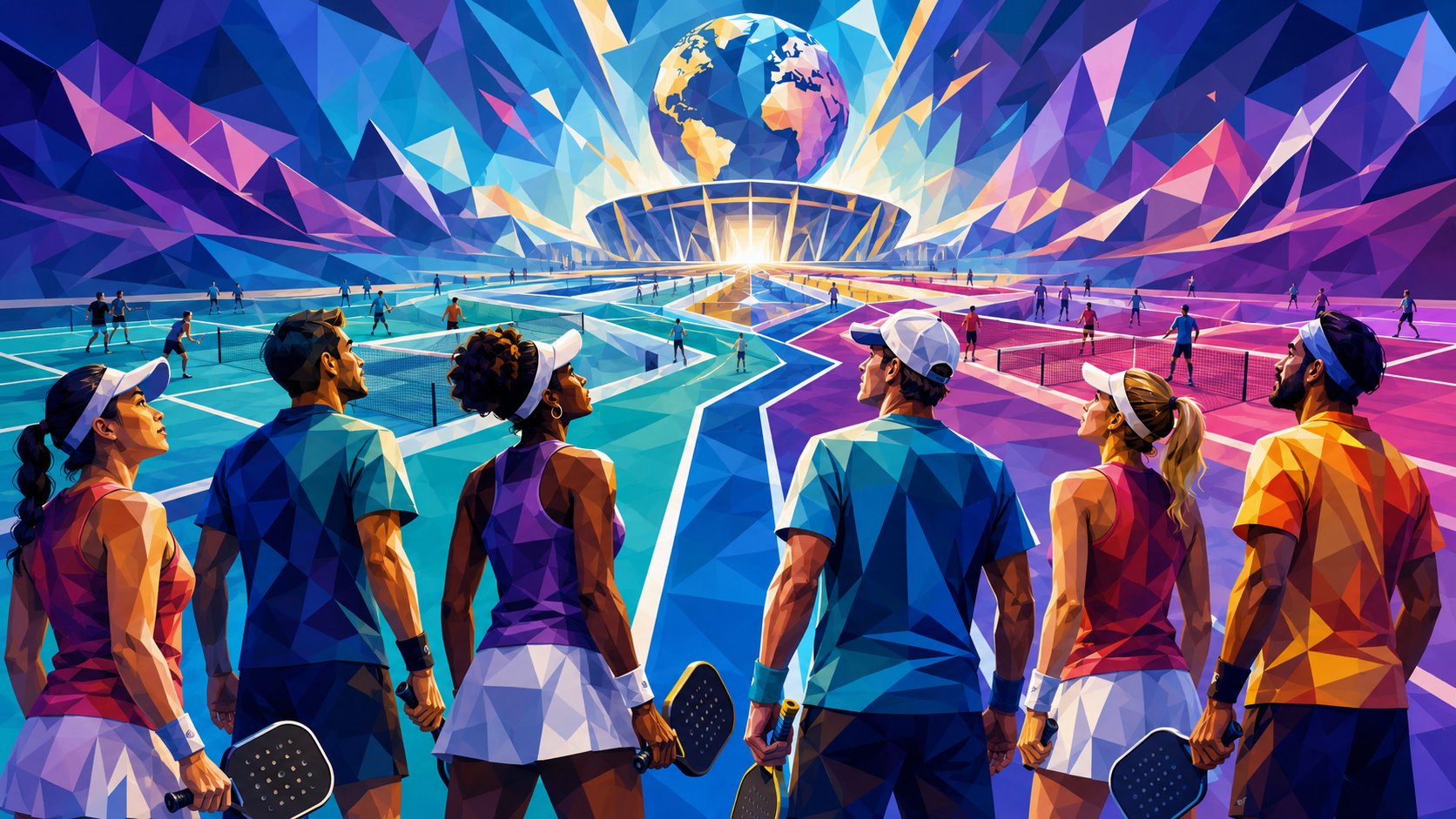
More than 60 players responding to a World Pickleball Magazine community discussion said they would welcome pickleball into the Olympic Games. Their enthusiasm is clear—but popularity cannot compensate for a sport still working to establish unified international leadership.
By Sarah Leaver
Key Takeaways
- More than 60 respondents to an informal WPM community discussion supported pickleball joining the Olympics.
- Popularity alone is insufficient: international governance, anti-doping, competitive integrity and geographical reach all matter.
- Brisbane 2032 is the earliest plausible target, but pickleball does not yet have a defensible Olympic date.
Pickleball players rarely struggle to make the case for their sport.
It is accessible, competitive and social. It can be learned quickly but takes years to master. It produces long rallies, rapid exchanges and the kind of tension that makes players stop whatever they are doing to watch the court next to them.
Ask whether it belongs in the Olympics and the enthusiasm becomes even easier to find.
More than 60 people responding to an informal World Pickleball Magazine community discussion said they would like to see pickleball added to the Games. Some recognised that it could take years. Others believed divisions between the sport’s governing bodies presented a greater problem than its playing credentials.
One respondent distilled the debate rather differently.
“Any sport that I’m good at shouldn’t be an Olympic sport.”
Behind the humour, however, is a serious question.
Pickleball has already persuaded millions of people that it deserves to be played. Can its institutions persuade the Olympic movement that it is ready to be governed as one international sport?
The Community Appears Ready
The case made by players is straightforward.
Pickleball is fast, strategic and relatively easy for a new viewer to understand. Matches can be staged inside or outside, and the court requires less space than tennis. Singles and doubles would provide several possible Olympic formats, while mixed doubles would fit the Games’ increasing emphasis on gender-balanced competition.
Its supporters also believe it could translate well to television. The ball is slower than a tennis ball, but the exchanges at the kitchen line are quick, confrontational and tactically complex. Close-up camera angles and replays can reveal decisions that happen too quickly for a spectator watching from behind the court.
The sport is also expanding beyond its North American base.
Professional tours have moved into Asia, Australia and other international markets. National federations, clubs and independent tournament operators are forming in a growing number of countries. Players are increasingly able to build careers across several regions rather than remaining within one domestic system.
That international development can be seen in stories such as Yuta Funemizu’s historic victory in Tokyo, as regional competition begins producing players and milestones with significance beyond the United States.
That growth matters. The Olympics cannot add a sport simply because it is popular in one commercially valuable country.
But an enthusiastic response from a community discussion is not evidence of a worldwide Olympic audience. Nor does rapid recreational growth automatically establish the governance, competitive depth or integrity systems expected of an Olympic sport.
The players may be ready to watch. The more difficult question is whether pickleball is ready to apply.
Popularity Is Only the Beginning
The Olympic programme is not a popularity contest.
A sport seeking recognition must demonstrate far more than rising participation. It needs credible international governance, national organisations across a meaningful geographical spread, established competition, clear rules and structures capable of protecting athletes and the integrity of results.
Anti-doping compliance matters. So do safeguarding, financial transparency, independent decision-making and the ability to stage qualification fairly across different continents.
Pickleball can point to growth in many of those areas. What it cannot yet present is an entirely settled international structure.
That is the central obstacle.
The Global Pickleball Federation has pursued international recognition and describes Olympic inclusion as one of its priorities. Elsewhere, the International Pickleball Federation and World Pickleball Federation completed a merger intended to create a more unified organisation.
Those developments indicate movement towards consolidation. They do not yet amount to one universally accepted global authority.
Further unification efforts have been announced, but pickleball still has multiple organisations, alliances and commercial interests attempting to shape its international future.
To players focused on their local courts, those distinctions may feel remote. To the Olympic movement, they are fundamental.
It must be clear who sets the rules, who represents participating nations, who administers international competition and who can be held accountable when something goes wrong.
A sport cannot make one Olympic case while speaking through several competing voices.
“The Politics Could Hold It Back”
Several contributors to the WPM discussion understood that tension.
They wanted to see pickleball in the Olympics but worried that the politics surrounding its governing bodies could delay—or even derail—the process.
That concern is more substantial than the familiar argument that the Games already contain enough racket and paddle sports.
Tennis, badminton and table tennis each have distinct histories, playing characteristics and international competition structures. Pickleball would not be excluded simply because athletes hit an object over a net.
One sceptical respondent was unconvinced.
“The day hitting a plastic ball with a plastic bat becomes an Olympic sport is the day the Olympics is over.”
Every emerging sport encounters some version of that dismissal. Snowboarding, skateboarding, sport climbing and breaking have all challenged traditional ideas of what belongs at the Games.
Pickleball does not need to prove that it resembles an existing Olympic sport. It needs to demonstrate that it can offer elite international competition on its own terms.
That means producing more than recreational participation figures. It needs strong national championships, credible continental competition and events in which leading players from different systems meet under commonly accepted rules.
Olympic inclusion should be the result of that development—not a substitute for it.
Could Brisbane 2032 Be Possible?
Los Angeles 2028 is no longer a realistic target. Its additional sports have been selected, with baseball and softball, cricket, flag football, lacrosse and squash joining the programme.
Brisbane 2032 is therefore the earliest Games around which pickleball supporters can construct a plausible conversation.
The IOC approved a new methodology for determining the Olympic programme in June 2026. It will be applied for the first time to Brisbane 2032 and is intended to make future programmes more relevant, flexible and sustainable.
That creates an opportunity. It does not create a promise.
Australia has a growing pickleball community, which may strengthen the local argument. But the host’s interest would be only one part of the process. Pickleball would still need the international organisation, competitive credibility and governance standards required to present a serious case.
Six years may sound like a long time. In international sports administration, it is not.
Recognition processes, federation alignment, anti-doping systems and qualification structures cannot be assembled in the months before an Olympic decision. They have to be operating—and trusted—well in advance.
Brisbane is best understood as the earliest possible target, not the most likely one.
Predicting 2036 would be equally premature. Pickleball does not yet have a defensible Olympic date.
What Has to Happen Next
The route forward is clearer than the timetable.
First, the sport needs one international governing structure capable of securing broad support from national federations. That does not mean every administrator must agree on every issue. It means countries must know which organisation legitimately represents the sport.
Second, pickleball needs a stronger calendar of international competition organised around nations and regions—not only commercial tours built around individual professionals.
Third, its rules, equipment standards, ranking systems and qualification processes must become sufficiently consistent for athletes from different countries to compete on equal terms.
Finally, the sport must demonstrate that its growth is durable. Court construction, coaching systems, youth development and national participation will ultimately carry more institutional weight than social-media excitement.
None of that is as immediately appealing as imagining a gold-medal match.
It is, however, the work that makes such a match possible.
The Dream Is Real. The Date Is Not
The WPM community response revealed something important.
Players are not merely enjoying pickleball as a social activity. Many believe it deserves to be treated as a serious international sport, watched by a global audience and contested at the highest level.
That belief should not be dismissed.
Neither should it be confused with Olympic readiness.
Pickleball’s playing community has expanded faster than its international institutions. Its professional game is travelling into new markets, but its global leadership is still being consolidated. Its supporters can imagine an Olympic tournament more clearly than its administrators can currently present one unified route towards it.
So, is pickleball heading for the Olympics?
Possibly—but “when” is not yet the right question.
The more urgent question is whether the organisations leading the sport can stop competing for authority long enough to build the international structure Olympic recognition demands.
The players have made their enthusiasm clear.
Now pickleball has to make its case.
Further Reading
- Latest pickleball news from around the world
- Tournament coverage and results
- Rankings and player profiles
- Regional pickleball coverage

Sarah Leaver
EditorSarah Leaver is part of the World Pickleball Media Academy, a contributor programme designed to develop emerging sports media talent.
View All Articles →

