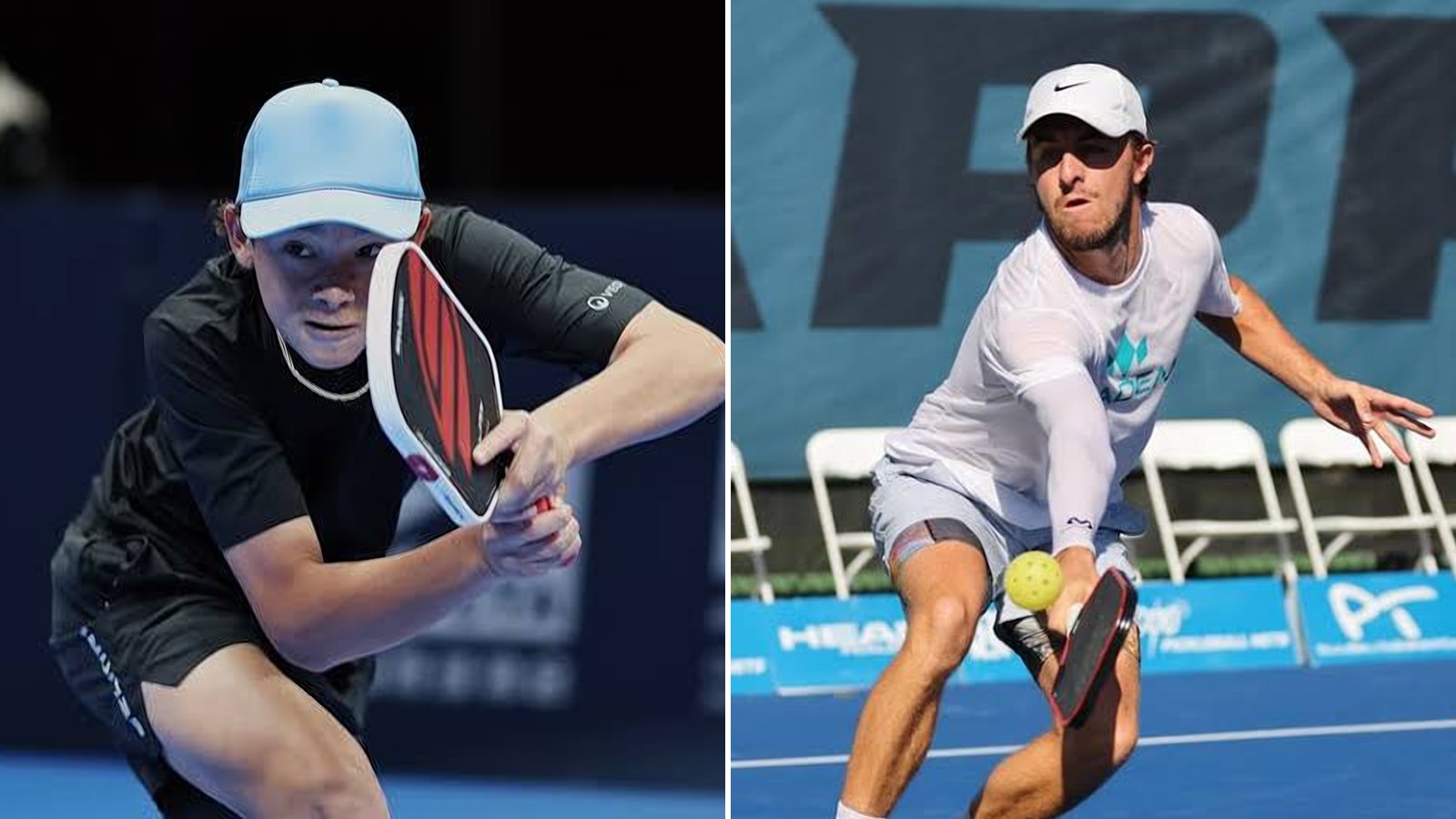
Main image: Tama Shimabukuro (left) and Hunter Johnson. Photos: supplied
The short answer: Hunter Johnson beat Tama Shimabukuro 11-4, 6-11, 11-7 in the Hong Kong Slam men’s singles final on 25 October, levelling their head-to-head at 1-1 after Shimabukuro won their Atlanta semi-final in May. It is the best rivalry men’s singles has, and the sport should start treating it that way.
In Atlanta in May, the crowd did something pro pickleball crowds rarely do: it picked the outsider and refused to let him lose. “This is the loudest crowd I’ve ever heard at any PPA event,” the PickleballTV analyst Matt Manasse said during the semi-final. Shimabukuro, then a 15-year-old seeded 22nd, had missed his way through a second game against the No 3 seed, Hunter Johnson. Then he won the third 11-1, as pickleball.com and The Dink reported.
“The crowd definitely got me through that third game,” he said afterwards. “In the second, I started missing a little bit but when the third game started, the crowd started going crazy, and that definitely hyped me up.”
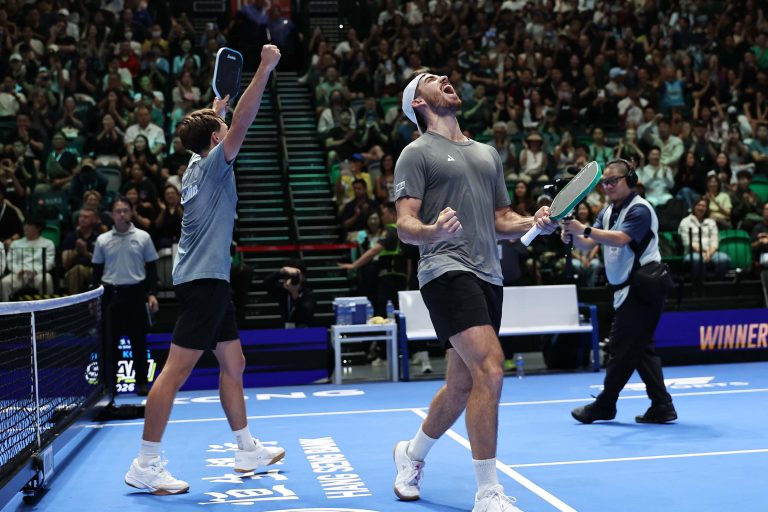
Five months later at Kai Tak Arena, Johnson got his answer. He won the opening game of the Hong Kong final 11-4, lost the second 11-6, and closed out the decider 11-7, according to pickleball.com‘s report and ThePickleBase. One win each. Two three-game matches. The first two chapters of what ought to be the defining story of men’s singles over the next five years.
Why does Johnson v Shimabukuro matter?
Because men’s singles has been short of stories that people outside the sport could follow. It has had dominant players and good matches, but not a rivalry with an obvious shape. This one has a shape anyone can grasp: the established champion against a teenager who has already beaten him and who plays as if he does not know he is supposed to be nervous.
Look at what each brought to Hong Kong. Johnson arrived having won in Brisbane a week earlier, where he led Christian Alshon 7-0 in the third game of the final, trailed 8-7 and still won 11-8. That is a player whose game holds up after his lead has collapsed. In Hong Kong he came from a game down to beat Federico Staksrud 3-11, 11-8, 11-5 in the semi-final. He is now a serial three-game winner, which is not the same as a lucky one.
Shimabukuro, meanwhile, beat Noe Khlif 11-8, 11-2 in his semi-final and has spent 2026 turning a promising teenager into a fixture: a first PPA Tour final in Atlanta after beating Staksrud on the way, a run in Kuala Lumpur, ninth pick in the US MLP draft and first overall to the Viet Panthers in MLP Asia. Every team that has had a chance to bet on him has done so.
Is Shimabukuro already Johnson’s equal?
Not yet, and the Hong Kong final showed why. Johnson’s 11-4 opening game was the sound of a player who had studied what went wrong in Atlanta. When Shimabukuro took the second, it was the older man who absorbed the momentum swing rather than chasing it. In Atlanta, the decider was a rout the other way. In Hong Kong, Johnson kept it at arm’s length. That is experience, and it is the one thing the 15-year-old cannot speed up.
But the trend is not in Johnson’s favour, and he seems to know it. “We’re probably going to meet each other a ton more times, hopefully in the finals,” he said after Hong Kong. “[Tama] definitely has a bright future, as does the sport of pickleball.” That is generous, and it is also accurate. Johnson’s best years are now. Shimabukuro’s have not started.
What should the tour do with it?
Sell it. Pickleball’s governing bodies and broadcasters spend a lot of energy explaining why the sport is growing. They spend much less on giving casual viewers a reason to watch a particular match. Tennis built its global audience on rivalries. Pickleball has one forming in front of it, between an American star and a Japanese teenager who has just been the most sought-after player in an Asian league draft. It also crosses the two halves of the tour, US and Asia, more neatly than any marketing campaign could.
That means putting their matches on the main court, building broadcast packages around the head-to-head, and resisting the temptation to bury men’s singles behind the doubles at the big events. It also means remembering that Shimabukuro, by pickleball.com’s account, is still only 15. His schedule, and how much of it is spent crossing time zones for team events, is a matter of long-term welfare as well as box office.
The third meeting will tell us more than either of the first two. If Shimabukuro wins it, the conversation about who leads men’s singles will start earlier than anyone expected. If Johnson wins, he will have shown that he can manage the threat, not just survive it. Either way, it is the match the sport should want most.
Johnson v Shimabukuro: the head-to-head
- Atlanta Pickleball Championships, semi-final, 2 May 2026: Shimabukuro (22) bt Johnson (3) 11-7, 8-11, 11-1
- Hang Seng Bank Hong Kong Slam, final, 25 October 2026: Johnson bt Shimabukuro 11-4, 6-11, 11-7
- Head-to-head: 1-1
Frequently asked questions
Hunter Johnson beat Tama Shimabukuro 11-4, 6-11, 11-7 in the final on 25 October 2026.
One win each. Shimabukuro won their Atlanta semi-final 11-7, 8-11, 11-1 in May 2026, and Johnson won the Hong Kong Slam final in October.
He was 15 when he beat Johnson in Atlanta in May 2026 and when he reached the Hong Kong Slam final, according to pickleball.com.

Chris Beaumont
Founder and Editor-in-ChiefChris Beaumont is the founder and Editor-in-Chief of World Pickleball Magazine. Chris follows the global game closely, reporting on the latest news, developments, stories and tournaments from all five continents. He also hosts the World Pickleball Podcast, interviewing people at…
View All Articles →