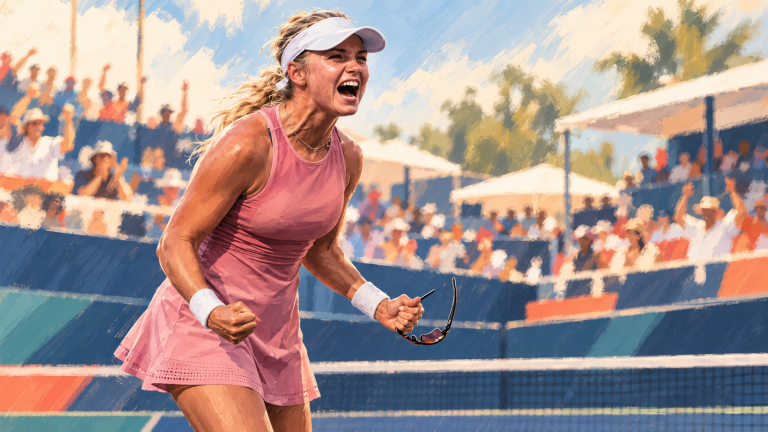

Tama Shimabukuro arrived in Atlanta as an exciting teenage prospect. He left looking like something far more significant: one of the clearest signs yet that professional pickleball’s next generation is arriving much faster than expected.
- Fifteen-year-old Tama Shimabukuro made deep runs in both men’s singles and men’s doubles at the Atlanta Pickleball Championships
- His run showed the rise of players developed inside pickleball rather than converted from other racket sports
- His appearance on the Pickleballers podcast added useful insight into how calmly he handled the moment
By the second half of the week in Atlanta, opponents had largely stopped reacting to Tama Shimabukuro like a curiosity.
That may have been the most revealing part of his tournament.
At 15 years old, the Hawaiian entered the Atlanta Pickleball Championships carrying obvious intrigue. Young talents breaking into professional pickleball still attract attention, particularly at a Slam-level event on the PPA Tour calendar.
But somewhere across the course of the week, the conversation shifted.
The focus moved away from his age and towards the level itself.
Atlanta Felt Different
Shimabukuro’s run was not a vague “good week” story. It had real weight.
In men’s singles, he reached Championship Sunday as the No. 22 seed, beating No. 2 seed Federico Staksrud in three games before later defeating No. 3 seed Hunter Johnson in the semi-finals. In men’s doubles, he and Yuta Funemizu also made a deep run, including a notable win over Hayden Patriquin and Christian Alshon.
That is why the performance mattered.
It did not feel like a teenager briefly riding momentum before reality arrived. Match after match, Shimabukuro looked increasingly comfortable inside the pace, pressure, and emotional demands of elite professional play.
A few years ago, the idea of a 15-year-old becoming a genuine factor deep into a major professional pickleball event would have felt unrealistic.
In Atlanta, it increasingly felt inevitable.
A Different Kind Of Pickleball Player
Shimabukuro’s movement around the kitchen line, willingness to absorb pressure exchanges, and comfort during fast transition points all reflected something slightly different from the sport’s earlier generations of professionals.
The first generation of elite pickleball players largely learned the sport after arriving from elsewhere, particularly tennis.
Shimabukuro belongs to a different wave entirely.
These are players developing inside pickleball itself from a young age. Their instincts are shaped by the sport’s patterns rather than adapted into them later.
That changes things.
The hands become quicker earlier. Resets become more natural. Transition movement becomes instinctive rather than learned through conversion from another racket sport.
Atlanta felt like one of the clearest examples yet of that shift happening in real time.
The Pickleballers Podcast Offered Another Clue
Part of the wider reaction to Shimabukuro’s week also came through his appearance on the Pickleballers podcast with Roscoe Bellamy and Jared Paul after the tournament.
Rather than sounding overwhelmed by the scale of the moment, Shimabukuro discussed the week with a composure that mirrored the way he had carried himself throughout the event itself.
He spoke about handling pressure, competing deep into a Slam-level tournament, and adjusting to the attention that followed his performances in Atlanta.
That tone mattered.
Because part of what made the Atlanta run feel important was not simply the results. It was how normal Shimabukuro often made the level appear.
If you’re following how the global game is shifting week by week, the World Pickleball Report breaks this down every day in our morning briefing.
The Men’s Game May Already Be Changing
The deeper significance of Atlanta extends beyond one player or one tournament.
Professional pickleball is now beginning to produce athletes who have spent years developing specifically for this sport rather than arriving after careers elsewhere.
That evolution matters because it changes the technical ceiling of the professional game.
The current elite generation is still extraordinarily strong. But players like Shimabukuro are arriving with different instincts, different movement patterns, and increasingly fewer reasons to feel intimidated by established names.
That creates a very different competitive environment from the one professional pickleball had even three or four years ago.
And it may accelerate the sport faster than expected.
Because once one teenage player proves this level is reachable, others tend to follow quickly behind.
What It Means
Atlanta may not ultimately be remembered as the week Tama Shimabukuro arrived.
It may be remembered as the week the rest of the men’s game realised how quickly the next generation was already catching them.
For a clearer view of where the sport is heading each month, you can download the latest free issue of World Pickleball Magazine.
Further Reading
- Latest pickleball news from around the world
- Tournament coverage and results
- Rankings and player profiles
- Regional pickleball coverage

Chris Beaumont
Founder and Editor-in-ChiefChris Beaumont is the founder and Editor-in-Chief of World Pickleball Magazine. Chris follows the global game closely, reporting on the latest news, developments, stories and tournaments from all five continents. He also hosts the World Pickleball Podcast, interviewing people at…
View All Articles →