Major League Pickleball publicly promoted Zane Navratil’s confrontation with Casey Diamond after Navratil admitted that he had taken it too far. The contradiction exposes the difficulty of building a league around emotion without explaining where its boundaries lie.
Key Takeaways
- MLP shared Navratil’s celebration with the caption “Let ’em hear you, Zane!” after he yelled towards Diamond following a body attack.
- Navratil later apologised to Palm Beach and acknowledged that he had exceeded the balance between creating energy and respecting opponents.
- All four higher seeds advanced from Dallas, but the repeated 2–0 series scores concealed several closely contested matches.
- Dallas extended its winning run to 13 matches, while Sofia Sewing went unbeaten and Texas won two DreamBreakers against Atlanta.
Zane Navratil’s backhand counter struck Casey Diamond high on the shoulder. From that distance, there was little Diamond could do except turn away and absorb it.
The shot was hard, deliberate and legitimate. Body attacks are part of professional doubles, particularly when four players are exchanging the ball from either side of the kitchen. Diamond had left an available target. Navratil found it.
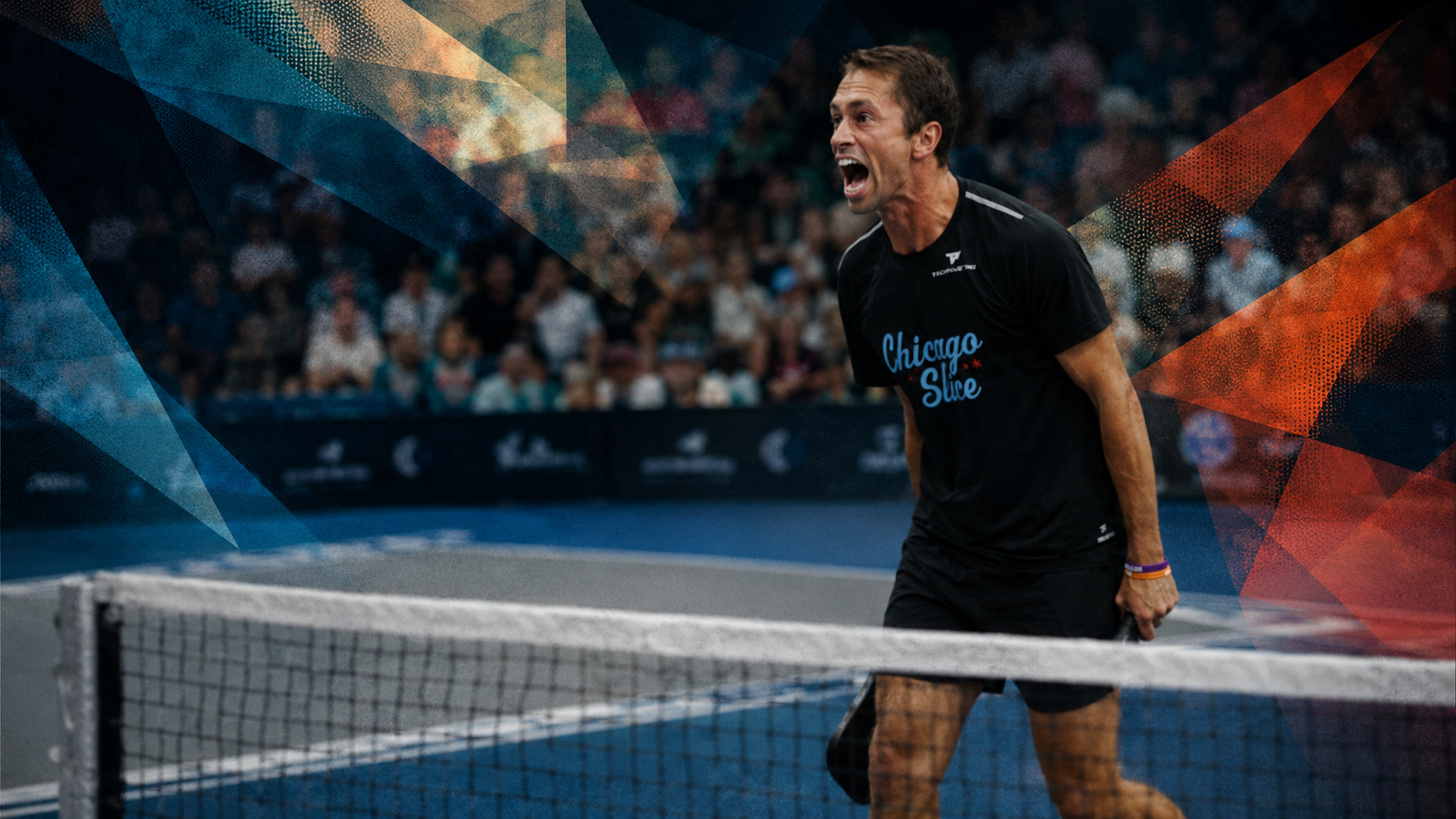
Then Navratil stepped forward and roared directly towards him.
Palm Beach’s bench was on its feet almost immediately. Diamond walked away, smiling at first, although the mood around the court had changed. What might have remained an aggressive piece of playoff pickleball became the most discussed exchange of Major League Pickleball’s opening postseason round in Dallas.
The league’s own social account later shared the clip with the caption: “Let ’em hear you, Zane!”
Navratil reached a different conclusion. In a message sent to The Kitchen, he acknowledged that he had “exceeded that balance” between expressing emotion and maintaining respect for opponents. He said that he had apologised to the Palm Beach team for taking things too far. Dekel Bar, watching from the Royals’ bench, called the behaviour “embarrassing and unhinged” on Instagram and said Navratil had crossed the line more than once.
The disagreement is interesting because MLP does not have a problem with emotion. Emotion is one of the foundations upon which the league has been built. It places teammates beside the court, turns individual tensions into collective ones and gives players permission to behave in ways that would look peculiar during an ordinary doubles match on the professional tour.
Dallas showed why that works. It also exposed how complicated the arrangement becomes when the league promotes a moment that one of the participants later accepts went too far.
MLP does not need to choose between passion and restraint. It does, however, need to be clearer about what happens when the competitive theatre it encourages becomes directed at an opponent.
What Actually Crossed the Line?
It is worth separating the shot from the reaction because much of the argument after the match failed to do so.
Players attack the body because it is often the percentage play. The paddle-side shoulder, dominant hip and space around the hitting elbow are difficult areas to defend at speed. A player who tries to avoid every physical exchange in the interests of courtesy will not remain at professional level for long.
Nor was Navratil required to apologise for enjoying the point. MLP would lose much of its appeal if players responded to playoff pressure with a nod and a walk to the baseline. Chicago Slice were playing to preserve their season. Navratil had won an important exchange and wanted to lift his teammates.
The objection arose from what he did with that emotion.
His shout was not released towards the Chicago bench or into the crowd. It followed the path of the ball. Diamond had been struck, turned away and then found Navratil advancing towards him while yelling. The sequence made the celebration look less like a response to winning the rally and more like an extension of the attack after the rally was over.
The distinction is subjective, but it is not imaginary. Players make it every week. A fist pump towards one’s own team is understood differently from a gesture towards an opponent. A yell made in celebration is not received in the same way as one delivered from close range towards somebody who has just been hit. Timing, distance and direction alter the meaning.
The 2026 USA Pickleball rulebook allows referees to issue verbal or technical warnings for minor unsportsmanlike conduct, including objectionable language directed at another person and other behaviour falling within that category. MLP, however, operates under its own MLPlay rules. Its publicly linked rules guide does not make the league’s position on direct taunting easy for supporters to establish, and MLP had issued no public explanation of the Dallas incident by 10 August.
The question is therefore less about demanding another rule than about transparency. Do players and officials share a clear understanding of when a celebration becomes misconduct? If they do, what are officials expected to do, and why was there no visible intervention in Dallas?
MLP’s social post made the uncertainty sharper. By presenting the clip as entertainment, the league appeared to endorse the whole exchange. Navratil’s apology then supplied a more restrained reading than the competition itself had offered.
This does not require a disciplinary drama. An official warning would not have transformed the playoff round, and an apology may be sufficient in this instance. Yet the next player might respond differently. Diamond walked away. Another opponent could step forward, leaving officials to restore order only after a boundary has been negotiated at close quarters.
That is why Dallas matters beyond a single shout.
MLP Has Created Different Emotional Conditions
Team pickleball changes the pressure around a point.
On the individual tour, defeat belongs mainly to the two players on court. In MLP, a poor passage can jeopardise the work of an entire roster. Teammates are watching from a few feet away. Owners and general managers have invested in the result. A player may be facing somebody who was traded, released or selected in a draft decision that reshaped both teams.
The format gives ordinary sporting moments a history. That attempt to turn a travelling competition into a coherent league has been central to MLP’s developing identity in 2026.
Kaitlyn Christian’s final point against the Atlanta Bouncers carried one such history. Atlanta had acquired her from Texas in February, only to send her back to the Ranchers as part of a three-team trade in June. Now she had the opportunity to help eliminate the franchise she had represented earlier in the season.
Christian celebrated when the ball landed beyond the reach of her opponent. Her teammates poured onto the court. It was plainly personal, in the sense that the result meant more because of what had happened earlier in the season, but the score had expressed the answer for her.
That was MLP at its best. The league had created the conditions for a compelling moment without needing anybody to pretend that the trade had been forgotten.
The opening playoff round offered several versions of that tension. All four higher seeds advanced by winning their series 2–0, but the repeated scoreline hid four rather different contests. Brooklyn survived the kind of opening match that can unsettle a favourite. Dallas played with the assurance of a team that has almost forgotten how to lose. Palm Beach had to keep its composure during the weekend’s most antagonistic exchange. Texas repeatedly handled the peculiar pressure of the DreamBreaker.
Those were not incidental stories surrounding the Navratil incident. They showed the range of emotions MLP already produces when the competition is allowed to do the work.
Brooklyn Survive the Match That Could Have Changed Everything
Brooklyn Pickleball Team came within two points of losing the opening match of their series against the SoCal Hard Eights.
SoCal were already weakened by the absence of Armaan Bhatia, who missed the series with a knee injury, yet pushed the fifth seeds into a DreamBreaker and reached 22–22. At that point, the regular-season table offered Brooklyn no protection. One exchange could give SoCal the first match and change the emotional terms of the series.
Jackie Kawamoto provided the difference. She won the final two points and outscored Meghan Dizon 8–2 across their singles rotations, giving Brooklyn the margin they needed to escape 24–22.
It was the sort of moment that reveals why the DreamBreaker remains MLP’s most volatile device. A team’s doubles quality can bring it to the brink of victory, only for the competition to be reduced to a sequence of singles match-ups, some of which it has spent the entire evening trying to conceal.
Brooklyn were more convincing in the second meeting and closed the series in regulation, but that control came after SoCal had missed their chance to alter the weekend. The Hard Eights found a way to make the higher seed uncomfortable. They could not turn discomfort into the lead that might have made Brooklyn question themselves.
No confrontation was required. The pressure was visible in the score and in the increasing importance of every singles rotation as the DreamBreaker tightened.
Dallas Are No Longer Behaving Like a Sixth Seed
The Dallas Flash encountered their own warning against the Las Vegas Night Owls.
Las Vegas won women’s doubles in the opening match and kept men’s doubles close. Dallas then took control through mixed doubles, winning those games 11–4 and 11–1 to complete a 3–1 match victory.
The second meeting was far less forgiving. Dallas won 3–0, taking the games 11–5, 11–2 and 11–1.
The Flash have now won 13 consecutive matches, a sequence dating back to 12 July. They arrived in the playoffs as the sixth seed because of the season that preceded the run, but that designation has become increasingly unhelpful. A team does not win 13 successive MLP matches through a fortunate draw or one favourable match-up.
The run has developed since Dallas traded Tyra Black to Columbus and received Danni-Elle Townsend and cash in return, a move WPM previously examined as a gamble with consequences for both franchises. What initially looked like a retreat from the title race has instead helped reshape it.
Dallas have learned how to recover within games and prevent one difficult pairing from spreading uncertainty through the rest of the roster. By the end of July, the winning run had already reached 11 matches and forced the league to reconsider where the Flash belonged in the championship hierarchy.
The leading four seeds must now decide which opening-round winner they would prefer to face at Newport Beach. Dallas’s official seeding makes them available. Their recent record makes choosing them a far less comfortable act.
MLP’s opponent-selection process adds another personal element to the playoffs. New Jersey, as the No. 1 seed, will choose first from Brooklyn, Dallas, Palm Beach and Texas. A high seed does not simply receive an opponent. It publicly identifies the team it regards as the most beatable.
If somebody selects Dallas after 13 straight victories, the Flash are unlikely to need help finding a reason to take it personally.
Palm Beach Keep the Weekend About the Result
The Navratil-Diamond exchange occurred during Palm Beach’s second match against Chicago, but it did not determine the series.
Sofia Sewing did more than anybody to settle that.
Sewing finished the weekend with a 4–0 individual record as the Royals won both matches 3–1. She and Diamond took their mixed doubles game against AJ Koller and Elsie Hendershot 11–9 in each meeting, twice supplying the narrow margin that stopped Chicago from extending the contest.
Those scores place the confrontation in its proper competitive setting. Palm Beach were not cruising through an overmatched opponent. The mixed games remained close enough for one short run to alter the shape of either match.
Diamond’s response was therefore significant. He had every reason to be angry, particularly with his team operating close to the margins. Instead, he disengaged. Palm Beach’s bench made its displeasure known, then the Royals returned to the part of the argument that they could settle themselves.
They won.
There is a risk, when a clip travels widely, that the player on the receiving end becomes a supporting character in somebody else’s controversy. Diamond’s weekend deserves better than that. He and Sewing twice beat Koller and Hendershot in the games that closed each match. Whatever he thought of Navratil’s behaviour, he did not allow the incident to become more important than the series.
Navratil’s apology should also be treated seriously. Professional players misjudge moments, particularly in a team environment designed to amplify every emotional swing. He acknowledged the balance he had been trying to strike and accepted that he had exceeded it. That is a more useful response than denial or the suggestion that playoff intensity excuses anything.
It also leaves MLP in an odd position. The player recognised a need for restraint after the league had used the same moment to generate attention.
Texas Give Atlanta an Answer
Texas and Atlanta produced the most competitive sweep of the round. Both matches went to DreamBreakers. The Ranchers won them 21–14 and 21–11.
All four Texas players contributed across the singles rotations. Nico Acevedo finished 12–7, while Lea Jansen and Christian both went 11–5. Eric Oncins finished 8–8.
The margins widened in the second DreamBreaker, but the pressure did not disappear. DreamBreakers ask players to move repeatedly between participation and observation. A player may win a rotation, return to the bench and then watch a teammate surrender the advantage. Tactical decisions are exposed in sequence. Every unfavourable match-up has to be survived until the rotation moves again.
Texas handled that environment twice. Atlanta could stay with them through four doubles games but could not find enough winning singles exchanges afterwards.
Then Christian completed the elimination of her former team.
There was satisfaction in her reaction and an obvious message in the result. It worked because everybody understood the background. Christian did not need to stand over an Atlanta player or explain what the point meant. The trades, the two DreamBreakers and the final score had already supplied the story.
MLP should want more moments like it. Player movement has consequences in a team league that it cannot have on the ordinary tour. The traded player can return wearing another uniform. The franchise responsible for the decision can be made to answer for it directly.
This is the emotional advantage MLP possesses. Its rivalries can be rooted in decisions rather than invented through hostility.
What Dallas Leaves Unresolved
The four winning teams now move to Newport Beach with different reasons to believe they can trouble the leading seeds.
Brooklyn survived a 22–22 DreamBreaker and then settled. Dallas extended the most imposing run in the league. Palm Beach found in Sewing a player who did not lose all weekend. Texas proved twice that their singles order could carry them through the most pressurised part of the format.
They join New Jersey, St. Louis, Columbus and Los Angeles in the quarter-finals. New Jersey enter as the No. 1 seed after defeating St. Louis in Orlando, a result that restored their place at the head of the MLP title race.
The Dallas results also showed that emotional intensity does not require disorder. SoCal pushed Brooklyn to the limit. Las Vegas threatened the league’s form team before being swept aside. Christian helped eliminate the franchise that had traded her. Diamond answered an ugly moment by helping Palm Beach complete the sweep.
That does not mean every MLP match should become polite. Team benches will protest calls, players will shout and opponents will try to unsettle one another. Body attacks will continue because they are effective. Removing those elements would leave the league less honest and less interesting.
The responsibility lies in recognising that MLP has built a setting in which feelings travel quickly. A celebration can involve entire rosters rather than the four players on court. A grievance can bring a bench to its feet. A trade made months earlier can return in an elimination match. The same structure that creates genuine theatre can turn one poor decision into a confrontation before anybody has time to reconsider it.
That makes clarity more important.
MLP should explain how its rules cover direct taunting, what officials are expected to do when it occurs and why nothing visible happened in Dallas. It should also be more careful about the incidents it promotes. A league cannot reasonably ask players to find the proper balance while treating anything that attracts attention as useful content.
Navratil’s apology prevented the incident from going any further. His wording also supplied the most honest judgement available. There was a balance, and in that moment he exceeded it.
MLP shared the clip anyway.
That contradiction, rather than the body attack itself, is what the league should resolve before the next player decides to answer back.
Further Reading
- New Jersey Answer the Biggest Question Ahead of the MLP Playoffs
- Dallas Arrive Red Hot. Orlando Will Decide Everyone Else’s Fate.
- Columbus Make Major Tyra Black Trade Gamble
- MLP’s 2026 Season Signals a Shift Towards Real League Identity

Chris Beaumont
Founder and Editor-in-ChiefChris Beaumont is the founder and Editor-in-Chief of World Pickleball Magazine. Chris follows the global game closely, reporting on the latest news, developments, stories and tournaments from all five continents. He also hosts the World Pickleball Podcast, interviewing people at…
View All Articles →