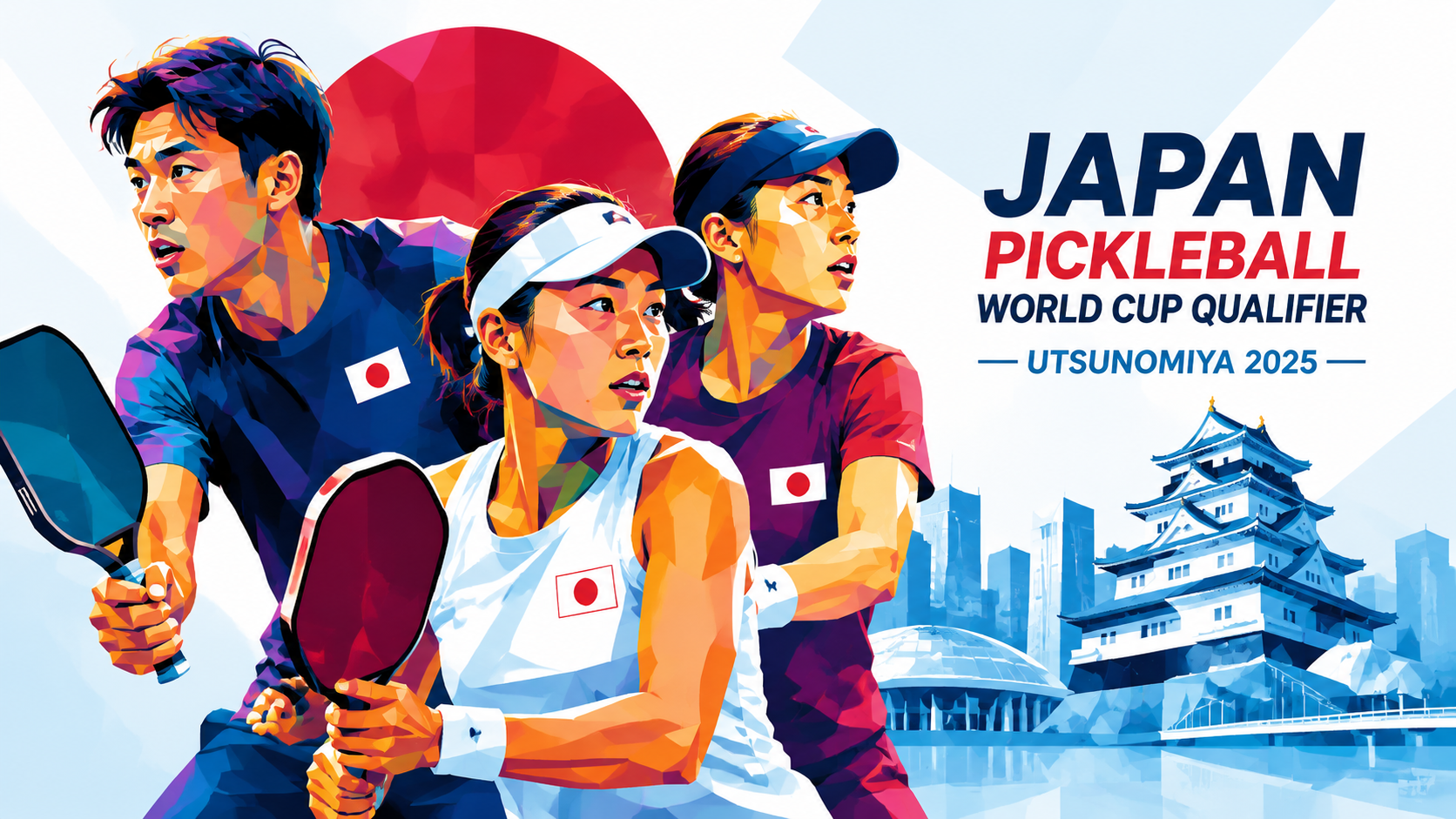
Three months after Japan’s pickleball governance unified under a single national federation, the country’s leading players have arrived in Utsunomiya with places at the 2026 Pickleball World Cup on the line. The results will decide more than just a national team.
Key Takeaways
- The KINTO Utsunomiya APP Asia Qualifier is the first major international event staged by the newly formed Pickleball Japan.
- Players are competing for World Cup selection alongside a share of a ¥2 million prize fund.
- The tournament offers an early indication of whether Japan’s governance reforms can produce a clearer national pathway.
For most players in Utsunomiya this weekend, the objective is straightforward: win enough matches to earn selection for Japan’s team at the 2026 Pickleball World Cup in Da Nang, Vietnam.
For Japanese pickleball itself, however, the stakes are rather different.
The three-day KINTO Utsunomiya APP Asia Qualifier, being played at Nikkan Arena Tochigi from July 10 to 12, is the first major international event since the Japan Pickleball Association and Pickleball Japan Federation merged in April to form a single governing body.
After a period of split administration, this is the first opportunity to see how the unified structure performs when meaningful places on the international stage are at stake.
A Merger Moves From Policy to Competition
The two organisations signed their merger agreement in March before the new structure formally took effect on April 14. Operating under the name Pickleball Japan, the governing body was created to establish a unified competitive structure and oversee the sport’s development nationally.
The aims outlined in the official unification announcement included bringing competition, rankings and player development under one organisation. Those ambitions now move beyond boardrooms and policy documents onto the court.
The immediate reward for success in Utsunomiya is a place at the World Cup, scheduled to take place from August 30 to September 6. Players are also competing for a share of a ¥2 million prize fund across men’s and women’s singles, doubles and mixed doubles.
Over three days, competitors must adapt quickly between disciplines, moving from the court coverage and physical demands of singles to the reflexes, positioning and partnership decisions required in doubles.
Cross-Sport Experience Adds Depth
The entry list also reflects a trend that continues to shape pickleball in Japan. Athletes arriving from other racquet sports are adding experience and technical quality to the domestic game.
Former soft tennis star Yuta Funemizu and former French Open doubles semi-finalist Rika Fujiwara are among the headline competitors.
Their backgrounds do not guarantee success in a different sport, particularly across a schedule that demands rapid tactical adjustments. They do, however, add further depth to a field whose leading players are competing for more than prize money.
Commercial Support and a Broader Programme
KINTO’s sponsorship has helped deliver the tournament’s prize fund and stage the event at one of Japan’s leading indoor venues.
Wheelchair divisions have also been included within the wider tournament programme, placing those competitions alongside the main singles and doubles brackets rather than treating them as a separate addition.
That support matters, but it is not the most interesting measure of success this weekend.
Governance mergers are easy to announce. They are much harder to judge. Their value is ultimately determined by whether they create clearer pathways for players, deliver stronger international tournaments and improve a country’s ability to compete beyond its own borders.
This qualifier represents the first meaningful opportunity to assess whether Japan’s new structure is beginning to achieve those aims.
Why It Matters
Japan has no shortage of talented racquet-sport athletes, ambitious organisers or commercial interest. The challenge now is turning a newly unified governing body into a system that consistently develops elite players and prepares them for international competition.
The medals awarded in Utsunomiya will help settle selection for the World Cup. Whether Japan’s new governing model proves successful will take much longer to answer.
This weekend simply provides the first meaningful evidence.
Further Reading
- Latest pickleball news from around the world
- Tournament coverage and results
- Rankings and player profiles
- Regional pickleball coverage

Noah Burns-Green
Founder and Editor-in-ChiefNoah Burns-Green is an APP Correspondent for World Pickleball Magazine and a member of the WPM Academy. Aged 21, he has recently completed his first year studying at Solent University and is developing his skills in sports journalism through regular…
View All Articles →