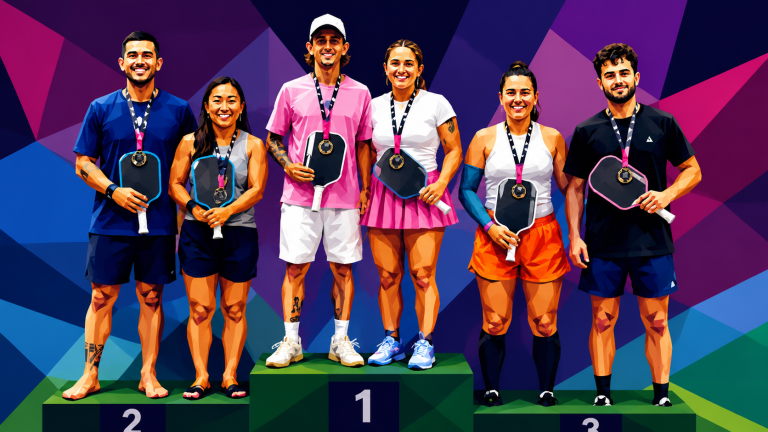
The Hong Kong Slam will become the richest professional pickleball tournament staged in Asia. Its deeper purpose is harder to measure. PPA Tour Asia is attempting to give a young circuit the hierarchy, symbols and season-ending importance from which sporting traditions are eventually made.
Key Takeaways
- The first PPA Asia Slam will take place at Hong Kong’s Kai Tak Arena from 19 to 25 October, offering a prize purse of up to US$1.1 million and 1,500 ranking points.
- Hong Kong will conclude a ten-stop season across seven markets and sit at the top of PPA Tour Asia’s three-tier structure of Opens, Cups and Slams.
- The tournament’s real test is whether prize money, a distinctive trophy and finale status can develop into traditions that players and supporters genuinely value.
Every successful sport eventually develops certain weeks that feel bigger than the rest.
Players organise their seasons around them. Supporters recognise their importance before the first ball is struck. Victory carries meaning that cannot be reduced to prize money or ranking points.
PPA Tour Asia does not yet possess many weeks like that.
In October, it will attempt to create one.
The PPA Asia 1500 Hang Seng Bank Hong Kong Slam will take place at Kai Tak Arena from 19 to 25 October. It will offer a prize purse of up to US$1.1 million, approximately HK$8.58 million, together with 1,500 ranking points.
It will be the richest professional pickleball tournament staged in Asia and the first event on the regional tour to carry Slam status.
Those are the headlines.
The more interesting story is what PPA Tour Asia is trying to construct around them.
A Tour Needs More Than a List of Dates
When PPA Tour Asia was launched, progress was naturally measured through geography.
How many countries could it enter? How quickly could it build a recognisable calendar? Could it attract international professionals while creating opportunities for emerging Asian players?
The 2026 season has supplied part of that answer through ten stops across seven markets.
WPM has followed the competitive layer of that expansion, from Yuta Funemizu’s landmark doubles victory in Tokyo to Jack Wong’s third consecutive men’s singles title in Singapore.
Those stories have begun to give the circuit recurring champions, national breakthrough moments and rivalries that continue from one event to the next.
Hong Kong introduces another requirement.
Hierarchy.
PPA Tour Asia operates through three competition levels: Opens, Cups and Slams. Points earned across them contribute to the global PPA Rankings, but each tier is intended to carry a different degree of sporting value.
The Hong Kong event sits alone at the top of that structure.
It offers the largest purse, the greatest ranking reward and the final opportunity of the season to win the tour’s most distinctive piece of silverware.
This is not simply another destination added to the calendar.
It is an attempt to make one destination mean more than the others.
The Roaring Dragon Head Is Not a Trivial Detail
The tournament champion will receive the Roaring Dragon Head, described by PPA Tour Asia as the crowning piece of the season’s interlocking hardware.
It is available only at the final stop.
That may sound like a promotional flourish. It is actually part of the sporting architecture.
Successful competitions develop objects, rituals and visual symbols that acquire meaning beyond their physical value. Players want to lift them because of what previous winners, memorable contests and accumulated history have taught the audience they represent.
PPA Tour Asia is trying to accelerate that process.
The dragon gives the finale a recognisable identity. The interlocking trophy concept connects Hong Kong to the rest of the season. The single opportunity to complete the collection encourages players to view the calendar as one connected journey rather than a series of unrelated weekends.
That is smart design.
It is also where the difficult question begins.
Can tradition be deliberately created?
The Biggest Stage PPA Asia Has Built
Hong Kong has been given the tour’s largest production platform.
Kai Tak Arena sits inside the recently opened Kai Tak Sports Park, a major venue development intended to attract premium international sport and entertainment to the city.
The tournament is organised by F-Sports Promotions Limited, title-sponsored by Hang Seng Bank and supported by the Hong Kong, China Tennis Association.
That combination matters because PPA Asia is not presenting the Slam as a specialist tournament for existing pickleball followers alone.
It is being positioned as a major Hong Kong sporting event.
A prominent indoor arena provides scale. A major financial institution provides mainstream commercial credibility. The US$1.1 million purse provides a reason for elite players to treat the week seriously.
Each piece reinforces the same message.
This is supposed to feel different.
The Season Must Arrive in Hong Kong With It
A major finale cannot rely solely on the week in which it is staged.
Its meaning must be carried into the arena by everything that happened beforehand.
Players need rankings to defend. Rivalries need another chapter. Breakthrough competitors need the chance to confront the established names they have spent the season chasing.
PPA Tour Asia is beginning to acquire those ingredients.
Wong has become the dominant men’s singles player through victories in Beijing, Tokyo and Singapore. Yufei Long has established herself among the leading women on the circuit. Players from Japan, Vietnam, China, Hong Kong and several other markets are appearing often enough for audiences to recognise their progress rather than encounter them as strangers at every stop.
That development was visible when Vietnamese teenager Le Xuan Duc came through qualifying in Singapore and demonstrated that the tour’s expanding calendar was also creating opportunities below its established group of champions.
Hong Kong must bring those separate stories together.
Without that season-long context, it risks becoming a wealthy standalone tournament.
With it, the Slam can become the place where the year is resolved.
Amateurs Are Part of the Event’s Identity
The tournament will include professional and amateur divisions in singles, doubles and mixed doubles.
Registration for both opens on 10 August, with amateur places allocated on a first-come, first-served basis.
This continues the tour’s “Play Where the Pros Play” approach, allowing recreational competitors to share the venue and wider event environment with international professionals.
The idea is commercially useful because it increases participation and expands the audience surrounding the professional draws.
It is also culturally important.
Pickleball has developed with a far smaller distance between elite competitors and everyday players than exists in most established professional sports. PPA Asia is attempting to preserve that relationship even as its leading events move into larger arenas and carry seven-figure prize purses.
That balance will become harder to maintain as the professional product grows.
Hong Kong will test whether a tournament can feel exclusive enough to carry Slam status while remaining accessible enough to reflect the sport from which it emerged.
History Cannot Be Announced
The Hong Kong Slam has many of the elements a major tournament would choose if it were designing itself from the beginning.
The largest purse.
The greatest ranking reward.
A season-ending position.
A premium arena.
A distinctive trophy.
A place at the top of a clearly defined competition structure.
What it does not yet possess is history.
That cannot be guaranteed by a press release, purchased through prize money or installed alongside the court.
It has to be created by the players who win there, the rivalries that develop there and the moments supporters continue discussing after the arena has emptied.
The first Hong Kong Slam can establish the conditions.
Only the sport can turn them into tradition.
Further Reading
- Latest pickleball news from around the world
- Tournament coverage and results
- Rankings and player profiles
- Regional pickleball coverage

Chris Beaumont
Founder and Editor-in-ChiefChris Beaumont is the founder and Editor-in-Chief of World Pickleball Magazine. Chris follows the global game closely, reporting on the latest news, developments, stories and tournaments from all five continents. He also hosts the World Pickleball Podcast, interviewing people at…
View All Articles →