
A paddle can lose the feel a player bought it for while its frame remains intact. Gearbox is trying to make that feel last within a fixed design. Reload wants players to replace the surface when it wears. Between them lies a bigger question about how pickleball measures performance, durability and what a legal paddle is allowed to become.
Key takeaways
- Reload’s published wear test found a large decline in surface roughness on one heavily used paddle. It did not measure a 50% loss of ball spin across the paddle market.
- Gearbox’s Pressure X and Reload’s replaceable-face system offer different answers to surface wear. Neither has yet established its long-term advantage over the other through an independent comparative test.
- USA Pickleball permits approved original-equipment replacement faces. UPA-A’s published professional-tour rules prohibit components designed to be removable, subject to specified exceptions.
Nick Bicanic did not set out to redesign the pickleball paddle. He wanted to keep using one.
While returning to play after a meniscus injury, the Reload founder practised thousands of shots and began to notice that his premium paddle no longer behaved as it had when new. Its hitting surface appeared to have worn. The core had not collapsed, the handle was still in his hand and the frame was intact. Yet the quality he had paid for, the grip between paddle and ball, seemed to be changing.
That distinction became the basis of Reload. If the hitting face wears before the rest of the paddle, Bicanic argues, the player should be able to renew the face without throwing away the whole object. “That component should be replaceable if that’s possible,” he said in a public Pickleball Rx interview.
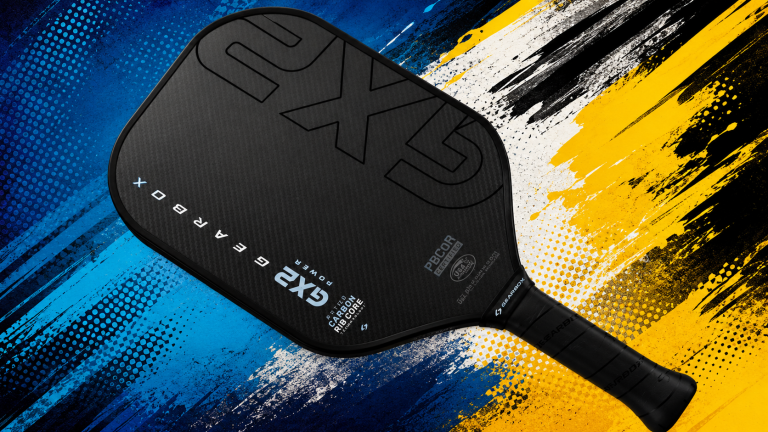
Rafael Filippini sees the same broad problem from another direction. The Gearbox founder has built the new Pressure X around an intricate internal structure and a fixed surface intended to hold its playing characteristics as it wears. Reload asks why the surface must be permanent. Gearbox asks how much better a permanent system can be engineered.
This is more than a contest between two paddles. Both companies are exposing a weakness in the way equipment is often discussed. A new paddle can be tested, certified and praised for its initial performance. A player, however, lives with what happens after the first thousand hits, then the next several thousand. How long should its useful playing life be, and which part of it ought to define that life?
The wear problem, and what the evidence can prove
Reload has made its strongest public case through a published endurance exercise on a Joola Hyperion CFS 16. Players repeatedly struck topspin drives with one side of the paddle. The company measured its surface as the hits accumulated, using both contact and optical instruments. After roughly 16,000 hits, the recorded decline in the roughness measures it reported was approximately 46% to 49%.
There is a meaningful observation here. The resin texture on a hitting face can change substantially under repeated contact even while the paddle remains structurally sound. Reload’s measurements also make the wear question specific enough to investigate, rather than leaving it to a player’s impression that a paddle has “gone dead”.
The result has limits which matter just as much. The published exercise centred on one paddle and was conducted by a company with an interest in the answer. Its measurements concerned surface roughness, not the revolutions per minute imparted to a ball. A stroke’s spin also depends on speed, path, angle of contact, incoming ball and the response of the paddle beneath its surface. A roughly 50% change in one roughness measure cannot responsibly be rewritten as a 50% loss of spin for every carbon-fibre paddle after a certain number of hours.
Nor does every player need a new surface on the same schedule. Someone playing once a week and someone drilling hundreds of heavy topspin balls a day expose a paddle to very different use. The point is that buyers rarely receive useful durability evidence alongside the familiar claims about power, control and spin. Initial performance is easier to sell than performance six months later.
Reload’s proposed solution is straightforward in principle. Keep the paddle body and fit a fresh manufacturer-supplied hitting face when the old one wears. It borrows an idea from other racket sports, where replacing a worn component does not automatically mean replacing the whole piece of equipment. Whether it saves an individual player money depends on the cost of faces, how often they change them and how long the underlying paddle remains sound.
The environmental argument needs the same care. Keeping a core in use for longer could mean discarding fewer complete paddles. It does not make used surface sheets disappear. Reload discusses a take-back route for those sheets, but says that a recycling programme is not yet operating. The present case for less waste is therefore a plausible design argument, rather than a measured outcome across the product’s life.
Gearbox’s answer starts inside the paddle
Pressure X is a useful counterpoint because Gearbox has chosen greater integration instead of easier replacement. Its description of the 8M sets out a carbon-fibre rib structure, engineered foam and a pressure-tuned core. Gearbox says the carbon provides the foundation, while foam and controlled pressure shape the response across the face. The company offers an 8M and an 8E with different playing responses.
On top sits its fixed SpinLock surface. Gearbox describes an initial peel-ply texture, particles intended to become exposed as the surface wears and structural support beneath the face. The idea is that the player should not need to peel anything off to regain the paddle’s intended response. Bicanic is sceptical that embedded particles solve surface wear in the long run. In his interview, he called such approaches “a band-aid”. That is a competitor’s assessment, not a finding from an independent test of Pressure X.
Gearbox also describes testing performance across 20 locations on the face. Those measurements speak to another question Filippini cares about: what happens when a player strikes away from the centre? If power and feel vary sharply between the sweet spot and the edge, a single headline measurement tells only part of the story. Mapping the whole face may give a fuller picture of a new paddle’s response.
It does not, on its own, answer the durability question. A map of the paddle today is not a map of the paddle after sustained play. Nor can a company’s measurements of its own paddle establish how its surface compares over time with a renewable one. The most useful independent test would track ball spin and surface condition across several examples of each design, through a consistent number and type of impacts. At present, buyers are being asked to weigh competing engineering explanations without that comparison.
Certification is about more than a number
The dispute becomes more consequential once a player takes a paddle into competition. A paddle’s approval is tied to the rules of the organisation running the event. It is not a universal passport.
USA Pickleball lists Reload’s RLD1-14mm as an approved model. Its equipment manual expressly includes original-equipment-manufacturer replacement paddle faces among permitted alterations and exceptions to its prohibition on removable parts. That does not mean a player may apply any face to any paddle. Model approval and the tested configuration still matter.
UPA-A’s published specifications draw the line differently. Section 3.4.2 says paddles shall not incorporate components designed to be removable, except for the grip. A separate list permits customisations including edge guards, overgrips and flat weighted tape. The specifications apply to professional UPA competitions, including PPA and MLP events and PPA properties in Asia, Europe and Australia.
That written difference is enough to establish a genuine conflict for a replaceable hitting face. It does not establish why UPA-A chose the rule. A removable surface raises practical questions about whether every replacement has the properties of the certified sample, whether it has been fitted correctly and how officials could check it over time. Those are reasonable questions to put to a governing body. They should not be presented as UPA-A’s stated rationale without its explanation.
Pressure X presents a different difficulty. In a public interview, Filippini said Gearbox was developing “two distinct paddles for UPA”. His account is that the rigid Pressure X structure does not compress in the manner expected during UPA-A’s accelerated break-in process, so the company has designed another structure for that route. “You have to design a product to a test,” he said.
He described a requirement involving 3.2mm of compression, or 20% of core thickness. We could not verify that number as an express requirement in UPA-A’s publicly available paddle specifications. The written document does describe performance limits and break-in testing. Filippini’s account helps explain his design decision, but it is not evidence that a particular Pressure X model was submitted and rejected. Gearbox says the 8M meets USA Pickleball’s incoming spin test, whose 2,100 RPM certification limit takes effect on 1 October 2026.
For a manufacturer, the cost of two routes extends beyond certification paperwork. Different structures need separate development, testing and production decisions. For a sponsored professional, an amateur who plays across circuits or a buyer attracted by a tour-used paddle, the same brand name may no longer be enough to establish that two paddles are constructed alike. The exact approved model matters.
WPM has examined a similar question about how tour decisions affect an emerging market in its analysis of PPA Europe’s exclusivity plans. Equipment rules work closer to the player’s hand, but they too can influence which products a market gets and which ideas manufacturers pursue.
What should a player expect from a premium paddle?
It is tempting to make this a choice between a durable face and a replaceable one. The useful questions are less tidy. How much spin does a paddle produce when new? How quickly does that change with a particular kind of use? Does the core retain its response after the surface has worn? What does it cost to restore the performance the player originally bought? And will the resulting paddle be legal in the competitions that player actually enters?
Gearbox has a detailed account of how its fixed construction should behave. Reload has a clear answer to what a player can do when a face wears. Each has shown why the other question matters. Neither has yet supplied the independent, long-term comparison that would tell players which approach delivers more consistent performance for the money.
In the meantime, the rulebooks are helping determine which answer can reach which court. A replaceable manufacturer face can sit within USA Pickleball’s approval system, provided the exact configuration is approved, while the underlying design conflicts with UPA-A’s removable-component rule. Gearbox, according to its founder, is building a second structure to meet a different testing route. That is a considerable consequence for two organisations examining the same basic object.
The paddle market has spent years asking how much a new paddle can do. Gearbox and Reload have brought the harder question into view: how much of that performance should a player still have after living with it, and what should they be allowed to do when it goes?
Further reading
- Why Your Pickleball Grip Matters More Than You Think — WPM on another part of the paddle that changes with use.
- USA Pickleball Equipment Standards Manual — the provisions covering replacement faces and model approval.
- UPA-A Paddle Specifications and Testing Requirements — the professional-tour certification rules.

Chris Beaumont
Founder and Editor-in-ChiefChris Beaumont is the founder and Editor-in-Chief of World Pickleball Magazine. Chris follows the global game closely, reporting on the latest news, developments, stories and tournaments from all five continents. He also hosts the World Pickleball Podcast, interviewing people at…
View All Articles →