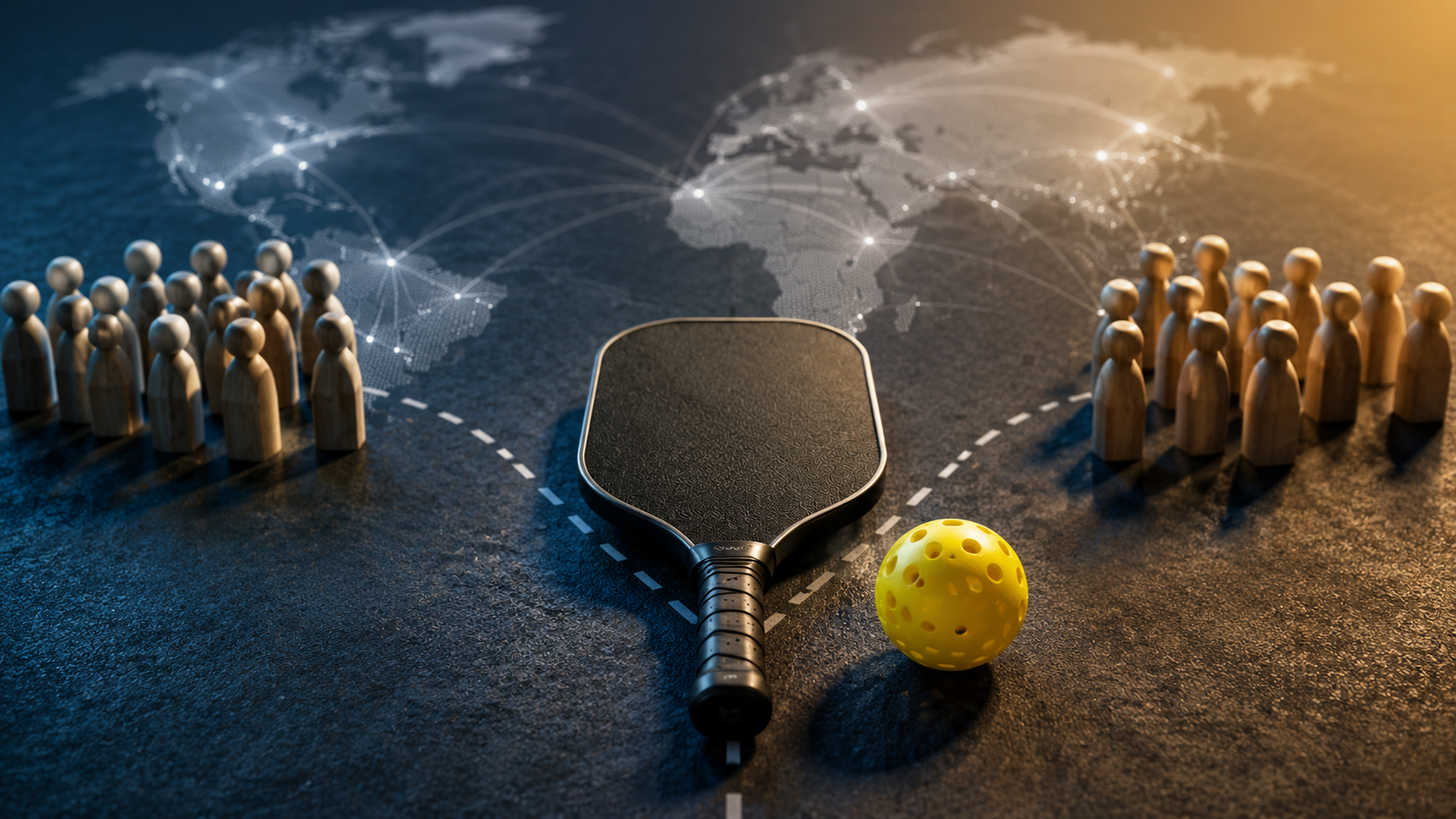
The election of Kim Janice Wagner as president of the World Pickleball Federation is the latest development in a governance story that could shape pickleball’s future for years to come. As the sport expands internationally and pursues Olympic ambitions, one fundamental question remains unresolved: who represents pickleball globally?
- Kim Janice Wagner has been elected president of the World Pickleball Federation.
- Multiple international organisations continue to pursue leadership roles within the sport.
- The outcome could influence Olympic ambitions, international championships and the future structure of global pickleball.
The Question Behind the Election
Most pickleball players could name a professional tour.
Many could name a major tournament.
Far fewer could tell you who represents the sport internationally.
That uncertainty sits at the centre of one of the most important questions facing pickleball in 2026.
The World Pickleball Federation has elected Kim Janice Wagner as president following a unanimous vote by its Board of Directors on 4 June. Wagner takes over at a moment when the sport is expanding across multiple continents and trying to build the credibility required for wider international recognition.
In her first comments following the appointment, Wagner highlighted leadership, stability, integrity and transparency as priorities for the organisation.
Those are familiar words in international sport.
In pickleball, they carry added significance.
Behind the election lies a larger debate about legitimacy, recognition and the future governance of the sport.
Why This Matters More Than One Election
In many sports, the election of a federation president would be a routine administrative update.
Pickleball is not yet in that position.
The sport is still establishing the structures that will shape its future.
Professional tours are expanding. International tournaments are becoming more common. National federations are appearing across Europe, Asia, Africa and Latin America.
As that process accelerates, governance becomes increasingly important.
Who sanctions championships?
Who determines international standards?
Which organisation speaks to international sporting bodies?
Who represents pickleball if Olympic discussions become more serious?
These are no longer theoretical questions. They are becoming practical ones.
How Pickleball Arrived Here
For much of its history, pickleball did not need a complex international governance framework.
The sport was still finding its feet. Participation was the priority. Infrastructure was the priority. Introducing new players was the priority.
Then the sport expanded internationally at remarkable speed.
As new federations emerged and international competitions became more ambitious, governance moved from the background to the foreground.
In some ways, this is a sign of how quickly pickleball has evolved. Only a few years ago, the sport’s biggest questions revolved around participation and awareness. Today, it is debating governance models, international representation and Olympic pathways.
That is a very different conversation, and one usually associated with far more established sports.
The Two-Federation Question
The World Pickleball Federation is one organisation seeking to play that leadership role.
The Global Pickleball Federation is another.
Both organisations have promoted international development. Both have pursued relationships with national federations. Both have spoken about the long-term goal of Olympic recognition.
Yet they do not enter the conversation from identical positions.
The WPF’s current positioning is built around becoming a democratic, IOC-aligned global federation. The GPF has also presented itself as a broad international structure, with its own elections, membership base and development ambitions.
The distinction matters because the issue is not simply whether pickleball has enough energy behind it. It is whether that energy can be organised into one recognised international framework.
As WPM has explored through recent coverage of India’s emerging player pathway and the growing significance of pickleball in Latin America, the sport’s future is increasingly being shaped outside its traditional North American base.
That makes international governance more urgent, not less.
The existence of multiple organisations does not automatically create conflict.
But it does create uncertainty.
For national federations, players and observers, there is still no universally accepted answer to a simple question.
Who speaks for pickleball internationally?
Why Players Should Care
Governance can feel distant from everyday pickleball.
Most players care far more about tournaments than constitutions.
Yet governance decisions eventually affect what happens on court.
International eligibility. Recognised championships. World rankings. Qualification pathways. Anti-doping frameworks. Future Olympic ambitions.
All depend upon governance structures.
The decisions being made today may influence opportunities available to players years from now.
That is why this debate matters beyond boardrooms.
The Merger Question Nobody Can Ignore
Perhaps the most interesting aspect of the current landscape is that the future may not require a winner.
There have been signs that discussions around cooperation and potential unification remain possible. Previous merger and alignment conversations have already shown that international pickleball understands the need for a clearer structure, even if the final shape of that structure remains unresolved.
If that happens, Wagner’s election could ultimately be viewed as part of a broader effort to create a more unified international model.
Many within the sport would welcome that outcome.
A single recognised international federation would provide greater clarity for national bodies, tournament organisers and athletes.
It would also simplify any future conversations involving international recognition.
Of course, mergers are rarely straightforward.
Questions around leadership, voting structures, representation and organisational identity would all need to be resolved.
For now, the possibility remains exactly that.
A possibility.
Yet it may prove to be the most important governance story in pickleball over the next few years.
The Olympic Dream and the Immediate Reality
Olympic inclusion is often presented as the finish line.
It is certainly one of the sport’s most visible ambitions.
But focusing exclusively on the Olympics risks missing the immediate challenge.
Before pickleball can convince the wider sporting world that it deserves a place on the Olympic programme, it may first need to answer a more fundamental question.
Who represents the sport?
The International Olympic Committee does not recognise sports simply because they are popular. Governance structures, recognised federations and international legitimacy form part of the pathway.
Participation matters. Professional tours matter. Global visibility matters.
But governance matters too.
Perhaps more than many people realise.
What Happens Next?
Nobody knows exactly how this story ends.
Will multiple international federations continue to coexist?
Will national bodies eventually align behind a single structure?
Will cooperation lead to unification?
Or will competing visions continue to shape the sport’s future?
Those questions remain unanswered.
What is clear is that governance is no longer a niche issue discussed only by administrators.
The sport has grown beyond that stage.
The popular narrative says pickleball is racing towards the Olympics.
The reality is more complicated.
Before pickleball can convince the world that it deserves a place on the Olympic programme, it may first need to convince itself who represents it.
Kim Janice Wagner’s election is one step in that story.
The outcome remains unwritten.
Further Reading
- Latest pickleball news from around the world
- Tournament coverage and results
- Rankings and player profiles
- Regional pickleball coverage

Chris Beaumont
Founder and Editor-in-ChiefChris Beaumont is the founder and Editor-in-Chief of World Pickleball Magazine. Chris follows the global game closely, reporting on the latest news, developments, stories and tournaments from all five continents. He also hosts the World Pickleball Podcast, interviewing people at…
View All Articles →