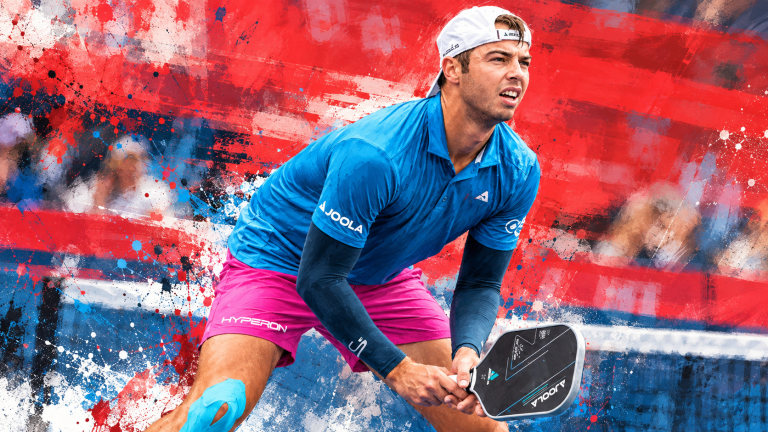

Professional pickleball has finally found its way into the betting world, but not through the traditional sportsbooks that dominate most major sports. Instead, prediction market Kalshi has quietly become the first meaningful platform for wagering on the professional game, offering an unexpected insight into where pickleball sits in its commercial evolution.
- Kalshi has become the leading platform currently offering betting markets on professional pickleball.
- The absence of traditional sportsbooks says more about the sport’s current characteristics than its popularity.
- Betting markets measure demand, but bookmakers also need confidence that a sport can be priced consistently and sustainably.
Betting has arrived. Bookmakers have not.
For years, professional pickleball has edged towards another commercial milestone.
Not another broadcast deal. Not another equipment sponsor. A betting market.
That milestone has now arrived, although not in the way many expected.
Rather than established bookmakers launching dedicated pickleball sections, the first meaningful wagering activity has emerged through Kalshi, the regulated prediction market where users trade contracts based on sporting outcomes rather than placing conventional bets.
At first glance, that might look like a small detail. In reality, it reveals something far more interesting about where professional pickleball stands today.
The problem is not demand. It is certainty.
Kalshi now offers markets covering both the Carvana PPA Tour and Major League Pickleball, allowing users to speculate on match winners, selected totals and outright champions through its event contract model.
For fans, the experience delivers many of the same attractions as traditional sports betting. Every point carries greater significance when there is something riding on the outcome.
The more intriguing story, however, is not who has entered the market. It is who has chosen not to.
Despite professional pickleball’s growing profile, mainstream sportsbooks have yet to embrace the sport in any meaningful way. That is unlikely to be because they are unaware of pickleball’s rise. It is more likely because pricing an emerging sport presents challenges that established competitions simply no longer face.
Why pickleball is hard to price
Bookmakers make money by managing risk.
To do that successfully they need confidence that their pricing models accurately reflect the probability of an outcome. Professional pickleball is still developing many of the characteristics those models depend upon.
Doubles partnerships can change quickly. New players continue to emerge at an unusually rapid rate. Professional competition is split across multiple tours and formats. Historical data remains relatively limited compared with sports that have accumulated decades of results and statistical modelling.
None of those factors makes betting impossible. Together, however, they create uncertainty.
Prediction markets approach that uncertainty differently. Rather than relying entirely on traders to determine the correct price, markets allow participants themselves to establish value through buying and selling contracts. In a sport where confidence is still developing, that flexibility becomes a significant advantage.
Every sport reaches this point differently
Every established betting sport once faced similar questions.
There was a time when bookmakers had to decide whether mixed martial arts, esports and even Twenty20 cricket offered enough consistency to justify serious investment. Some markets matured quickly. Others took years before bookmakers considered them commercially worthwhile.
Professional pickleball may simply be following the same path.
The important distinction is that popularity alone does not create a betting market. A sport also needs stable competition, reliable data and predictable competitive structures that allow bookmakers to price events with confidence.
That process is often invisible to fans, but it shapes how quickly an emerging sport enters the mainstream betting industry.
What this means
It would be easy to view the arrival of pickleball betting as another sign of the sport’s commercial growth.
The more revealing story lies elsewhere.
Prediction markets measure interest. Traditional bookmakers measure certainty.
Professional pickleball has clearly reached the point where people are willing to speculate on its biggest matches.
Whether it has yet reached the point where bookmakers are willing to risk their own money on consistently pricing those matches remains an open question.
That may be one of the clearest indicators yet of where professional pickleball sits today: established enough to attract financial interest, but still evolving quickly enough that the industry’s biggest bookmakers are watching rather than participating.
Further Reading
- Latest pickleball news from around the world
- Tournament coverage and results
- Rankings and player profiles
- Regional pickleball coverage

Chris Beaumont
Founder and Editor-in-ChiefChris Beaumont is the founder and Editor-in-Chief of World Pickleball Magazine. Chris follows the global game closely, reporting on the latest news, developments, stories and tournaments from all five continents. He also hosts the World Pickleball Podcast, interviewing people at…
View All Articles →