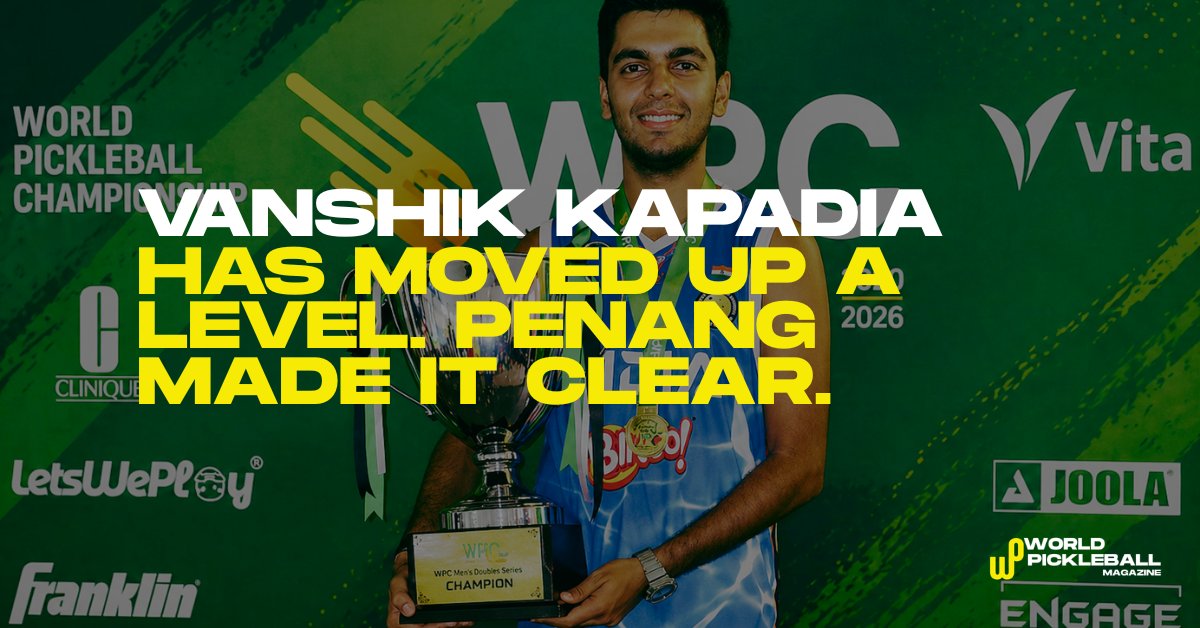
Vanshik Kapadia’s Triple Crown at the WPC Series stop in Penang was not just another medal haul. After two golds at the previous Malaysia Open, it points to a player whose results are starting to harden into reputation.
- Vanshik Kapadia won men’s singles, men’s doubles and mixed doubles gold at the WPC Series event in Penang.
- The result follows his two golds and one silver at the 2025 PPA Tour Asia Malaysia Open in Selangor.
- The story is no longer just Indian success. It is Kapadia’s move into a higher competitive tier.
Winning across singles, doubles and mixed in the same tournament is not just a test of ability. It is a test of control.
The formats ask different questions. Singles demands movement, patience and shot tolerance. Doubles is about positioning, patterns and trust. Mixed adds another layer of timing and role clarity.
The physical load builds quickly. The mental load often builds faster.
Vanshik Kapadia handled all of it in Penang.
Three titles, one clear signal
Kapadia took gold in Men’s Singles 19+ Open, then backed it up in Men’s Doubles with Mayur Patil, before completing the sweep in Mixed Doubles alongside Vrushali Thakare.
There was no obvious drop in level as the schedule tightened. By the final stages, he was still moving through matches with the same control that had carried him through the opening rounds.
That, on its own, would be enough to mark a strong performance.
But Penang did not come in isolation.
At the 2025 PPA Tour Asia Malaysia Open in Selangor, Kapadia had already taken two gold medals and one silver, winning Pro Men’s Doubles and Pro Mixed Doubles while finishing runner-up in Pro Men’s Singles. The event was staged at 9pickle, Selangor, from July 4-6, and brought together more than 500 athletes from across Asia and beyond, according to published reports from the tournament.
That matters because it removes the idea of a one-week spike.
What Penang confirms is repeatability.
If you’re following how the global game is shifting week by week, the World Pickleball Report breaks this down every Wednesday.
A game that travels across formats
Kapadia’s results point to a player whose game travels across formats because it is built on control rather than risk.
That distinction matters. Some players can overwhelm one draw with form, power or a favourable match-up. Fewer can keep winning when the demands change across the day.
Singles asks him to create and survive alone. Doubles asks him to fit into a pattern without losing authority. Mixed doubles asks for judgement, patience and the ability to change tempo without forcing the point.
Winning all three suggests more than talent. It suggests efficiency.
That is where this result starts to carry weight. Kapadia is not only winning matches. He is showing that his game can hold together when the schedule, format and pressure keep changing.
India is part of the story, but not the headline
India’s presence across Penang was strong.
Aalyka Ebrahim won gold in Women’s Singles 19+ Advanced Plus, then added silver medals in Women’s Doubles with Ariana Muralidharan and Mixed Doubles with Willy Chung. Kuldip Mahajan also collected two bronze medals, contributing to a strong Indian return at the WPC Series stop.
Those results support a broader pattern. India is no longer just placing players in draws. It is starting to place them in finals.
That sits naturally alongside wider Asian pickleball coverage, where the regional circuit is beginning to produce clearer player storylines and more meaningful competitive depth.
But the sharper reading here belongs to Kapadia.
This is no longer just about a country appearing on the podium. It is about an individual starting to separate from the group.
What this means next
Penang does not define a career. But it changes how a player is viewed.
Kapadia will now enter future WPC events, and likely stronger Asian draws, with a different level of expectation. Opponents will prepare for him differently. Draws will treat him differently. Matches that may once have been seen as manageable become more complicated.
That is the shift.
The next question is not whether he can win in this environment. He already has. The question is whether he can carry this level into deeper, more demanding fields, where recovery becomes harder and margins become thinner.
Back-to-back results suggest he has moved closer to that level. They do not guarantee he stays there.
From here, Kapadia is no longer part of the field. He is part of the problem.
For a clearer view of where the sport is heading each week, you can join the World Pickleball Report here.
Further Reading
- Latest pickleball news from around the world
- Tournament coverage and results
- Rankings and player profiles
- Regional pickleball coverage

Chris Beaumont
Founder and Editor-in-ChiefChris Beaumont is the founder and Editor-in-Chief of World Pickleball Magazine. Chris follows the global game closely, reporting on the latest news, developments, stories and tournaments from all five continents. He also hosts the World Pickleball Podcast, interviewing people at…
View All Articles →