
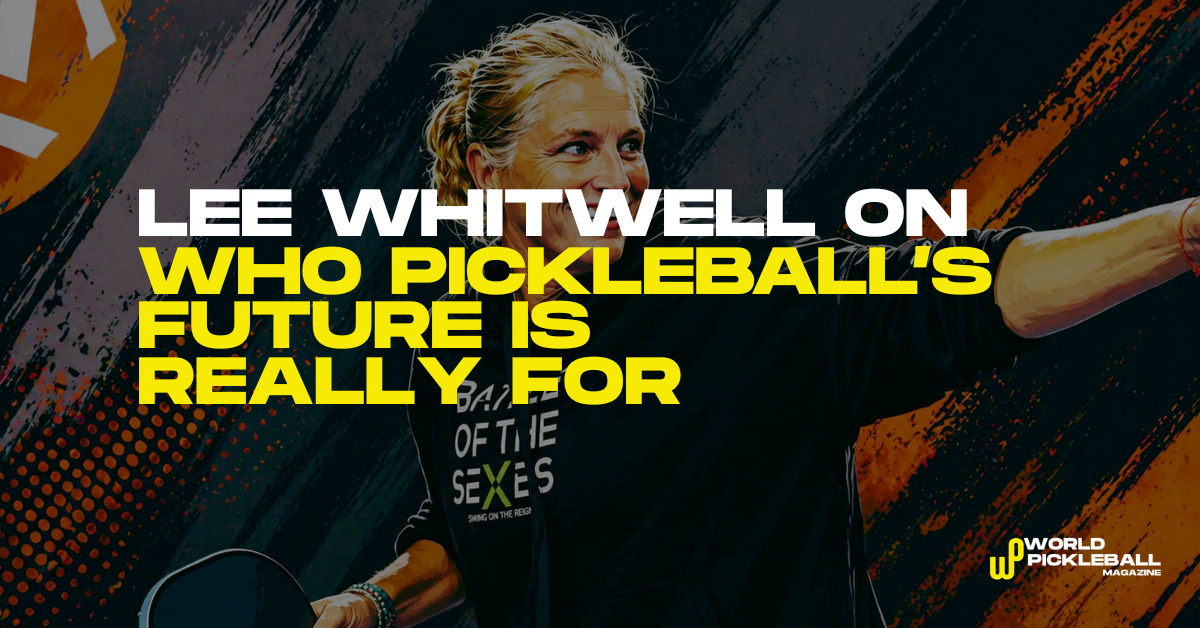
On the World Pickleball Podcast, Lee Whitwell does more than reflect on tournaments and results. She sets out a clear argument about where pickleball’s future really sits, and who the sport risks leaving behind if it gets that wrong.
- Lee Whitwell believes pickleball’s future depends on its recreational base, not just the pro game.
- She argues the sport still has work to do as a spectator product and needs smarter storytelling.
- Her work with Game ChangeHER shows pickleball’s deeper value as a social and psychological space.
Lee Whitwell is not worried about pickleball growing.
She is more interested in how it grows.
On the latest episode of the World Pickleball Podcast, the senior pro standout and Game ChangeHER co-founder moves quickly past results and into something more uncomfortable. Her argument is simple, and it cuts through a lot of the noise around the sport.
Pickleball’s future will not be decided by the pro game alone.
It will be decided by the people who play it.
Listen to the full Lee Whitwell episode of the World Pickleball Podcast here.
The events that still feel like pickleball
Whitwell had just come off another successful US Open, adding more medals to a record that already places her among the most consistent senior players in the game.
But what stayed with her was not the podium.
It was the atmosphere.
“They really do call it a party in the park for a reason,” Whitwell said. “They’ve kept true to pickleball’s roots.”
That idea carries across to the English Open, which moves to the NEC Birmingham in 2026. Pickleball England says the tournament will take over three halls and create a 60-court venue, while the NEC describes the event as one unified arena built across three exhibition halls.
For Whitwell, that kind of scale only works if the experience stays human.
“If you took the pros away, they’d still have 3,300 participants,” she said of the US Open. “It’s because of what they create in the atmosphere and the energy.”
That is not a criticism of the professional game. It is a reminder of what holds everything else in place.
If you’re following how the global game is shifting week by week, the World Pickleball Report breaks this down every Wednesday.
Pickleball is still a playing sport, not a watching one
Where Whitwell becomes more direct is on the subject of broadcasting.
Pickleball, she says, is still far more powerful as something you do than something you watch.
That is not a weakness. It is just reality.
“Right now we’re still in that mode of way more people love to play than watch,” she said.
The problem is not exposure. It is presentation.
Right now, pickleball is asking new viewers to sit through hours of matches without giving them enough reason to care. Too many matches are being streamed simply because they can be, not because they should be.
Whitwell’s solution is not to show less pickleball. It is to show better pickleball.
More focus on moments. More clarity on what matters. More honesty in commentary. Less noise.
Because the aim is not just to broadcast the sport. It is to convert players into fans.
Right now, that conversion is not happening often enough.
The real economy sits at the bottom, not the top
That same idea carries into Whitwell’s view of the paddle market.
She is blunt about where companies are getting it wrong.
Too much money is still flowing towards a small number of top players, based on the assumption that visibility drives sales. In reality, she argues, most buying decisions happen much closer to the ground.
Coaches. Club players. Senior pros. Community organisers.
The people who see hundreds of players every week.
“If you’re putting 150 people through your classes every week, you’re going to move the needle,” Whitwell said.
The numbers behind that point are simple. Millions of people play pickleball. Only a small fraction play tournaments. An even smaller group follow the pro game closely.
Most players are not buying paddles because of who endorses them.
They are buying them because someone they trust recommended them.
That distinction matters. Get it wrong, and companies burn money chasing exposure. Get it right, and they build something that lasts.
Why Game ChangeHER matters more than it looks
If Whitwell’s argument has a centre, it sits in her work away from the court.
Through Game ChangeHER Events, which she co-founded with Angela Farmer, Whitwell has helped build pickleball spaces aimed especially at women over 40. The company describes its events as clinics, camps and programmes designed to build skill, confidence and community.
Whitwell explains it more personally.
She talks about women arriving at events carrying grief, illness, loneliness or loss, and finding something that feels like an outlet again.
“We want to belong,” she said. “Pickleball makes us feel like we’re a part of something again.”
That idea is easy to overlook if you only look at the sport from the outside.
But it explains why pickleball works.
It creates a space that many people no longer have. Somewhere between work and home. Somewhere social, but not forced. Somewhere competitive, but still welcoming.
That is not a side effect of the sport.
It is the point.
The player behind the argument
The conversation is not all theory.
Whitwell also talks through her own tactical view of the game, and one line explains a lot about why she has been so effective for so long.
“I don’t need to beat you,” she said. “I just need you to beat you.”
That is pure Whitwell. Funny on the surface, serious underneath.
Her game is built on patience, discomfort and control. She is not trying to win every point with the obvious shot. She is trying to make opponents play one more ball, rush one more decision, feel one more rally going longer than they wanted.
The winner, as she puts it, is often only the formality. The real work happened three or four shots earlier.
That playing philosophy fits the wider conversation. Whitwell is interested in what sits underneath the obvious part of pickleball: not just the winning shot, but the set-up; not just the professional product, but the people who carry the sport underneath it.
What this conversation is really about
Whitwell is not arguing against growth.
She is arguing against forgetting what made the growth possible.
Pickleball has the chance to become bigger, more structured, more visible. But if it follows the same path as other sports without understanding its own strengths, it risks losing something in the process.
The professional game will continue to develop. It should.
But the sport will not hold together if it disconnects from the people who fill the courts every day, run the sessions, build the communities and keep the atmosphere alive.
That is where pickleball’s future actually lives.
Whitwell’s point is not that pickleball should stay small. It is that the sport needs to be careful who it leaves behind while trying to become big.
For a clearer view of where the sport is heading each week, you can join the World Pickleball Report here.
Further Reading
- Latest pickleball news from around the world
- Tournament coverage and results
- Rankings and player profiles
- Regional pickleball coverage

Chris Beaumont
Founder and Editor-in-ChiefChris Beaumont is the founder and Editor-in-Chief of World Pickleball Magazine. Chris follows the global game closely, reporting on the latest news, developments, stories and tournaments from all five continents. He also hosts the World Pickleball Podcast, interviewing people at…
View All Articles →