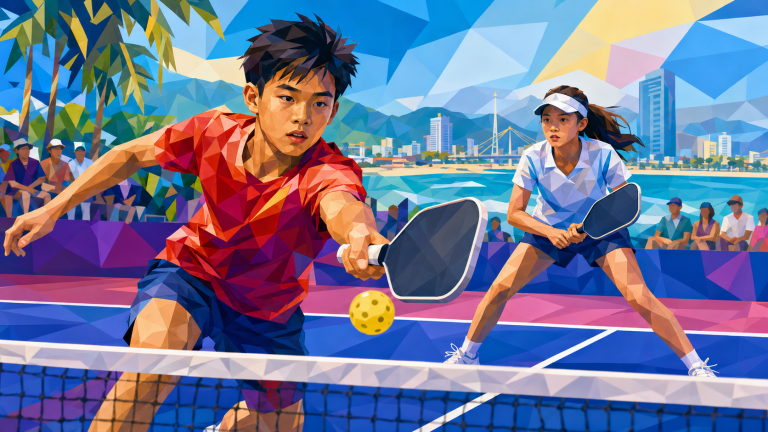

The Caribbean’s first Minor League Pickleball event is not simply another stop on the sport’s expanding calendar. In Trinidad and Tobago, it represents something far more important: a region trying to build serious competitive pickleball on its own terms rather than waiting for the rest of the world to notice.
- Trinidad and Tobago will host the Caribbean’s first Minor League Pickleball event from May 29 to 31.
- The tournament reflects a wider push to build regional competition so Caribbean athletes do not always have to travel abroad for serious matches.
- The bigger story is not simple growth. It is self-determination, identity, and infrastructure inside a developing pickleball region.
By Friday night in Trinidad, four courts will be running under lights while players from Jamaica, Bermuda, Barbados, Cayman, Canada, the United States, and Tobago squeeze around a venue that barely existed a few years ago.
There will be music. Caribbean flags. A packed schedule stretching from Friday evening through Sunday night. Medals handed out by Moko Jumbies, the stilt-walking figures tied deeply to Carnival culture across the region.
And underneath all of it sits something professional pickleball still does not fully understand.
Smaller markets are no longer waiting to be invited into the sport’s future.
A Caribbean First With a Bigger Meaning
At Pickleball Paradise in Trinidad and Tobago, founders Kristin Stepp and Nathaniel Alexander are preparing to launch the Caribbean’s first Minor League Pickleball event from May 29 to 31 as part of a three-day tournament weekend they hope becomes a landmark moment for the region.
But the deeper story is not simply that MiLP has arrived in the Caribbean.
It is why bringing it there matters so much.
“We’ve always believed Caribbean athletes deserve opportunities to compete at a high level without constantly feeling like they have to leave home,” Stepp told World Pickleball Magazine.
That idea runs through almost every part of what Pickleball Paradise is trying to build.
From Temporary Nets to a Competitive Home
A few years ago, the local scene was little more than a small group of players pulling together enough people for games using temporary nets.
Stepp had discovered pickleball while in Florida. Nathaniel had encountered it locally on a much smaller scale. Together, alongside a small early group, they started volunteering at a local high school to grow the sport.
According to Stepp, that programme eventually reached around 850 players.
But enthusiasm alone was not enough.
Equipment deteriorated. Courts needed maintenance. Support failed to keep pace with participation. Eventually, the pair decided to stop waiting for outside solutions and build their own.
Now Pickleball Paradise operates two facilities in Trinidad and Tobago, with courts booked heavily most evenings and a player base increasingly built around structured competition rather than casual recreation.
That distinction matters.
The Caribbean story is often framed too softly in global sports coverage, as though these are nice little scenes slowly learning the sport. The reality is far more competitive than that.
Trinidad and Tobago players are already competing internationally. The national side won bronze during its first Caribbean Championships appearance before narrowly missing the podium the following year.
This is not a participation story pretending to be elite sport.
This is a region trying to create legitimate pathways with far fewer resources than the sport’s major markets.
If you’re following how the global game is shifting week by week, the World Pickleball Report breaks this down every day in our morning briefing.
The Cost of Building Without Waiting
The United States has professional tours, established infrastructure, major investment, celebrity owners, and increasingly sophisticated broadcast production.
India is rapidly attracting major business backing and famous sporting investors.
The Caribbean is operating in a very different reality.
“We fund all our own trips,” Stepp said.
Every regional tournament involves calculations about flights, accommodation, sponsorship, and what can realistically be afforded next month.
Travel between islands can cost hundreds of US dollars. Flights to regional competitions are not quick budget hops. Players often balance tournament ambitions alongside running businesses, developing facilities, coaching locally, and trying to grow the sport at the same time.
That pressure shapes everything.
It is why regional competition matters so deeply.
A Regional Model, Not a Copy of America
For Stepp, the long-term vision is not just Trinidad succeeding independently. It is the Caribbean developing a stronger collective sporting identity through pickleball, much like West Indies cricket has done historically.
Island rivalries remain fierce internally, but there is also a wider sense that the region rises together internationally.
“We ride or die together,” she said.
That mentality already exists through Caribbean tournaments in Bermuda, Cayman, Jamaica, Barbados, and elsewhere. Players move between islands regularly, building relationships and standards collectively despite the financial challenges attached to travel.
The MiLP launch becomes important inside that wider context.
In smaller markets, team formats matter because they stop competitive ecosystems becoming too thin. A newer player can contribute before becoming elite. Stronger players still get meaningful matches. The result is a community that develops together rather than splitting into isolated levels.
That is why this event belongs in WPM’s wider regional pickleball coverage, not just as a tournament note but as a sign of how different parts of the world are building the sport in different ways.
Keeping the Caribbean in the Story
Pickleball Paradise does not want its tournament to feel interchangeable with every other event happening globally.
Stepp repeatedly referenced how many tournaments around the world feel like generic gymnasium experiences detached from local identity.
This event is deliberately different.
The Caribbean aesthetic is not being treated as decoration. It is central to the presentation. The organisers want players arriving from overseas to feel immediately that they are somewhere distinct.
That cultural confidence feels important.
One of the biggest risks for developing pickleball regions is becoming a copy of the American system without building their own identity alongside it. Trinidad appears determined to avoid that trap.
For readers following pickleball news from around the world, this is exactly the kind of story that shows where the sport is really moving once the focus shifts away from the usual professional tour centre of gravity.
What Trinidad Is Really Building
Professional pickleball still talks constantly about global growth, but many conversations remain centred around the same tours, same stars, and same American narratives.
The Caribbean story offers something different.
It is about athletes building infrastructure themselves. Communities funding their own development. Players travelling huge distances simply to strengthen the regional level. Organisers creating pathways so future Caribbean talent does not immediately feel forced to leave home in search of serious competition.
That is not a novelty story.
That is what happens when players stop waiting for infrastructure and start creating it themselves.
The Caribbean is not asking pickleball for permission anymore. It is building its own version of the sport, one court at a time.
For a clearer view of where the sport is heading each month, you can download the latest free issue of World Pickleball Magazine.
Further Reading
- Latest pickleball news from around the world
- Tournament coverage and results
- Rankings and player profiles
- Regional pickleball coverage

Chris Beaumont
Founder and Editor-in-ChiefChris Beaumont is the founder and Editor-in-Chief of World Pickleball Magazine. Chris follows the global game closely, reporting on the latest news, developments, stories and tournaments from all five continents. He also hosts the World Pickleball Podcast, interviewing people at…
View All Articles →