
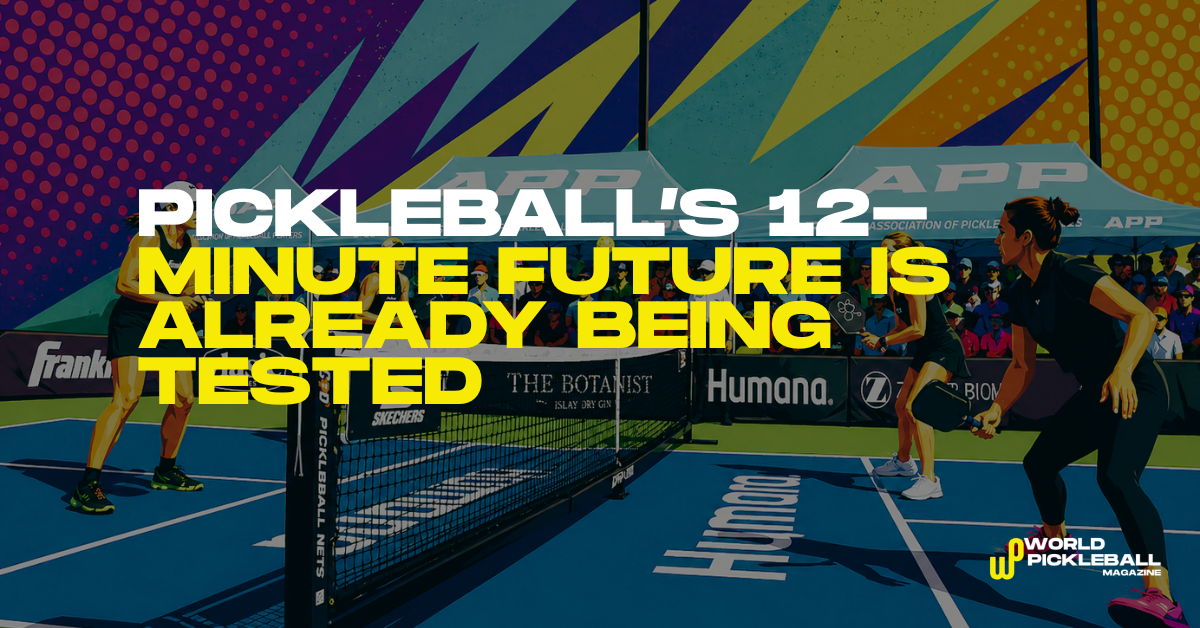
Timed matches, power plays, and a five-second serve are not small tweaks. In Sacramento this week, the sport is testing a faster version of itself — and it may not be a temporary experiment.
- The APP is trialling a 12-minute, high-intensity match format with new rules
- The changes prioritise speed, pressure, and viewer clarity over traditional pacing
- The format could reshape how the sport is played, and who succeeds within it
There is a moment, late in a match, where everything tightens.
The clock is running down. A team holds a single Power Play token. One decision left, one rally that could count double. No time to reset, no time to settle into a rhythm.
This is the version of pickleball being tested at the APP Shriners Invitational in Sacramento, staged ahead of the APP Sacramento Open. It looks familiar, but it behaves very differently.
A different kind of pressure
The format is simple on paper. Matches are capped at 12 minutes. A five-second service clock removes any pause between points. If time expires, the match can come down to a single deciding rally.
Each team also holds one Power Play token. Use it at the right time, and a rally carries double weight. Use it poorly, and the opportunity is gone.
These are not cosmetic changes. They alter how players think.
There is less space to build points. Less margin for patience. The slow, controlled exchanges that define high-level pickleball — the kind regularly analysed across weekly global match breakdowns — become harder to sustain when the clock is always present.
Instead, matches tilt towards urgency. Faster starts matter more. Risk arrives earlier. Players are pushed to act, rather than wait.
It is still pickleball. But it rewards a slightly different player.
From participation to broadcast
The logic behind this shift is clear. Pickleball has grown quickly as a participation sport, but participation does not automatically translate into viewership.
Traditional formats can stretch. Momentum ebbs and flows. For a casual viewer, it is not always obvious when a moment truly matters.
This format removes that ambiguity.
Matches have a defined length. Key moments are visible. The Power Play creates instant stakes that do not need explaining. The clock itself becomes part of the narrative.
For broadcasters, that matters.
Shorter matches are easier to schedule. High-pressure moments are easier to package. The sport becomes simpler to follow without losing its core mechanics.
This push toward clarity and control mirrors wider shifts across the professional game, from how pickleball content is shaped for digital audiences to governance changes like the UPA’s tightening control over equipment and competition.
If you’re following how the global game is shifting week by week, the World Pickleball Report breaks this down every Wednesday.
What changes on court
The tactical consequences are already clear.
There is less time to recover from a slow start. Falling behind early carries greater weight when matches are capped. The value of a fast opening increases.
Third shots become more aggressive. There is less incentive to settle into long, neutral exchanges. Players are more likely to press earlier in points.
Even at the kitchen line, patience shifts. Extended dinking battles still exist, but they carry a different cost when time is limited.
And then there is the Power Play.
It introduces a layer of decision-making that does not exist in the traditional format. Timing becomes part of strategy. Do you use it early to build a lead, or hold it for a decisive moment?
That single choice can define a match.
Two versions of the sport
The deeper question is not whether this format works in Sacramento.
It is what happens if it does.
Pickleball could begin to move in two directions. One version remains rooted in traditional structures, where patience, endurance, and point construction define elite play.
The other leans into speed, clarity, and pressure. A version designed not just for players, but for audiences.
Those versions can coexist. Other sports have shown that. But they do not produce the same matches, or the same types of winners.
That is the shift being tested here.
A test that will not stay isolated
This is being framed as an experiment. In reality, it is a signal.
If the format lands well with audiences and broadcasters, it will not remain a one-off. It will be refined, repeated, and expanded.
The expectation around how pickleball is watched will begin to change.
And once that expectation shifts, it rarely moves back.
For context on how the professional structure is evolving alongside these changes, the official PPA Tour platform outlines how formats, rankings, and broadcast partnerships are being aligned.
Pickleball built its rise on accessibility. The next phase may be defined by how quickly it moves, and how clearly it can be understood in real time.
For a clearer view of where the sport is heading each week, you can join the World Pickleball Report here.
Further Reading
- Latest pickleball news from around the world
- Tournament coverage and results
- Rankings and player profiles
- Regional pickleball coverage

Chris Beaumont
Founder and Editor-in-ChiefChris Beaumont is the founder and Editor-in-Chief of World Pickleball Magazine. Chris follows the global game closely, reporting on the latest news, developments, stories and tournaments from all five continents. He also hosts the World Pickleball Podcast, interviewing people at…
View All Articles →

