
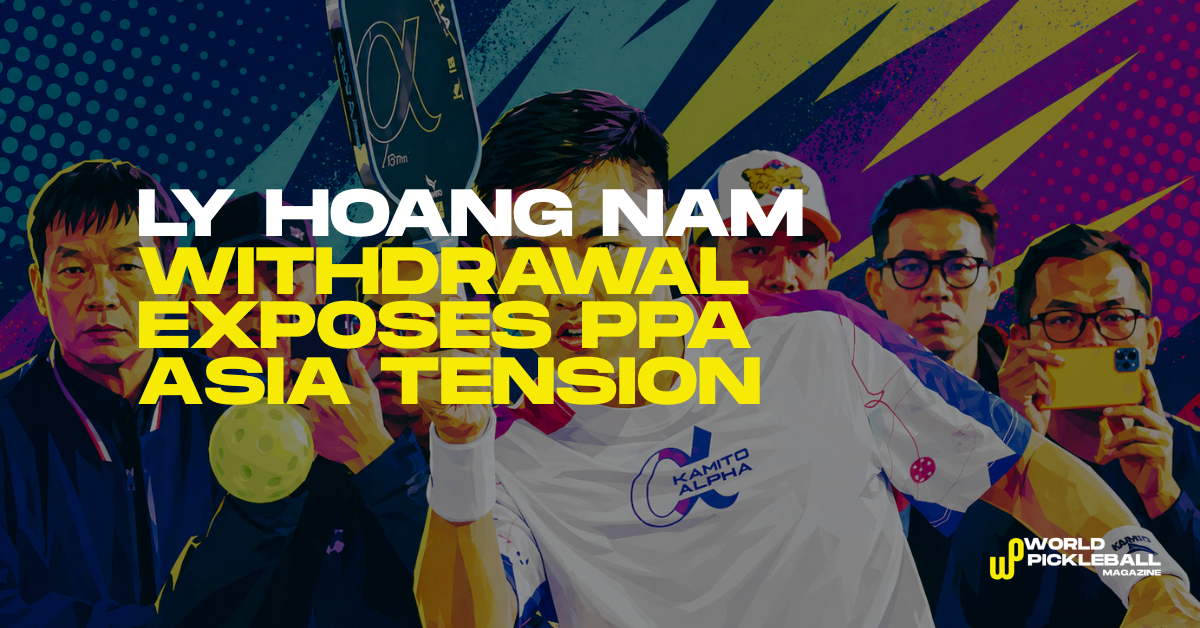
Vietnam’s leading pickleball player will not be beaten at the upcoming Panas Kuala Lumpur Open, because he will not be there. That decision says plenty about how professional pathways are being shaped.
- Ly Hoang Nam has withdrawn before the upcoming PPA Tour Asia 500 Panas Kuala Lumpur Open begins
- His recent titles were not enough to secure main draw protection without a formal PPA contract
- Alongside Phuc Huynh’s earlier Hanoi withdrawal, the episode suggests a wider pathway problem for independent players
In most sports, winning usually earns you a better draw, a higher seeding, or at least a clearer route into the next event.
For Ly Hoang Nam, it earned something more complicated.
The Vietnamese standout, winner of the PPA Asia Hanoi Cup 2026 and Hangzhou 2025, has withdrawn before the upcoming PPA Tour Asia 500 Panas Kuala Lumpur Open after being placed into the qualifying draw. The event is scheduled for May 13 to 17 at 9Pickle in Malaysia, carrying US$50,000 in prize money and 500 ranking points, according to the official PPA Tour Asia event page.
On the surface, this looks like a selection issue. It is more revealing than that.
The decision that says more than a result
Hoang Nam’s absence is not simply about whether he should or should not have been in the main draw.
The more important point is that he had to make the decision at all.
Because he does not hold a formal PPA contract, Hoang Nam was not granted the same level of protection as contracted players. Despite his results, he faced the risk of playing through qualifying before reaching the stage of the tournament where his ranking, form, and profile would normally suggest he belongs.
That changes the calculation.
Qualifying is not just another match. It means extra physical load, more risk, more uncertainty, and less control over preparation. One poor draw, one flat performance, or one difficult turnaround can leave a player out before the main event has properly begun.
For an independent player, that is not a small inconvenience. It is a strategic decision.
Contracted players get certainty. Independents get volatility
This is where the story becomes bigger than one player.
Contracted players move through the system with more certainty. They are easier for tours to promote, easier for events to schedule, and easier for broadcasters to build around.
That is understandable from a business point of view.
But independent players face a different version of the same circuit. They carry more exposure. More travel risk. More competitive jeopardy before the tournament even reaches its main stage.
The gap is not only about money or status. It is about behaviour.
If the structure makes competing less rational for a proven player, the structure begins to shape the field before the first ball is hit.
That is the uncomfortable part.
It also sits alongside a wider professional tension already visible across the sport, from questions around player economics to recent debates over control and governance in the pro game.
If you’re following how the global game is shifting week by week, the World Pickleball Report breaks this down every Wednesday.
Why this matters for Asia
The timing matters because PPA Tour Asia is still building its identity.
The Kuala Lumpur Open is not a minor event. It is the second PPA Tour Asia 500 stop of the season, with seeded players including Chao Yi Wang, Hien Truong, and Giang Trinh. The tour’s preview positions it as one of the more significant regional tests of the current season.
That should make it a stage for the region’s strongest players.
Hoang Nam’s withdrawal complicates that picture before the event has even begun.
It is not an isolated case. Phuc Huynh also withdrew from the Hanoi event earlier this season under similar conditions, another instance where participation became a calculation rather than an assumption.
Southeast Asia is producing serious talent. Vietnam, Malaysia, China, and other regional markets are no longer just participation stories. They are beginning to produce players with genuine professional relevance.
But if the pathway does not match performance, the region’s competitive development hits a ceiling.
Players outside the contracted layer are not only fighting opponents. They are fighting uncertainty before they even reach the draw.
The system is shaping decisions
This is not a simple argument about fairness.
Professional tours need stability. Contracts help provide it. They allow organisers to guarantee appearances, build commercial plans, and create recurring storylines around players.
But the trade-off is becoming clearer.
When access and protection depend heavily on contract status, results are no longer the only currency. A player can win, build profile, and still find himself facing a route that makes little practical sense.
That is why Hoang Nam’s withdrawal matters.
He did not protest through a statement. He did not lose on court. He read the situation and made a rational choice before the tournament began.
In a more open system, playing would have been the obvious answer. Here, stepping away may have been the smarter one.
A tension that will not stay quiet
As the sport expands, this issue will become harder to ignore.
Closed structures can create commercial order. They can also leave out exactly the kind of players a global tour needs if it wants to feel truly representative.
That is the line professional pickleball is now walking.
If the system tightens, more independents may make the same calculation. If it opens, tours will have to find a way to balance commercial certainty with sporting credibility.
Either way, Hoang Nam’s absence in Kuala Lumpur will not simply be empty space in a draw.
It is a warning about what happens when the route into the sport’s biggest stages becomes as important as performance itself.
For a clearer view of where the sport is heading each week, you can join the World Pickleball Report here.
Further Reading
- Latest pickleball news from around the world
- Tournament coverage and results
- Rankings and player profiles
- Regional pickleball coverage

Chris Beaumont
Founder and Editor-in-ChiefChris Beaumont is the founder and Editor-in-Chief of World Pickleball Magazine. Chris follows the global game closely, reporting on the latest news, developments, stories and tournaments from all five continents. He also hosts the World Pickleball Podcast, interviewing people at…
View All Articles →