
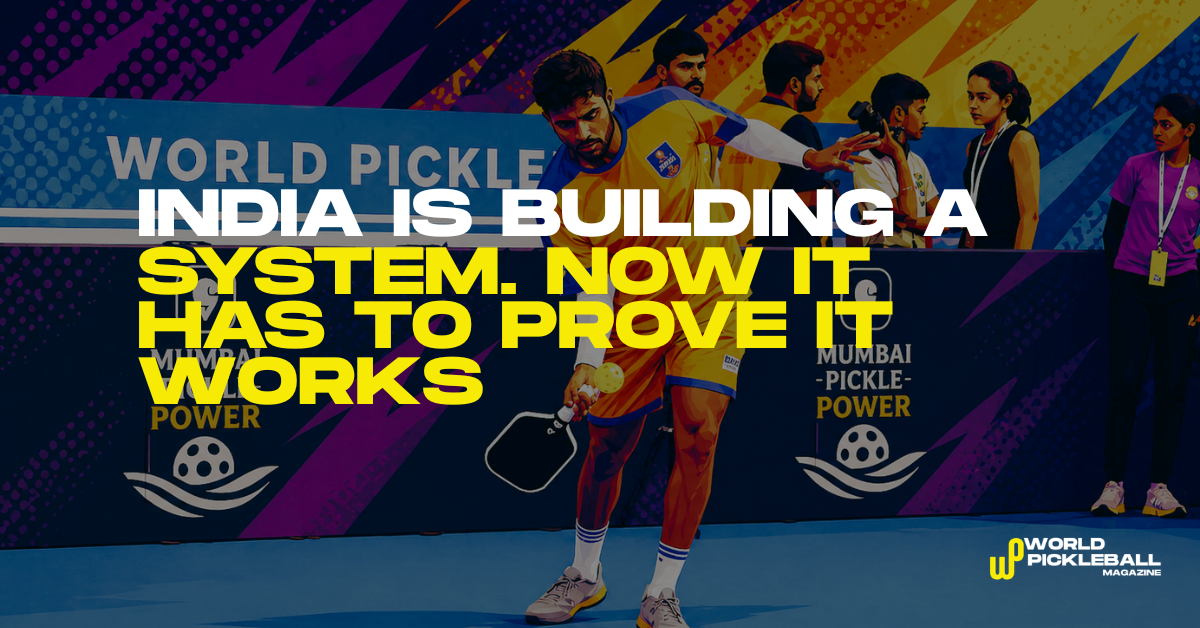
The Indian Pickleball Association’s partnership with Athletiq signals a shift from participation to performance, as the country begins to build the systems that actually produce elite players.
- The Indian Pickleball Association has appointed Indian brand Athletiq as its Official Performance Partner.
- The move points to a shift from rapid participation growth to structured player development.
- The real test will be whether India can turn scale into players ready for international competition.
India’s pickleball problem is no longer numbers.
Courts are filling. School competitions are expanding. National events are drawing larger fields. The base has been built quickly, and with real energy.
What comes next is harder.
Because once a sport reaches this stage, growth alone is not enough. Without structure, it starts to flatten. Standards drift. Talent slips through gaps. Good players emerge, but not consistently, and not at the level required to compete internationally.
That is the context behind the Indian Pickleball Association appointing Athletiq as its Official Performance Partner.
The shift from growth to structure
The announcement, made in New Delhi, brings together the IPA and a domestic performance brand founded by Harsh Sharma. On the surface, the objectives are straightforward: improve tournament infrastructure, strengthen talent identification, and supply equipment designed for Indian players.
But those phrases only matter if they translate into something real.
Better infrastructure is not a vague ambition. It means courts that meet consistent standards, events that run to schedule, and environments where players can prepare properly rather than adjust constantly. It means competitions that feel like steps in a pathway, not isolated weekends.
At the moment, a junior player can win a school event, enter a national competition weeks later, and still have little clarity on what comes next. That gap is what this kind of partnership is supposed to close.
Talent identification, meanwhile, only works if it connects to something tangible. India has already invested in inter-school competitions, national championships, and ranking systems. The next layer is linking those pieces so that a player can move from school level to national competition with clarity, not guesswork.
That is why India’s development story now needs to be read alongside wider Asian pickleball coverage, rather than treated as another isolated national boom. The continent is beginning to build different competitive models, and India is trying to make sure its model has enough structure to last.
Equipment is the third part of the puzzle, and it is often overlooked. A domestic partner matters because it reduces reliance on imported products that are not always priced or designed for the local market. More importantly, it allows feedback from players to feed directly into development, rather than being filtered through distant supply chains.
If you’re following how the global game is shifting week by week, the World Pickleball Report breaks this down every Wednesday.
Why timing matters now
Taken together, these are the components of a performance system.
The risk, if they are not built properly, is easy to recognise. Rapid growth without structure rarely produces better players. It produces more average ones. Participation rises, but standards vary. Pathways become unclear. Players plateau because there is no consistent framework pushing them forward.
Pickleball has already seen versions of this elsewhere, where expansion has outpaced organisation and left gaps between recreational play and elite competition. India is trying to avoid that outcome.
The IPA, led by President Suryaveer Singh Bhullar, has already laid some of the groundwork through national tournaments, coaching certifications, and ranking systems. Its listed affiliation with the Asian Pickleball Association places India inside a broader regional structure, while the Global Pickleball Federation gives the sport another layer of international context.
The Athletiq partnership suggests a move to tighten those systems, not just extend them.
That matters because Indian results are already starting to create stronger expectations. The next generation will not be judged only by domestic numbers, but by whether Indian players can appear regularly in international tournament coverage and look prepared when they get there.
From participation market to player pathway
This is not about how many people are playing anymore. It is about what those numbers produce.
That distinction is important for a country often discussed through the language of scale. India’s advantage is not simply that it can introduce pickleball to a huge population. The advantage comes if that population is connected to coaching, ranking, equipment, events and selection pathways that actually push the best players forward.
Without that, the system becomes noisy. With it, India has a chance to build something more durable.
The recent conversation around Asian competition and player movement has already shown how quickly regional pathways can become complicated. Players need clear routes, credible events, and enough competitive pressure at home before they test themselves elsewhere.
That is where this partnership has to become more than a badge on a press release.
What this means for Indian pickleball
If this works, India will not just be a large pickleball market. It will be a structured one.
That opens a different set of possibilities. Stronger domestic tournaments create better preparation. Clearer pathways reduce drop-off between junior and senior levels. Locally developed equipment improves access and consistency. Over time, those details shape the level of player the system produces.
It also changes India’s position globally. Instead of relying on external tours to validate its players, it can begin to develop athletes who are ready before they step onto international stages.
The next 12 to 18 months will show whether this is a real system or just another layer of organisation. The difference will be visible in the players who emerge, not the announcements that accompany them.
For a clearer view of where the sport is heading each week, you can join the World Pickleball Report here.
Further Reading
- Latest pickleball news from around the world
- Tournament coverage and results
- Rankings and player profiles
- Regional pickleball coverage
Chris Beaumont is the founder and Editor-in-Chief of World Pickleball Magazine. Chris follows the global game closely, reporting on the latest news, developments, stories and tournaments from all five continents. He also hosts the World Pickleball Podcast, interviewing people at all levels of pickleball. Chris is also an avid player, currently struggling to make the breakthrough from 4.0 to 4.5.