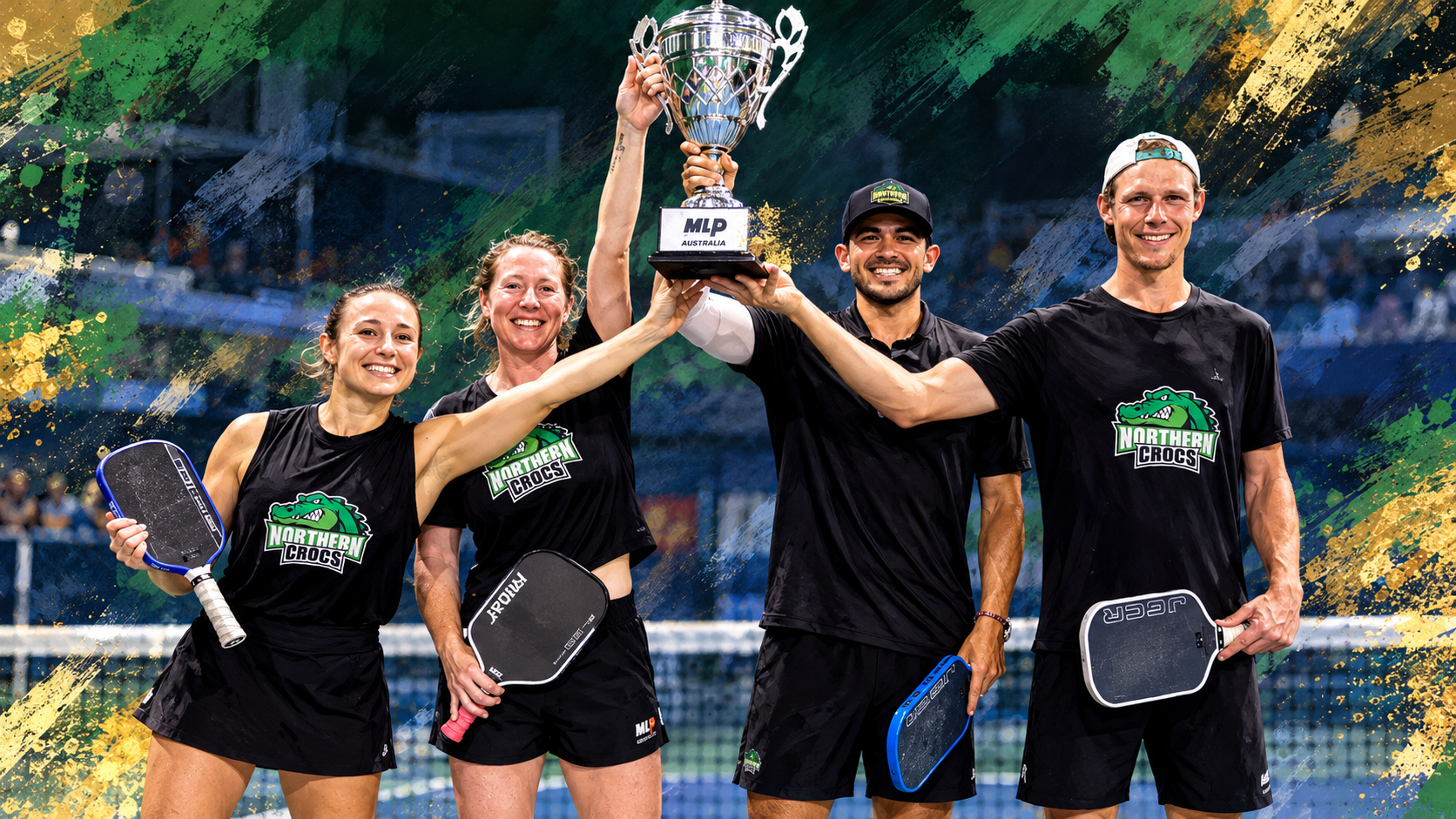
Northern Crocs recovered from a group-stage defeat to Pacific Flame, survived a 21–19 semi-final DreamBreaker against The Coasters and then claimed the Major League Pickleball Australia Brisbane Premier title with a 3–1 victory in Sunday’s final.
Key Takeaways
- Northern Crocs defeated Pacific Flame 3–1 to win the MLPA Brisbane Premier event on 11 October 2026.
- The champions had lost 3–1 to Pacific Flame during the group stage, making Sunday’s final a significant reversal.
- Northern Crocs survived a dramatic semi-final against The Coasters, winning a deciding DreamBreaker 21–19 after surrendering a 2–0 lead.
- Andie Dikosavljevic and Prycen Haas combined to win the decisive mixed doubles game in the final.
- The 2026 MLPA season continues on the Gold Coast and concludes in Sydney in November.
From Group-Stage Defeat to Brisbane Champions
Northern Crocs had already lost to Pacific Flame once during the Brisbane leg of Major League Pickleball Australia. By Sunday afternoon, they had also come within two points of seeing their title challenge end in a semi-final against The Coasters.
Yet it was the Crocs who finished the weekend as champions, defeating the previously unbeaten Pacific Flame 3–1 in the final to complete a remarkable turnaround at GetPickld in Meadowbrook, Queensland.
The result brought together the defining elements of the three-day competition. Pacific Flame had controlled Pool 1, Northern Crocs had needed to fight their way through the knockout rounds, and The Coasters had produced one of the weekend’s most dramatic recoveries before losing a deciding DreamBreaker 21–19.
For Crocs captain Andie Dikosavljevic and teammates Talia Saunders, Daniel Fogl-Kulich and Prycen Haas, the title was built on the strength of their doubles combinations and the ability to respond when matches became uncomfortable.
Their final victory was especially significant because it came against opponents who had beaten them 3–1 on Friday. Pacific Flame had not lost a tie since arriving in Brisbane, but their advantage disappeared when the championship was on the line.
The Brisbane title did not go to the team with the strongest preliminary record. It went to the side who produced the most effective partnerships at the decisive stage of the weekend.
Northern Crocs Take Control of the Final
The championship match began with the two same-gender doubles contests, and Northern Crocs immediately established the advantage that would ultimately decide the title.
Dikosavljevic and Saunders faced Pacific Flame’s Bernadette Massih and Sahra Dennehy in women’s doubles, winning 11–8 to give the Crocs the opening point.
The margin was competitive rather than emphatic, but the result mattered because it prevented Pacific Flame from setting the early pace. Against a side who had won all three of their group matches, securing the first game gave Northern Crocs a valuable foothold.
Fogl-Kulich and Haas then faced Lucas Pascoe and Nicholas Maleganeas in men’s doubles. The Crocs pairing also won 11–8, extending the lead to 2–0 and placing Pacific Flame in a difficult position.
The group winners now needed both mixed doubles contests simply to force a deciding DreamBreaker.
It was a situation Northern Crocs had experienced earlier that afternoon, although on that occasion they had been the team trying to protect a two-game lead.
Pacific Flame responded through Massih and Pascoe, who defeated Saunders and Fogl-Kulich 11–5 in the first mixed doubles contest.
That result reduced the deficit to 2–1 and demonstrated that the finalists were capable of disrupting the Crocs’ momentum. It also introduced the possibility of another deciding game, something Northern Crocs had narrowly survived against The Coasters.
The championship therefore rested on the second mixed doubles contest. Dikosavljevic partnered Haas against Dennehy and Maleganeas, with the Crocs needing one more win and Pacific Flame requiring victory to extend the tie.
Northern Crocs prevailed 11–7, completing a 3–1 championship victory and ensuring that no DreamBreaker would be necessary.
For Dikosavljevic and Haas, the final provided a particularly satisfying conclusion. Both had contributed to victories in the opening same-gender doubles matches before combining to secure the title in mixed doubles.
It was an effective demonstration of the four-player team format, where individual ability matters but the composition of partnerships can determine the outcome of an entire tie.
The 21–19 DreamBreaker That Saved Their Tournament
If the final demonstrated Northern Crocs’ ability to close out a match, their semi-final against The Coasters revealed how close they had come to elimination.
The opening stages suggested a comfortable victory. Dikosavljevic and Saunders overwhelmed Danni-Elle Townsend and Tayah Cross 11–0 in women’s doubles, while Fogl-Kulich and Haas defeated Roman Estareja and Ryan Henry 11–7 in men’s doubles.
Northern Crocs led 2–0, having conceded only seven points across the opening two games. At that stage, The Coasters faced the prospect of elimination without having established any sustained momentum.
But the mixed doubles contests transformed the tie.
Cross and Henry defeated Saunders and Fogl-Kulich 12–10, taking a closely contested game that required extra points to produce a winner.
Townsend and Estareja then faced Dikosavljevic and Haas in the second mixed doubles match, with the Crocs still needing only one victory to advance. Again, The Coasters prevailed by the narrowest possible margin, winning 13–11 and forcing the tie into a DreamBreaker.
The contrast was extraordinary. A team that had failed to score a single point in the opening women’s doubles contest had recovered to win two consecutive mixed doubles games, both by two points.
For Northern Crocs, the challenge had changed completely. They had been in control of the semi-final, but now needed to win a deciding singles contest after watching their opponents claim both mixed doubles matches under pressure.
The DreamBreaker was as close as the preceding games suggested it might be. Northern Crocs eventually won 21–19, securing the final two-point margin that separated qualification from elimination.
The match record confirms the result, although it does not establish a reliable rally-by-rally account of the closing stages. There is no basis for claiming that either side saved specific match points.
What the result does establish is that the Crocs had surrendered a two-game lead, endured two consecutive narrow defeats and still found a way to win the contest that decided their tournament.
That resilience became a central part of their championship story. Within hours, Northern Crocs would face another opponent capable of overturning a 2–0 deficit. This time, they ensured the comeback stopped after one mixed doubles victory.
Pacific Flame’s Unbeaten Run Meets Its Limit
Pacific Flame had arrived at the knockout stage with the strongest record in Pool 1.
Their three group victories included the 3–1 defeat of Northern Crocs on Friday, a 4–0 sweep of Gold Coast Glory and a 3–2 success against Brisbane Breakers.
The Breakers match was particularly significant because it required Pacific Flame to win a DreamBreaker 21–19. That result preserved their unbeaten record while demonstrating that they could survive a tight deciding contest, not merely win ties through comfortable doubles victories.
By the end of the group stage, Pacific Flame had established themselves as the leading side in Pool 1, with Northern Crocs second on two victories and one defeat.
The two teams had therefore followed different routes towards Sunday’s championship contest. Pacific Flame had maintained their consistency across the preliminary matches, while Northern Crocs had already experienced defeat against the opponents they would eventually face again.
There was little in the group-stage standings to suggest that the final would produce a reversal. Yet the MLPA format creates opportunities for precisely that kind of change.
As explained in the official MLPA competition format, each team tie features women’s doubles, men’s doubles and two mixed doubles games. If the teams split those four contests, a DreamBreaker singles tiebreaker determines the winner.
The structure means that a team can lose an earlier meeting but succeed in a rematch if its partnerships perform differently, particularly across the two opening doubles contests.
That was the central difference in the Brisbane final.
Pacific Flame remained competitive, and Massih and Pascoe provided a convincing mixed doubles victory, but the Crocs had already won both opening matches and needed only one more result.
When Dikosavljevic and Haas delivered it, Pacific Flame’s unbeaten run ended one tie short of the title.
Sydney Smash and The Coasters Challenge from Pool 2
The other half of the competition produced its own closely contested group standings.
The Coasters finished first in Pool 2 with two victories and one defeat, ahead of Sydney Smash and Bondi Pickleball Club, who recorded identical win-loss records but were separated by the competition’s standings criteria.
Melbourne Thunder finished fourth after losing all three group matches.
The Coasters’ campaign included a 4–0 victory over Melbourne Thunder and a 3–1 win against Sydney Smash, results that helped establish them as serious contenders for the Brisbane title.
Their semi-final performance against Northern Crocs ultimately reinforced that status, even though they were unable to complete the comeback.
Sydney Smash also produced a competitive preliminary campaign. Their results included a 3–2 DreamBreaker victory over Melbourne Thunder and a 4–0 success against Bondi Pickleball Club, demonstrating that they could win both closely contested and more decisive ties.
The Sydney squad of Mitchell Hargreaves, Jose Farias, Katherine Westbury and Shannon Spencer subsequently faced Pacific Flame in the semi-finals.
Pacific Flame won 3–1, eliminating Sydney and securing their place in the championship match.
That victory added another important result to Flame’s Brisbane campaign. They had already beaten Northern Crocs and survived a DreamBreaker against the Breakers, then defeated one of Pool 2’s leading teams to reach the final.
Their eventual defeat should therefore be understood in the context of an otherwise highly successful weekend.
For The Coasters and Sydney Smash, the results provided evidence of their competitiveness, even though neither reached the championship contest.
Brisbane Breakers Miss Their Opportunity at Home
The Brisbane Breakers endured a difficult event on home territory, finishing fourth in Pool 1 without a victory.
Their three defeats came against Gold Coast Glory, Northern Crocs and Pacific Flame. The results, however, were not uniformly one-sided.
Gold Coast Glory defeated Brisbane 3–2, while Pacific Flame also needed a DreamBreaker to secure a 3–2 victory over the Breakers.
Those two ties demonstrated that Brisbane could compete closely enough to split the four doubles contests against other Premier franchises. The difficulty came in converting those positions into victories.
Against Northern Crocs, the result was more decisive, with the eventual champions winning 4–0.
Taken together, the three results left Brisbane at the bottom of the pool despite pushing two opponents into deciding contests.
For a team competition where each tie contributes to the standings, losing successive DreamBreakers can quickly undermine an otherwise competitive weekend.
Gold Coast Glory finished third in Pool 1 with one victory and two defeats, their win over Brisbane proving insufficient to move them ahead of Pacific Flame or Northern Crocs.
Why the Crocs’ Doubles Balance Mattered
The most revealing aspect of Northern Crocs’ championship campaign was the consistency of their opening partnerships.
Dikosavljevic and Saunders won women’s doubles in both the semi-final and final. Fogl-Kulich and Haas achieved the same in men’s doubles.
That gave Northern Crocs a 2–0 lead against both The Coasters and Pacific Flame, despite the very different circumstances of those matches.
The semi-final exposed the limitations of that advantage. The Coasters won both mixed doubles contests, demonstrating that the Crocs could not rely on their opening victories to guarantee progression.
But the final showed how effectively the same four players could respond. When Pacific Flame won the first mixed doubles game, Dikosavljevic and Haas secured the second, preventing their opponents from reaching a DreamBreaker.
That contrast illustrates the strategic challenge facing MLPA teams.
A four-player roster must provide effective combinations in women’s doubles and men’s doubles, but also needs mixed partnerships capable of performing under pressure.
There is no large squad to absorb an unsuccessful combination or replace several players when a tie begins to turn. Every member of the roster contributes to the available partnerships, and the result of one game can place enormous pressure on the next pairing.
For Northern Crocs, the final offered a particularly clear example. Dikosavljevic and Haas had each contributed to the 2–0 lead before combining to win the decisive mixed doubles contest.
Saunders and Fogl-Kulich had also helped establish that advantage, even though their mixed doubles result went against them.
The championship was therefore a collective achievement rather than a story dependent on one outstanding individual performance.
That is what makes the MLPA format distinctive, and why the Brisbane final offered more than a straightforward upset.
What Brisbane Means for the 2026 MLPA Season
The Brisbane competition was the second stop of the 2026 Major League Pickleball Australia season, following Melbourne in September.
Eight Premier franchises are competing across four scheduled events, with 32 rostered athletes and a season prize pool advertised at more than A$200,000.
The official 2026 MLPA roster announcement confirms the competing teams and the remaining calendar, with events scheduled for the Gold Coast on 20–22 November and Sydney on 27–29 November.
The Brisbane result does not settle the overall season, but it provides an important indication of the competitive balance between the leading franchises.
Pacific Flame showed that they can produce consistent results across a demanding group schedule, winning all three preliminary ties and progressing through the semi-finals.
The Coasters demonstrated that even a 2–0 deficit can be overcome when the mixed doubles combinations begin to perform, while Sydney Smash remained competitive enough to reach the final four.
Northern Crocs, however, delivered the result that mattered most.
Their route to the title included a group-stage defeat, a quarter-final victory over Bondi Pickleball Club, a 21–19 semi-final DreamBreaker against The Coasters and a 3–1 victory over Pacific Flame in the championship match.
It was a campaign in which their weaknesses were exposed, but their strengths ultimately proved decisive.
The Crocs were not unbeaten, and they were not the most convincing team throughout every stage of the weekend. They were, however, the side who found the necessary results when elimination or the title was at stake.
For Pacific Flame, the challenge at the remaining events will be to translate the quality of their group-stage performances into success in the final.
For Northern Crocs, Brisbane provides something more tangible: a Premier event title and proof that they can defeat the team who had previously beaten them.
The most important moment may still have been the 21–19 DreamBreaker against The Coasters. Without those final two points, there would have been no opportunity for revenge against Pacific Flame.
Instead, the Crocs survived, recovered and completed their turnaround.
Brisbane’s champions were not the team who started the weekend strongest. They were the team who finished it best.
Further Reading
- Major League Pickleball Australia: Official 2026 Premier rosters and calendar
- How the MLPA team format and DreamBreaker work

Chris Beaumont
Founder and Editor-in-ChiefChris Beaumont is the founder and Editor-in-Chief of World Pickleball Magazine. Chris follows the global game closely, reporting on the latest news, developments, stories and tournaments from all five continents. He also hosts the World Pickleball Podcast, interviewing people at…
View All Articles →