
There is an attractive simplicity to the idea that pickleball tournaments have more capacity hiding between matches.
Courts are expensive. Tournament days are already long. Demand for places at major events frequently exceeds the hours available to accommodate them. If smarter software can extract another six per cent from the same number of courts, the appeal is obvious.
More matches. More entries. More revenue. Less dead time.
That was the proposition at the heart of my recent conversation with RAQT founder Jens Larsson. His company had tested its scheduling engine against data from a large tournament and calculated that it could deliver six per cent higher court utilisation, potentially creating room for between 10 and 15 per cent more registrations.
The figures were striking. They were drawn from RAQT’s modelling of real tournament data, with the next test being whether those gains can be reproduced consistently during live events.
After the article was published, I spoke to an experienced organiser who has spent years working behind the scenes at major pickleball events. The response was not a rejection of RAQT’s technology. It was a warning about where the missing minutes may actually be going.
The argument was straightforward.
A scheduling system can decide which match should follow the one currently taking place. It cannot guarantee that the four players involved are beside the court, checked in, warmed up and ready to begin.
That gap matters because there is a difference between producing an efficient schedule and operating an efficient tournament.
A simulation is not a tournament
Tournament software works in a world of information.
It knows which courts are available, which matches have finished, which players remain in each draw and where potential scheduling conflicts may arise. A strong platform can process those variables far faster than a tournament director trying to manage them manually.
RAQT’s proposed Control Tower develops that principle further. It is designed to give organisers a live view of the event, showing where delays are developing and where courts or players are creating pressure elsewhere in the schedule.
That could be enormously useful.
The difficulty comes when theoretical availability meets human behaviour.
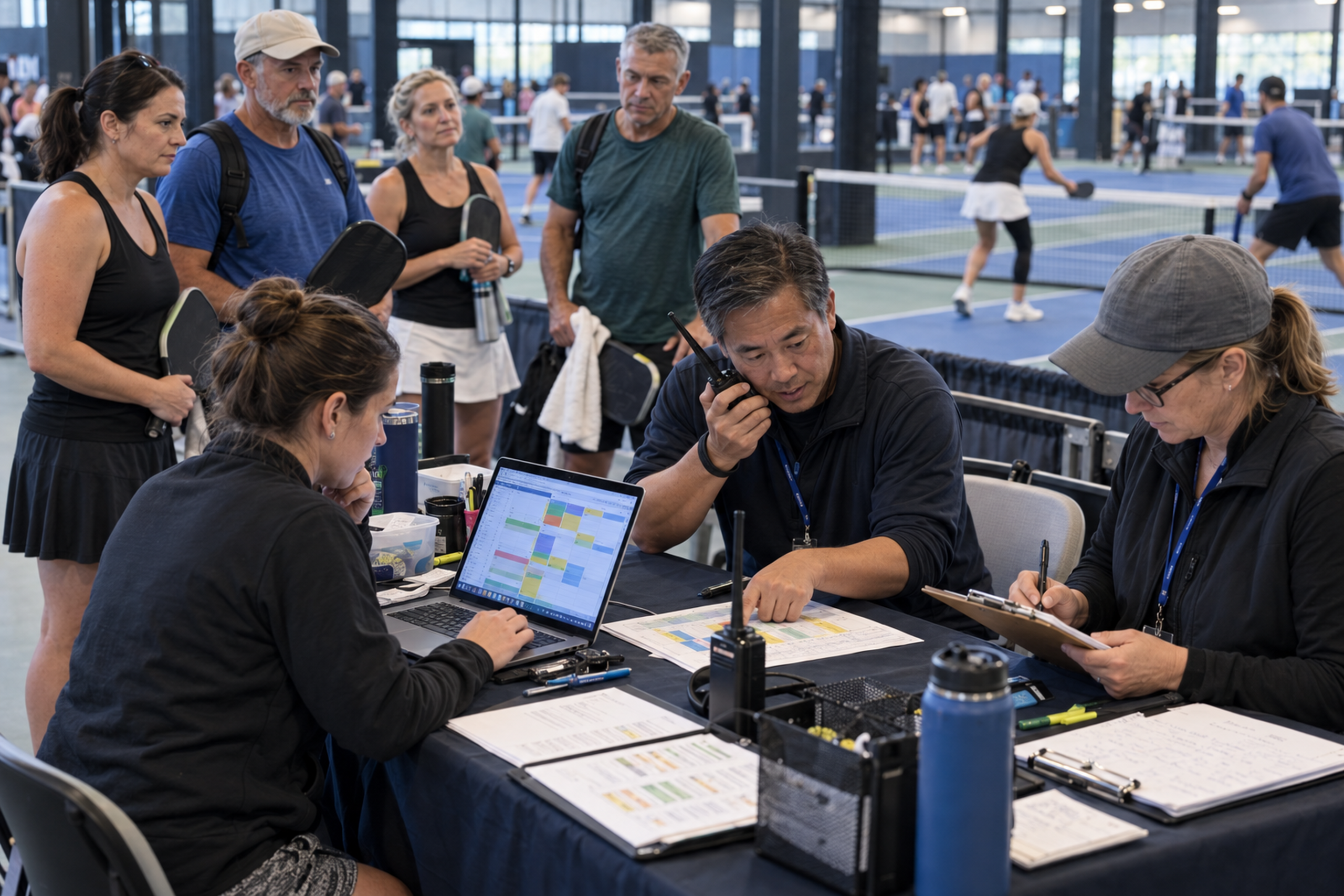
The system may show that Court 6 is ready for its next match. The players might still be on the other side of the venue. One may be searching for a partner. Another may only have started warming up after receiving the court notification. Somebody may have forgotten to check in. The previous players may still be collecting their belongings or confirming the score.
The court is available on the dashboard. It remains empty in the building.
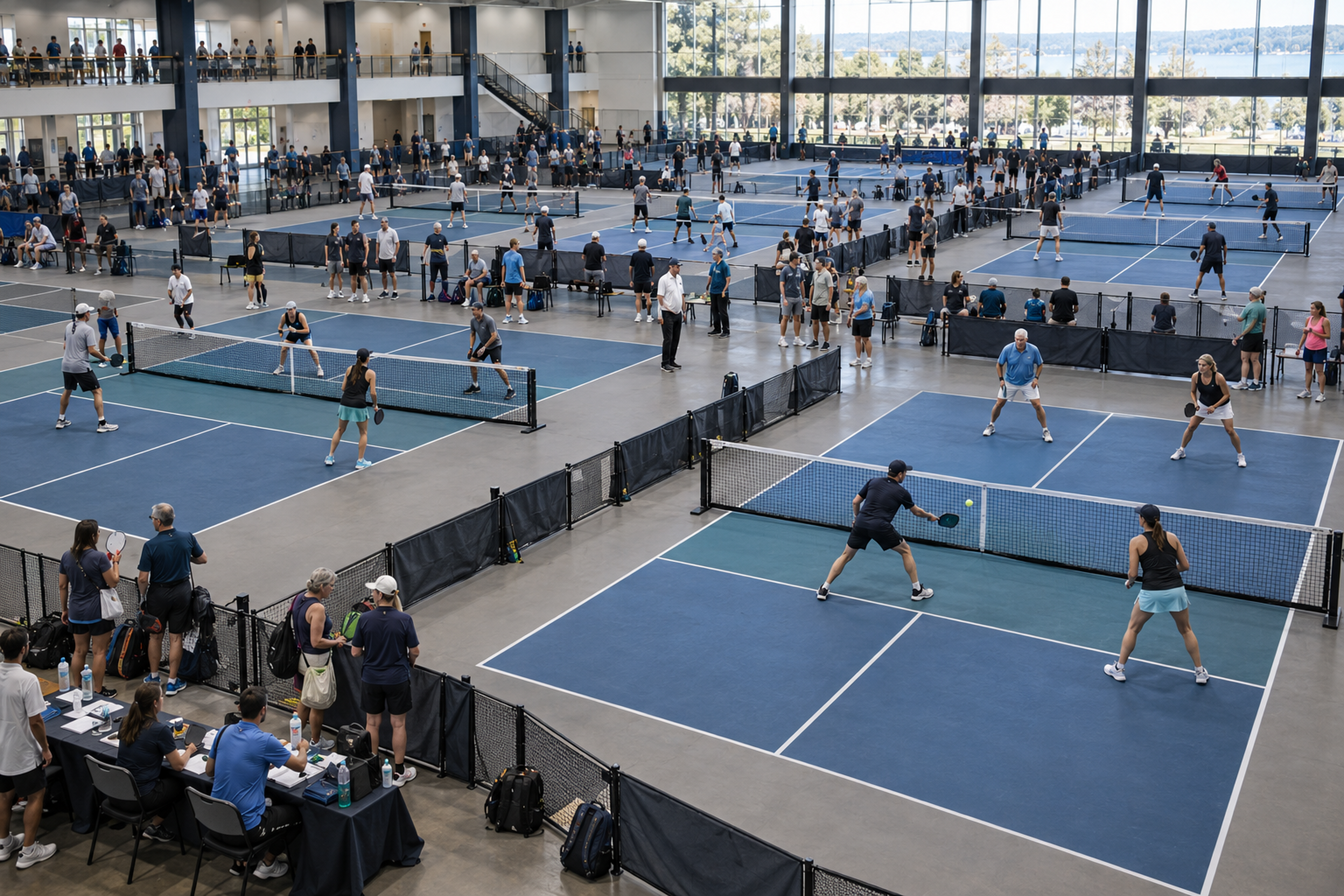
If that happens for five minutes on one court, the effect is negligible. If it happens repeatedly across 40 or 50 courts and hundreds of matches, those small delays become a considerable loss of playing time.
Software can identify and reduce that problem, but tournament operations will determine how much of the available time is ultimately recovered.
If you're following how the global game is shifting week by week, the World Pickleball Report breaks this down every day in our morning briefing.
What happens between matches?
Tournament schedules receive plenty of scrutiny because their failures are visible.
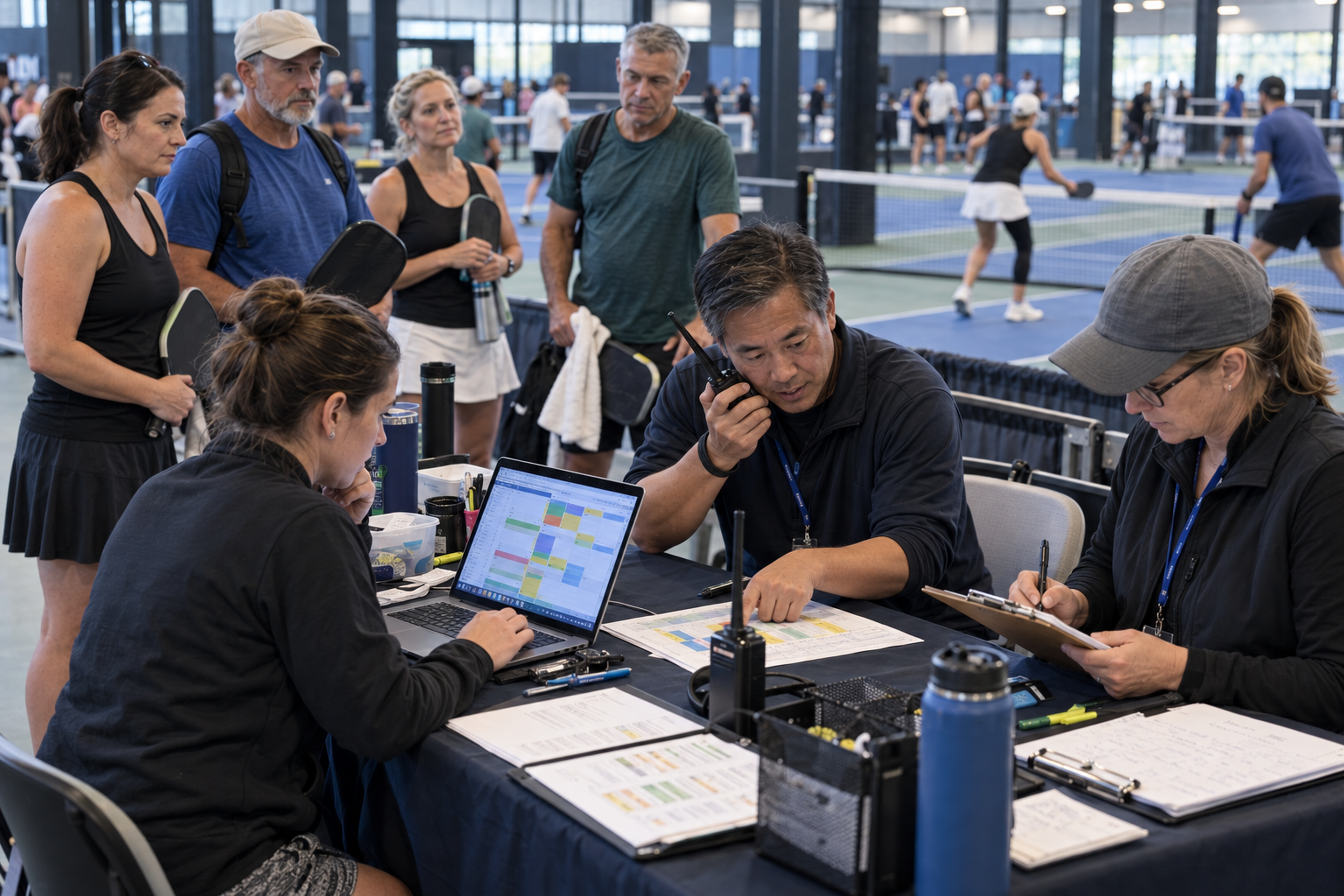
Players notice long waits, overlapping divisions and sudden changes. Organisers hear complaints when a draw falls behind or somebody is expected on two courts at once.
Court turnover receives less attention. Yet it is often during this transition that usable minutes disappear.
A player may treat the notification of a court assignment as the signal to start preparing. Partners may need to find one another. Bags and paddles have to be collected. The walk across a large venue can take several minutes. Once everybody arrives, the warm-up begins.
At the end of the match, there can be another delay while players leave the court, report the result or approve the score.
None of those actions appears unreasonable in isolation. Collectively, they can place a tournament under constant time pressure.
This is why operational guidance for tournament directors extends beyond building the draw. Pickleball Canada advises organisers to start all available courts and keep them occupied, warning that every minute a court sits unused adds to the tournament day. Its guidance also recommends notifying players who are “on deck”, providing separate warm-up courts where possible and limiting on-court warm-ups to two or three minutes.
Those are management measures rather than scheduling calculations.
They recognise that the next match must begin preparing before the current one finishes.
“A computer simulation assumes a player arrives at court 14 the instant their name is called. In reality, they are filling a water bottle on the other side of the park.”
Tournament Operations Director
The case for staging players
Large tournaments may need to think more like airports.
An airline does not wait until an aircraft is ready to depart before asking its passengers to find the gate. Travellers are called forward, assembled and processed in advance because the departure slot matters.
A tournament court is another limited asset. If four players begin making their way towards it only after the previous match has ended, part of that asset’s capacity has already been lost.
A stronger operating model would identify the next match early and place those players in a nearby staging area. They would be checked in, prepared and ready to enter as soon as the court became free.
Warm-ups would be time-limited and enforced. Scores would be recorded immediately. Players finishing their match would leave promptly so the next group could enter.
At smaller events, the tournament director and volunteers may handle much of this informally. At a major event spread across dozens of courts, it requires structure.
That might mean court monitors, referees or trained volunteers responsible for a defined group of courts. Their job would include locating the next players, keeping them nearby and ensuring that turnover happens consistently.
The players have responsibilities too.
Entering a tournament means more than arriving at the venue and waiting for a message. Participants need to understand when they must check in, where they should wait and how quickly they are expected to begin once called.
That expectation must be communicated before the tournament. It must also be enforced once play begins.
Technology still has a major role
None of this weakens the case for better tournament software.
It makes the case more precise.
Technology can build a stronger initial schedule. It can detect conflicts before they become delays. It can notify players earlier, identify open courts, track check-ins and give officials the information required to stage upcoming matches.
A live control system could show that one part of a venue is falling behind while another has spare capacity. It could alert an organiser when a player is required elsewhere or when an assigned court has remained empty for too long.
The opportunity lies in connecting the technology that identifies inefficiency with the people and procedures capable of eliminating it.
A dashboard can show that Court 6 has been unused for seven minutes. Its greater value comes when that information helps the tournament prevent the same delay from happening again.
An early warning gives tournament staff time to find the players. A reliable check-in system confirms who is present. A live court feed tells staff when the existing match is close to finishing.
Technology becomes the nervous system of the tournament. People still have to move its limbs.
Testing the right question
RAQT’s six per cent figure deserves a live trial because the underlying question is important.
Pickleball cannot respond to every increase in participation by building more courts or adding another tournament day. Existing facilities need to be used better.
Any proper trial should measure more than the total amount of time each court is occupied. It should record why each period of inactivity occurred.
Was there an avoidable gap in the schedule?
Did the previous match finish earlier than expected?
Were the next players involved in another division?
Had they checked in?
Were they standing close enough to reach the court immediately?
Did the warm-up exceed the permitted time?
Was the result of the previous match still being processed?
Was a referee or other official unavailable?
That information would allow organisers to distinguish between minutes lost in the schedule and minutes lost after the schedule had already done its job.
It might show that RAQT’s system can unlock the full six per cent. It may also reveal which operational changes are needed to convert that theoretical gain into additional matches.
A smarter schedule should make a tournament easier to run. A disciplined operating system should allow that schedule to work as intended.
Where the opportunity lies
Larsson is right to challenge the assumption that tournaments have already extracted everything possible from their courts.
There is almost certainly unused capacity inside many events.
Finding it will require better data, stronger scheduling and a clearer view of what is happening across the venue. It will also require early check-ins, staged players, shorter warm-ups, prompt score reporting and people responsible for turning courts around.
The most useful version of RAQT’s Control Tower may therefore be one that connects those two worlds.
Its software can tell organisers where the minutes are disappearing.
Whether those minutes are recovered will be decided beside the courts.
For a clearer view of where the sport is heading each week, you can join the World Pickleball Report here.

Chris Beaumont
Founder and Editor-in-ChiefChris Beaumont is the founder and Editor-in-Chief of World Pickleball Magazine. Chris follows the global game closely, reporting on the latest news, developments, stories and tournaments from all five continents. He also hosts the World Pickleball Podcast, interviewing people at…
View All Articles →