
THE LAB
Key Takeaways
- This story reflects a key shift defining the maturity and expansion of the global pickleball landscape in July 2026.
- Decisions and infrastructure investments made now are establishing the long-term foundations of the sport.
The Measurement Layer
What technology is changing pickleball right now — and why June 2026 matters
Pickleball still looks simple from the outside.
A net, two paddles, a plastic ball, and a court marked out in lines that most players could sketch from memory. At club level, the game still feels social, informal, almost unchanged in its rhythm from a decade ago.
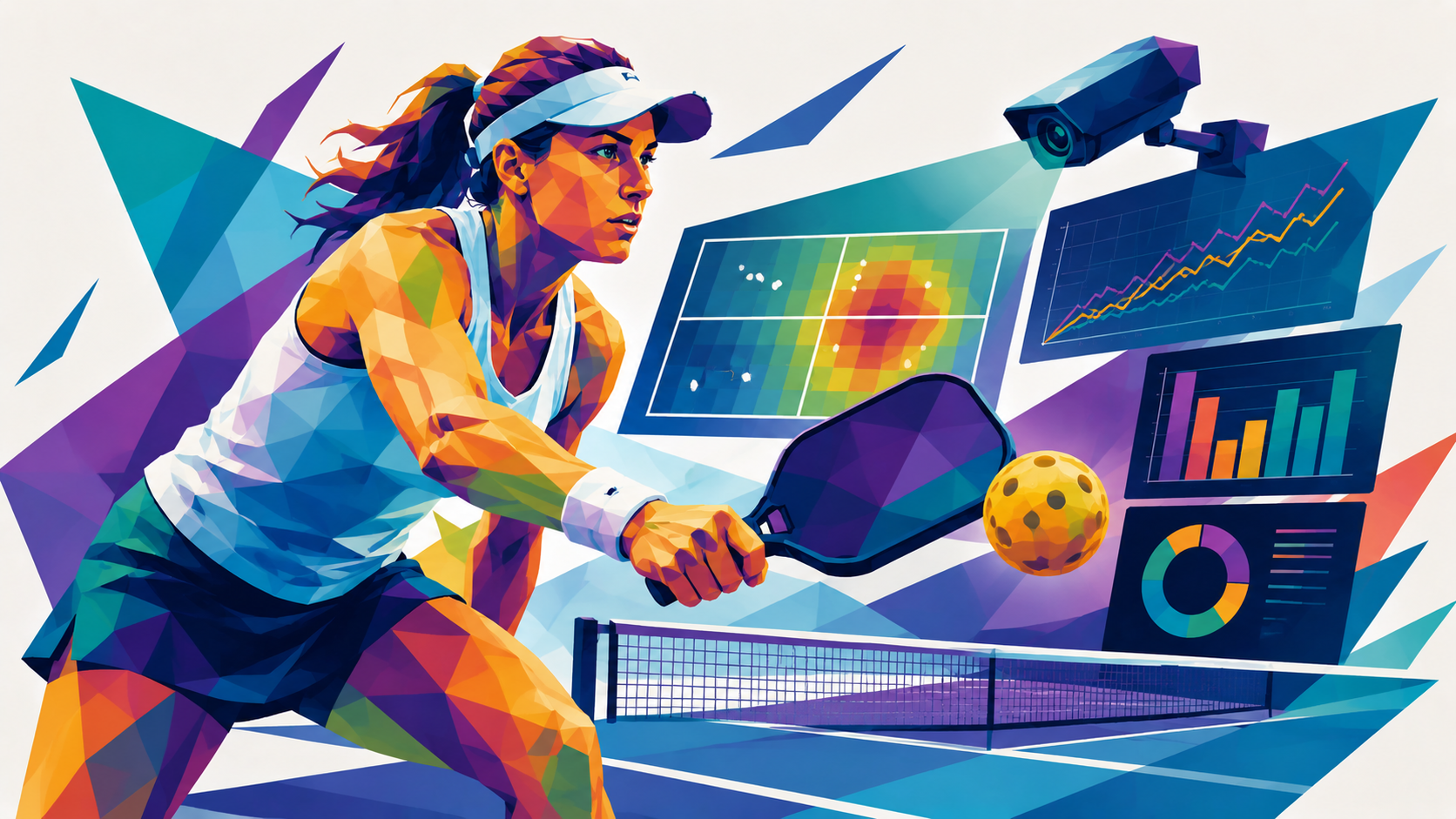
But if you look at what actually happened in June 2026, across courts, apps, tournaments and equipment systems, a different picture emerges.
The sport is not just growing.
It is being measured into something else.
And once a sport becomes measurable in every direction, it stops being purely recreational. It becomes a system.
The court is no longer just a surface
One of the clearest shifts in June came at infrastructure level, where court management and access systems are quietly moving into automation.
Trainge’s court management platform has been used in active deployment, linking booking, payment, and access control into a single system. A player pays, receives a digital access code, and enters a court that is effectively switched on for the duration of their booking. Lighting, power systems, and in some cases ball machines, activate only when the system recognises usage.
At the same time, court installation workflows have shifted behind the scenes. Contractors are now using mobile-first estimation tools such as QuoteIQ and Jobber to generate site assessments and project costs directly from uploaded imagery, compressing what was previously a manual surveying process into a software-led workflow.
Even public infrastructure is now being shaped through structured funding models. In June 2026, USA Pickleball Serves awarded $25,000 grants to complete court projects in Iowa and Kansas, directly linking grassroots expansion to centralised funding pipelines.
And in Seattle, a proposed reduction of 36 courts across multiple neighbourhoods showed the other side of the equation: as quickly as courts are being built, they are also becoming contested, regulated space.
The court is no longer neutral.
It is managed, funded, optimised, and disputed.
If you're following how the global game is shifting week by week, the World Pickleball Report breaks this down every day in our morning briefing.
Coaching is now a video feedback loop
The second shift is happening in how players improve.
June 2026 saw another step change in AI-assisted coaching tools, particularly through SwingVision’s latest updates, including its “Ground Mode” release, Paddle tracking system moving out of beta, and expanded ball-tracing overlays across recorded matches.
What matters is not the individual features, but what they collectively remove from the coaching process.
Manual tagging is disappearing. Post-match breakdown is being compressed. Video analysis that once required a coach and multiple hours can now be generated automatically from a single device recording.
Alongside this, competing platforms such as PB Vision and PickleWatch are pushing analysis in different directions. One focuses on tactical patterns and transition efficiency. Another prioritises physiological load and stroke detection without relying on video input at all.
At the same time, DUPR Vision continues to develop video-linked performance analysis tied directly to rating systems, linking how a player performs visually with how they are scored competitively.
The coaching loop is no longer:
play → review → adjust
It is becoming:
play → instant breakdown → continuous adjustment
The delay is disappearing.
DUPR is no longer just a rating system
The most structurally important development in June 2026 was not a new tool, but a reset.
DUPR completed its first full system-wide rating reset in early June, processing over 400,000 matches. Most players experienced minimal rating movement, but the significance was not volatility. It was standardisation.
From this point, DUPR functions less like a ranking system and more like a controlled calibration layer across the sport.
This is reinforced at tournament level.
Events such as the Samuell Grand DUPR Tournament, Life Time Garden City Jamboree, and multiple club “DUPR Day” sessions in June all moved toward stricter eligibility enforcement, where entry is no longer based on self-declared rating, but verified system averages.
At the club level, this is changing behaviour.
Players are no longer simply entering matches.
They are entering data points that affect future access.
Matches are becoming data objects
In parallel with coaching systems, match tracking has moved into real-time data capture.
PlayReplay systems were used across Major League Pickleball events throughout June 2026, generating structured datasets from live matches, including shot types, ball velocity and trajectory tracking.
Owl AI’s software-based officiating system also ran across the same events, integrating directly with broadcast feeds to automate line calling and challenge systems without requiring additional hardware installations.
If you’re following how the global game is shifting day by day, the World Pickleball Report breaks this down in our daily briefing.
This combination matters.
It means a professional match is no longer just recorded.
It is parsed, structured, and converted into usable datasets as it happens.
The match becomes something that can be queried after it is played.
Equipment is now a regulated variable
The paddle is no longer just equipment.
In June 2026, the delisting of the Facolos Pro Series Elite X paddle from USA Pickleball approval lists created immediate ripple effects through the professional ecosystem, including sponsorship complications for contracted players.
At the same time, certification systems under UPA-A standards continued to tighten, with testing now shifting away from surface roughness alone and toward direct performance measurement, including spin-rate analysis using motion tracking systems.
On-site tournament enforcement also increased, with major events introducing physical paddle inspection protocols to detect delamination, compression changes, and illegal modifications.
Paddle performance is no longer assumed.
It is verified.
Wearables are starting to split sport from fitness
Wearable technology is also moving closer to sport-specific integration.
In June, Huawei and Garmin both expanded sports tracking ecosystems, including dedicated pickleball activity profiles, gear lifecycle tracking, and live workload monitoring systems.
What is changing here is not accuracy, but specificity.
Generic fitness tracking is no longer enough. Devices are beginning to distinguish between indoor and outdoor pickleball movement patterns, stroke intensity, and sport-specific load metrics.
This is the early stage of pickleball becoming a defined dataset inside broader athletic monitoring systems.
Video officiating is being rebuilt as software
The final shift is happening in officiating.
Major League Pickleball integrated both PlayReplay and Owl AI systems across its June tournament series, introducing automated line calling and structured video challenge systems that operate with minimal human intervention.
At the same time, post-match accountability systems in the PPA Tour have introduced structured review and fine mechanisms based on recorded video evidence.
This changes the function of officiating.
It is no longer only about what happens during the match.
It extends beyond it.
Decisions are now distributed across time.
What this actually adds up to
Individually, none of these developments redefine pickleball.
Smart courts improve access.
AI improves coaching.
DUPR improves ranking structure.
Wearables improve tracking.
Video systems improve officiating.
Paddles are more tightly regulated.
But taken together, June 2026 shows something more fundamental.
Pickleball is being converted into a measurable sport at every layer of its structure.
The court is measured.
The player is measured.
The match is measured.
The equipment is measured.
The decision-making is measured.
And once a sport becomes fully measurable, it begins to behave differently.
Not necessarily better.
But differently enough that players will eventually notice something has changed.
Even if they cannot immediately explain what it is.
Because the game is still pickleball.
But the system around it is no longer simple.
📖 Read the Full July 2026 Issue
This article appears in Issue #18 of World Pickleball Magazine — download the complete edition free.
Further Reading
- Latest pickleball news from around the world
- Tournament coverage and results
- Rankings and player profiles
- Regional pickleball coverage
For a clearer view of where the sport is heading each week, you can join the World Pickleball Report here.

Chris Beaumont
Founder and Editor-in-ChiefChris Beaumont is the founder and Editor-in-Chief of World Pickleball Magazine. Chris follows the global game closely, reporting on the latest news, developments, stories and tournaments from all five continents. He also hosts the World Pickleball Podcast, interviewing people at…
View All Articles →