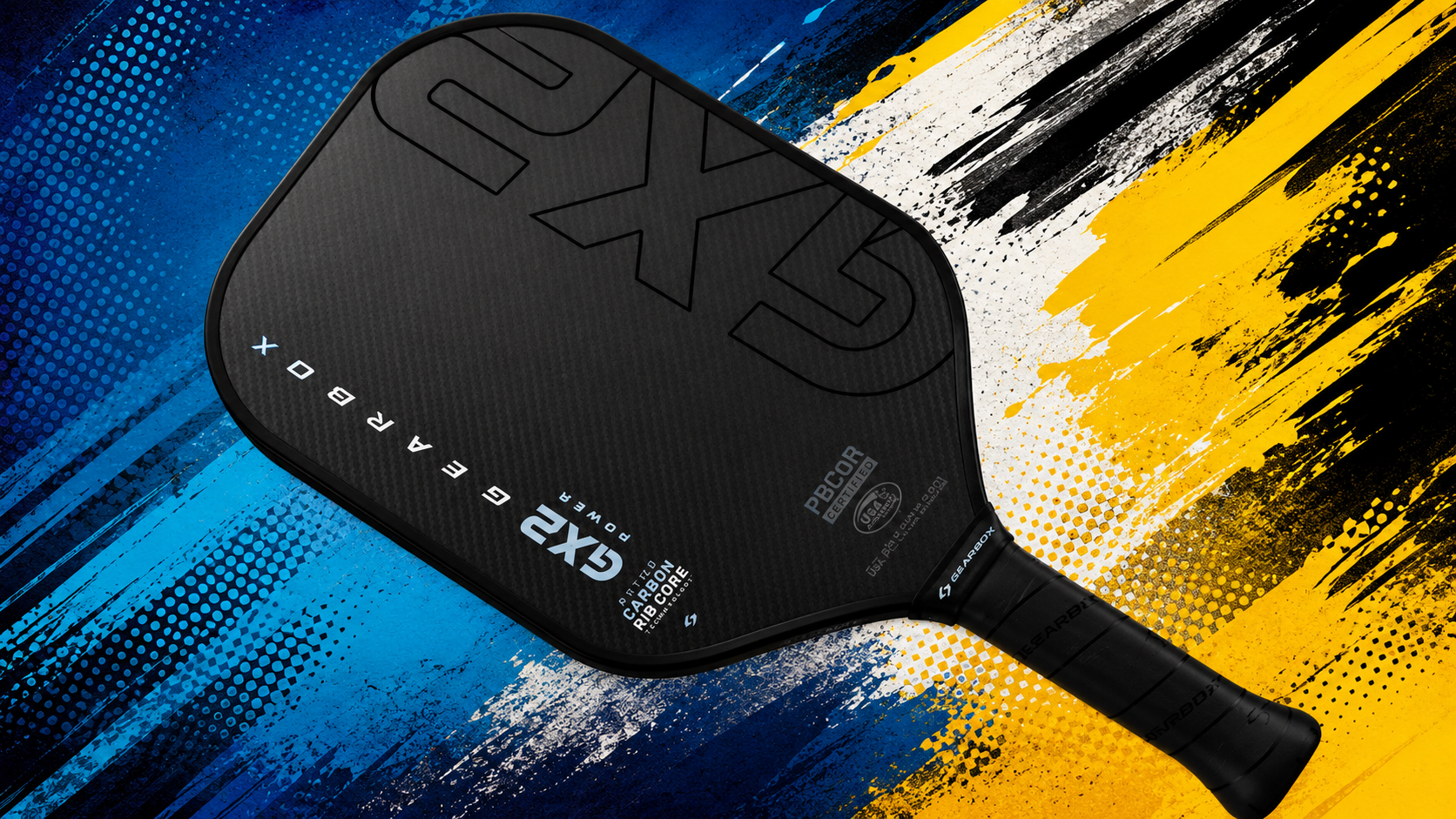
While many paddle brands compete through sponsorships, marketing campaigns and cosmetic refreshes, Gearbox has spent the past decade investing in engineering. Its latest milestone says as much about where pickleball equipment is heading as it does about the company itself.
Key Takeaways
- Gearbox says it has developed 50 original pickleball patents during its first decade in business.
- Founder Rafael Filippini brought aerospace composites expertise and engineering knowledge into paddle design long before carbon fibre became a mainstream talking point in pickleball.
- The milestone reflects a broader shift within the paddle industry as proprietary technology increasingly becomes a competitive advantage.
Ten years ago, Gearbox was building pickleball paddles in a garage.
Today, the San Diego-based manufacturer says it holds 50 original pickleball patents—an achievement that says as much about where paddle technology is heading as it does about Gearbox itself.
On one level, that is a company celebrating an anniversary.
On another, it says something about the direction of one of pickleball’s fastest-moving industries.
As the professional game matures, equipment manufacturers are discovering that success is becoming harder to achieve through branding alone. Elite players no longer talk only about feel. They discuss dwell time, swing weight, foam cores, carbon fibre layups and energy return with a technical vocabulary that barely existed in pickleball a few years ago.
Governing bodies continue to refine certification procedures as paddle performance comes under greater scrutiny, while manufacturers search for ever-smaller gains within increasingly regulated equipment.
The conversation around paddles has changed.
Five years ago, much of the industry’s attention centred on endorsements, launches and cosmetic redesigns. Today, engineering itself has become part of the competitive battleground.
Gearbox’s latest milestone is one of the clearest illustrations of that shift.
An Engineer’s Route Into Pickleball
Gearbox’s story begins with its founder, Rafael Filippini.
A first-generation immigrant who arrived in the United States from Mexico as a child without speaking English, Filippini followed an unusual path into sporting equipment.
He served in the military composites division, working on high-performance aircraft where carbon fibre structures, composite materials and manufacturing precision were everyday engineering challenges rather than marketing language. That experience provided a technical understanding of advanced materials that would later shape his approach to paddle design.
At the same time, he pursued engineering while competing professionally in racquetball, before spending 13 years with a racquetball equipment manufacturer.
Each stage added another layer.
Engineering taught him how materials behave.
Professional sport taught him how equipment performs under pressure.
Manufacturing taught him how products are developed and refined over time.
When he eventually launched Gearbox from his garage, those experiences combined into a philosophy that placed engineering at the centre of the business rather than treating it as a supporting department.
Betting On Intellectual Property
Many paddle companies have entered pickleball by adapting manufacturing techniques already common in tennis or other racquet sports, differentiating themselves through player sponsorships, branding and product positioning.
Gearbox chose a different route.
From the outset, the company focused on developing proprietary carbon fibre technologies and protecting those ideas through patent filings.
According to reporting published by The Dink, that strategy has now produced 50 original pickleball patents.
Patents, however, are not trophies.
Nor are they guarantees of commercial success.
Many patented technologies never become industry standards, while some of the most successful sporting products owe their popularity as much to player acceptance as engineering ingenuity.
The significance of Gearbox’s milestone therefore lies less in the number itself than in what it represents.
The company has spent a decade investing in research and development at a time when much of the wider industry was racing simply to meet exploding consumer demand.
Pickleball’s Engineering Arms Race
The timing of Gearbox’s announcement is notable.
Recent seasons have seen debates over foam-core construction, power levels and certification standards dominate conversations around equipment. The legal stakes have risen too, with JOOLA’s patent action against 11 paddle brands showing how fiercely companies are beginning to protect proprietary designs.
Manufacturers now face closer scrutiny over how paddles are designed, tested and approved for competition.
At the same time, elite players have become increasingly knowledgeable consumers.
Discussions that once focused primarily on feel now regularly include energy return, sweet-spot expansion, swing weight, stability and carbon fibre construction.
That evolution has changed the industry’s competitive landscape. Even the sound produced by different constructions has become an engineering question, as WPM explored in its examination of pickleball’s acoustic arms race.
Developing original technology is expensive.
It demands investment in material science, design, testing and manufacturing, often without any certainty that the resulting innovation will become commercially successful.
Yet as performance margins narrow and regulations tighten, genuine engineering expertise may become a more durable competitive advantage than marketing visibility alone.
What The Next Decade May Look Like
Gearbox’s anniversary is naturally a milestone for one company.
It is also a reflection of where pickleball equipment appears to be heading.
As the market matures, the gap between companies developing proprietary technologies and those primarily assembling existing concepts may become increasingly visible.
Consumers are becoming more informed.
Professional players are becoming more demanding.
Certification standards continue to evolve.
Together, those trends create an environment where technical innovation carries increasing value.
Whether Gearbox ultimately converts its patent portfolio into sustained market leadership remains to be seen. Patents protect ideas, but players ultimately decide which technologies deserve to survive.
What is already clear, however, is that pickleball’s equipment industry has entered a different phase of its development.
The next decade will almost certainly produce faster materials, more sophisticated construction methods and tighter equipment regulation. The companies that shape that future may not be those with the biggest marketing budgets, but those capable of solving engineering problems before the rest of the industry even recognises them.
Gearbox believes that is where its future lies.
Whether the wider market agrees will not be measured by the number of patents displayed on an office wall, but by the paddles players continue choosing to carry onto the court.
Further Reading
- JOOLA Files Sweeping Patent Case Against 11 Paddle Brands
- Pickleball’s New Acoustic Arms Race
- Selkirk Acquires Bread & Butter in Pickleball’s Biggest Indie Buyout

Chris Beaumont
Founder and Editor-in-ChiefChris Beaumont is the founder and Editor-in-Chief of World Pickleball Magazine. Chris follows the global game closely, reporting on the latest news, developments, stories and tournaments from all five continents. He also hosts the World Pickleball Podcast, interviewing people at…
View All Articles →