
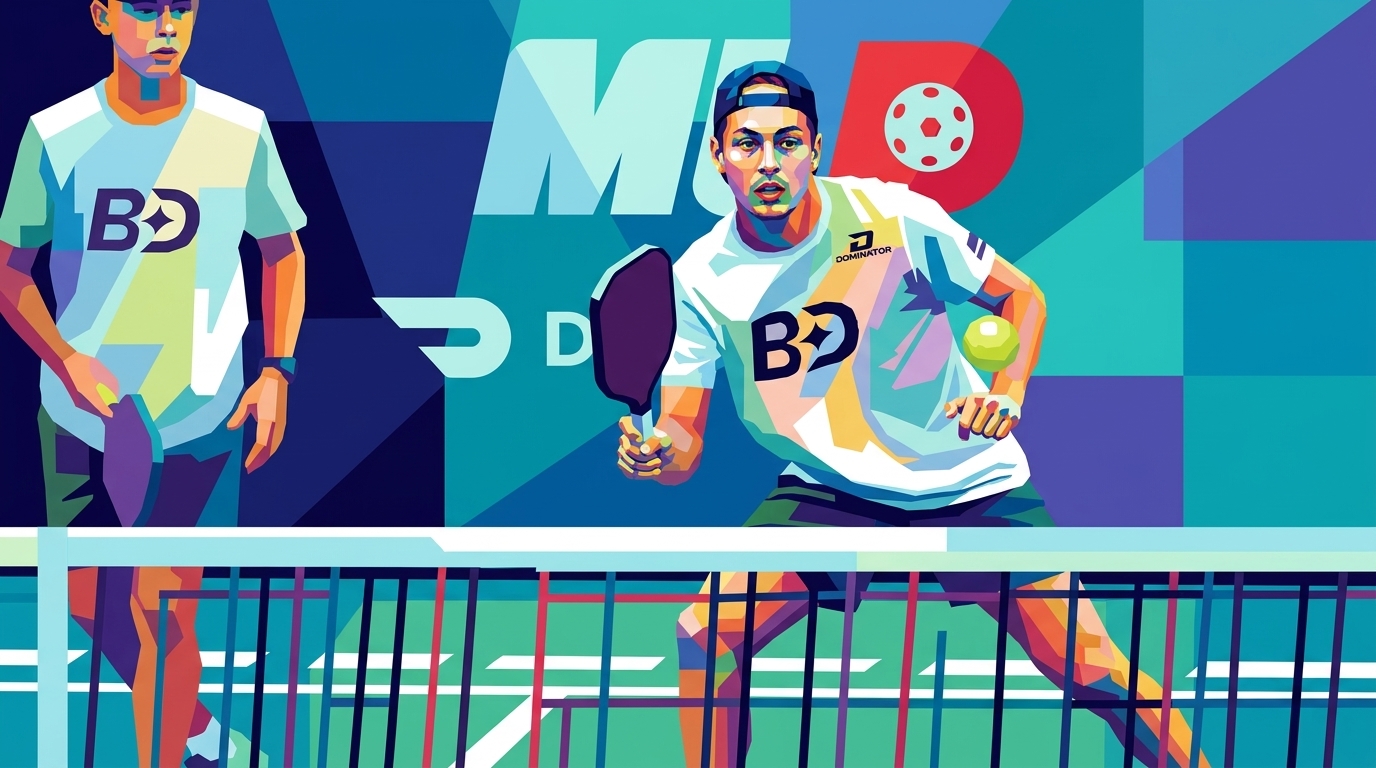
Connor Garnett Is Investing in Pickleball’s Future. One Decision at a Time
Key Takeaways
- This story reflects a key shift defining the maturity and expansion of the global pickleball landscape in July 2026.
- Decisions and infrastructure investments made now are establishing the long-term foundations of the sport.
Connor Garnett left investment banking to pursue professional pickleball, but he never abandoned the mindset that made him successful in finance. Whether he is building a brand, developing a new shot or deciding how to spend his next hour of practice, every choice is treated as an investment. That way of thinking may explain why he has become one of the sport’s most original voices.
The Athlete Who Thinks Like an Investor
Spend an hour talking to Connor Garnett and you begin to notice something unusual.
He answers questions like a professional athlete.
He thinks like an investor.
Ask him about leaving investment banking and he talks about spreadsheets rather than sacrifice. Ask him about building 2E Nation and he instinctively discusses opportunity cost before ambition. Ask him about the future of pickleball and he is less interested in making predictions than in identifying where the next advantage might come from.
Most elite athletes tell stories.
Garnett explains decisions.
It is a subtle distinction, but by the end of our conversation it feels like the thread connecting almost every chapter of his career.
That career has never followed the obvious path. Before becoming one of the PPA Tour’s most recognisable players, Garnett worked in investment banking, a profession where every decision is measured against risk, return and the value of finite resources. Walking away from that world to pursue a career in one of the world’s youngest professional sports has become one of the defining stories attached to his name.
The reality is considerably less romantic.
Connor Garnett does not appear to enjoy gambling.
If anything, he spends much of his time trying to remove uncertainty.
That instinct surfaces repeatedly throughout our conversation. Whether he is discussing tournament scheduling, coaching, content creation, tactical innovation or the emergence of young players, the process is remarkably consistent. Gather information. Understand the trade-offs. Make the decision. Review the outcome. Repeat.
It is easy to mistake that mindset for caution.
In reality, it allows him to be surprisingly bold.
Because once Garnett believes he understands the odds, he commits completely.
That philosophy extends far beyond tournament play. It shapes the way he experiments with technique, the businesses he builds, the opportunities he accepts and, perhaps most importantly, the ones he quietly declines.
Every decision is an allocation of capital.
Only the capital is rarely money.
It is time.
Attention.
Energy.
Curiosity.
Those are the assets Garnett protects most carefully because, unlike sponsorship deals or tournament prize money, they cannot be replenished once they have been spent.
Perhaps the most revealing sentence of the entire interview arrives almost in passing.
Reflecting on a period earlier this season when business commitments had begun to crowd out training, he pauses before offering an unusually candid assessment.
“The engine is still my pickleball.”
The line lasts only a few seconds, yet it quietly explains almost everything that follows.
Without the player, there is no brand.
Without continual improvement, there is no authority to coach, create content or build businesses around the sport.
Everything else rests upon the quality of the work that happens long before the cameras are switched on.
By the end of that opening conversation, it becomes clear this is not simply a story about one of professional pickleball’s leading players.
It is a story about how one of the sport’s most thoughtful minds makes decisions.
If you're following how the global game is shifting week by week, the World Pickleball Report breaks this down every day in our morning briefing.
The Spreadsheet That Changed Everything
There is a version of Connor Garnett’s story that has been repeated so often it has almost become folklore.
Investment banker leaves secure career to chase professional pickleball.
It is an irresistible headline because it follows a familiar sporting script. Stability gives way to passion. Financial security is exchanged for uncertainty. A sensible career is sacrificed for a dream.
Listening to Garnett tell it, however, the story becomes something rather different.
“I built a spreadsheet,” he says, almost matter-of-factly.
Before handing in his notice, Garnett worked out exactly what life as a professional pickleball player would need to look like financially. Not the dream scenario. Not the perfect outcome. Simply the point where the numbers started to make sense.
How much would travel cost?
What could he realistically earn?
Where was the break-even point?
Once he had answered those questions, the decision itself became remarkably straightforward.
“I realised I could make it work.”
That answer reveals something important.
Many athletes are celebrated for taking extraordinary risks.
Garnett seems more interested in understanding them.
There is a significant difference.
The popular narrative suggests he walked away from certainty.
His own version is that he reduced enough uncertainty for the opportunity to become worth pursuing.
There was another calculation sitting quietly behind the spreadsheet.
“I can always go back.”
It is such a simple observation that it would be easy to overlook, yet it fundamentally changes the story.
He was not choosing forever between investment banking and pickleball.
He was choosing between trying now or wondering forever.
It is the sort of thinking that feels entirely consistent with someone trained to evaluate opportunity cost rather than simply chase upside.
Ironically, the biggest challenge arrived only after he became a professional.
Winning tournaments was no longer enough.
Modern professional pickleball asks far more of its leading players than previous generations ever faced. Tournament schedules sit alongside coaching commitments, content creation, sponsorship obligations, travel, camps, product development and constant engagement with audiences that expect unprecedented access.
The career has become an ecosystem.
And ecosystems require decisions.
Every opportunity appears attractive in isolation.
Together, they compete for the same finite resource.
Time.
Looking back, investment banking did not simply teach Connor Garnett how to analyse numbers.
It taught him how to allocate attention.
That lesson may prove to have been far more valuable.
Every Hour Has to Earn Its Place
There is a phrase Connor Garnett never actually says during our conversation.
Yet it hangs over almost everything we discuss.
Every hour has to justify itself.
That may be the defining challenge facing today’s professional pickleball player.
A decade ago, success looked relatively straightforward. Train. Compete. Recover. Improve.
Today’s professionals live in a very different world.
They are expected to compete internationally while simultaneously becoming coaches, entrepreneurs, media personalities, content creators and business owners. Many now operate businesses that would have seemed unimaginable during the sport’s earliest professional years.
Pickleball’s growth has created extraordinary opportunity.
It has also created extraordinary distraction.
For someone with Garnett’s background, those opportunities are impossible not to see.
2E Nation has grown into far more than a memorable name attached to his distinctive two-handed backhand. It has become a coaching philosophy, a community and a business that extends well beyond tournament weekends.
From the outside, that looks like success.
Internally, it required a difficult reassessment.
Earlier this season, Garnett found himself questioning whether the balance had shifted too far.
Business was flourishing.
His pickleball wasn’t.
“I started focusing too much on the business side. I wasn’t practising enough.”
There is something refreshing about the honesty.
Elite athletes rarely admit that success itself can become a distraction.
Garnett does.
More importantly, he recognised it before it became permanent.
There is a temptation, particularly in a young sport, to assume progress comes from doing more.
More content.
More coaching.
More travel.
More partnerships.
Garnett’s experience suggests almost the opposite.
Eventually every professional reaches a point where progress depends less on finding another opportunity and more on having the discipline to ignore one.
In investment banking, that discipline protects capital.
In professional pickleball, it protects the player.
Which brings us back to the sentence that quietly anchors the entire interview.
“The engine is still my pickleball.”
It is no longer simply an observation.
It becomes a decision-making framework.
If an opportunity strengthens the player, it deserves serious consideration.
If it slowly weakens the player, no amount of commercial success can fully compensate for that loss.
Perhaps that is another lesson carried across from finance.
The best investors are rarely remembered for every opportunity they accepted.
If you’re following how the global game is shifting day by day, the World Pickleball Report breaks this down in our daily briefing.
They are remembered for the opportunities they declined.
Professional pickleball is beginning to demand exactly the same discipline.
Learning Faster Than Everyone Else
Spend enough time around elite athletes and one truth becomes difficult to ignore.
At the highest level, almost everybody is talented.
The difference rarely comes from natural ability alone.
It comes from learning faster than the people standing on the other side of the net.
That may be Connor Garnett’s greatest competitive advantage.
Throughout our conversation, he speaks less about mastering pickleball than about understanding why the game keeps changing.
Rather than asking how to hit a shot better, he seems more interested in understanding why that shot has suddenly become effective.
Rather than copying successful tactics, he wants to understand the conditions that allowed them to emerge in the first place.
It is the difference between following a trend and recognising one before everyone else does.
That distinction runs through almost everything he does.
His now-famous two-handed backhand is perhaps the best example.
Today it has become inseparable from the 2E Nation brand.
But the shot came first.
The brand followed.
He was never searching for something marketable.
He was searching for something better.
That sequence tells you almost everything about how Connor Garnett thinks.
A Sport That Refuses to Sit Still
If Connor Garnett has one advantage over many of his peers, it is that he seems entirely comfortable admitting the game is changing faster than anyone can fully understand it.
For some athletes, that uncertainty would be unsettling.
For Garnett, it is the attraction.
One of the most striking observations he makes during our conversation is that pickleball still feels unfinished. Not unfinished because it lacks quality or professionalism, but because nobody can say with confidence that the sport has reached its tactical destination.
That makes it very different from most established sports.
Football managers still study ideas first developed decades ago. Tennis continues to evolve through equipment, athleticism and analytics, but the broad tactical framework remains familiar across generations. Even golf, despite constant technological advances, asks essentially the same questions of today’s players that it asked fifty years ago.
Pickleball has not reached that point.
Its foundations are still shifting beneath its own feet.
Garnett describes a cycle that now feels almost permanent.
A player uncovers a new pattern.
A new shot appears.
Somebody finds an angle that opponents have not yet solved.
Results follow.
The rest of the professional game notices.
Within weeks, coaches are teaching it, analysts are breaking it down and rivals are developing counters.
Then the advantage disappears.
Not because it stopped working.
Because everyone else learned it too.
Listening to him, it is difficult not to think of the technology industry rather than traditional sport.
Innovation is temporary.
Adaptation is permanent.
That distinction explains why Garnett spends remarkably little time talking about perfection.
He is not searching for the finished version of his game.
He is searching for the next version.
“I think the game changes every six months,” he says. “If you’re doing the exact same thing you were doing a year ago, you’re probably behind.”
It is a deceptively simple observation, but one that carries enormous consequences.
Improvement is no longer enough.
Players now have to improve in the right direction.
That requires a different type of awareness.
Rather than asking, How do I become better?, Garnett appears to ask, What is the game becoming?
The difference is subtle.
The outcome is enormous.
That same curiosity shapes the way he looks beyond North America.
While the United States remains the centre of professional pickleball, Garnett believes the rest of the world is beginning to develop identities of its own rather than simply copying the American model.
Asia brings different athletic backgrounds and movement patterns.
Europe is growing through its own coaching influences and competitive structures.
Australia continues to blend ideas from tennis, squash and pickleball into something distinct.
Instead of one global style, he sees multiple versions of the same sport beginning to emerge.
Even the ball itself becomes part of that conversation.
Rather than dismissing the different balls used around the world as an inconvenience, Garnett wonders whether they might eventually shape playing styles in much the same way that clay, grass and hard courts shaped generations of tennis players.
It is an intriguing thought because it challenges one of modern sport’s strongest instincts.
Most governing bodies strive for uniformity.
Garnett appears to welcome variation.
Not because inconsistency is desirable.
Because different environments produce different ideas.
That willingness to embrace uncertainty also explains why he speaks so enthusiastically about the next generation.
Many established professionals instinctively compare younger players against their own careers.
Garnett does something different.
He studies them.
Players such as Tamashiro “Tama” Kaburaki are not simply talented prospects in his eyes. They are evidence that the sport is continuing to evolve. They have grown up watching thousands of hours of professional pickleball online. They borrow ideas from multiple racket sports. They arrive without carrying many of the assumptions that shaped the first generation of professionals.
Every generation inherits a game.
This one seems determined to redesign it.
There is a wonderful irony in all of this.
Connor Garnett left a profession built around analysing markets and recognising change before everybody else.
He has arrived in a sport that increasingly rewards exactly the same skill.
Perhaps that is why he feels so comfortable here.
Pickleball is not fascinating because it has finally discovered what it wants to become.
It is fascinating because, every few months, it becomes something slightly different.
And for someone who has built a career on recognising opportunity before it becomes obvious, there could hardly be a better game to play.
📖 Read the Full July 2026 Issue
This article appears in Issue #18 of World Pickleball Magazine — download the complete edition free.
Further Reading
- Latest pickleball news from around the world
- Tournament coverage and results
- Rankings and player profiles
- Regional pickleball coverage
For a clearer view of where the sport is heading each week, you can join the World Pickleball Report here.

Chris Beaumont
Founder and Editor-in-ChiefChris Beaumont is the founder and Editor-in-Chief of World Pickleball Magazine. Chris follows the global game closely, reporting on the latest news, developments, stories and tournaments from all five continents. He also hosts the World Pickleball Podcast, interviewing people at…
View All Articles →