
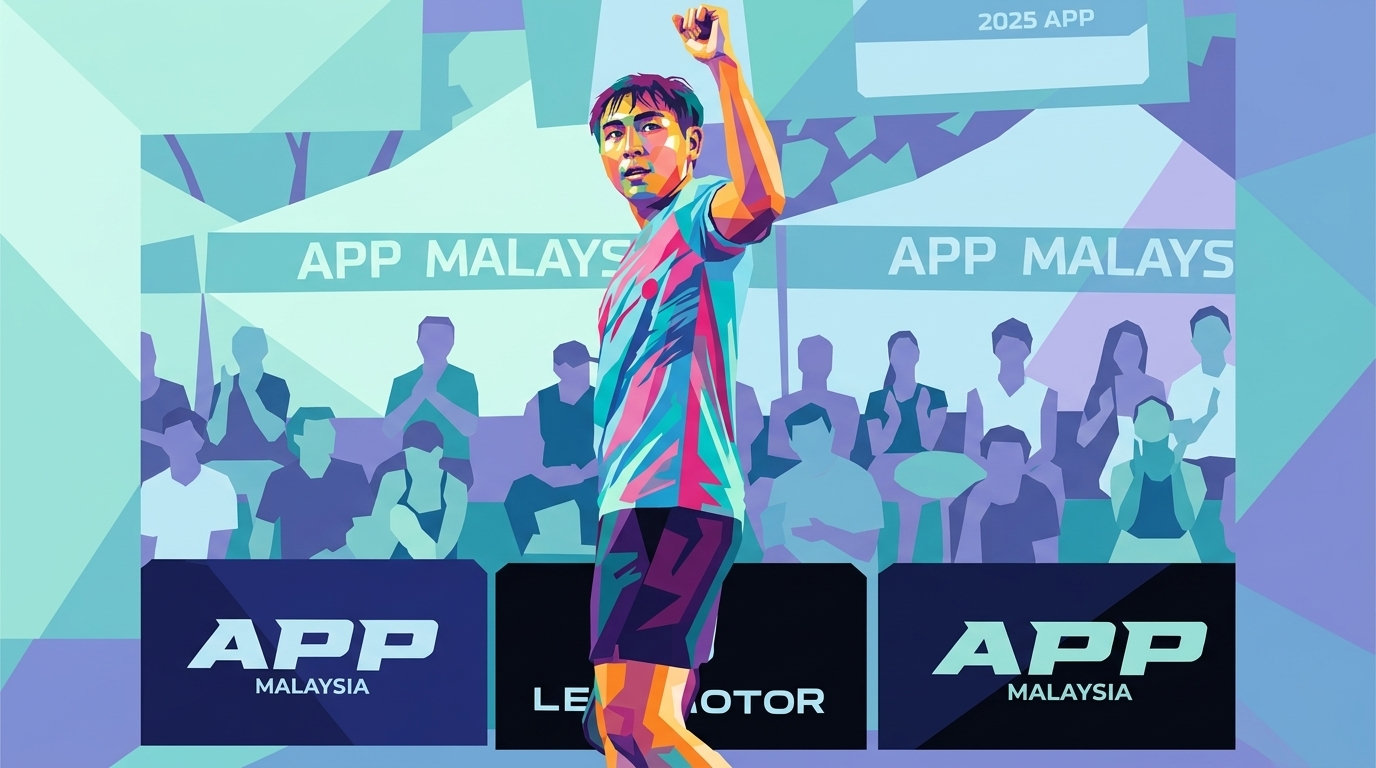
MORE THAN A TOURNAMENT
Key Takeaways
- This story reflects a key shift defining the maturity and expansion of the global pickleball landscape in July 2026.
- Decisions and infrastructure investments made now are establishing the long-term foundations of the sport.
How the APP Asia Tour in Penang is positioning Asia at the centre of professional pickleball’s next phase
By Marc Chua
The Leapmotor APP Penang Open 2026 is more than five days of competition.
It is an early signal of something larger: the attempt to build a structured, connected professional pickleball ecosystem across Asia.
A region reaching critical mass
Major sports rarely change direction because of a single tournament. More often, transformation happens when separate developments begin to align — participation growth, commercial investment, organisational structure, and a shared sense of direction.
That alignment is now becoming visible across Asia.
Pickleball has expanded rapidly in Malaysia, Singapore, Vietnam, Thailand, India, China, Japan and Chinese Taipei. New clubs are opening at pace, tournament fields are growing, and the sport is shifting from recreational activity to organised competition across multiple levels.
What is still emerging, however, is structure.
The Penang Open, held from 22–26 July at Pickle By The Sea, sits directly inside that transition. It is not just another stop on a growing calendar. It is part of an attempt to define what a professional Asian tour actually looks like.
If you're following how the global game is shifting week by week, the World Pickleball Report breaks this down every day in our morning briefing.
From isolated events to a connected tour
Historically, pickleball growth in Asia has been fragmented.
Each country has developed its own tournaments, pathways and informal competitive systems. The enthusiasm has been consistent. The structure has not.
The APP Asia Tour is attempting to change that.
Rather than treating tournaments as standalone events, the tour links them into a regional calendar spanning multiple countries, including China, Thailand, Chinese Taipei, India and Vietnam.
This creates continuity for players and clarity for organisers. More importantly, it introduces something that is still relatively new in Asian pickleball: the idea of a season.
Players are no longer simply choosing individual events. They are beginning to think in terms of schedules, rankings and sustained competition across borders.
That shift is a key marker in the professionalisation of any sport.
Why Malaysia has become the operational hub
The decision to establish the APP Asia headquarters in Malaysia reflects a broader strategic direction.
Successful tours are not built solely on events. They require infrastructure — administrative, commercial and operational — that extends beyond tournament week.
Malaysia offers several advantages. It sits centrally within Southeast Asia, has an established and growing pickleball community, and has already proven capable of hosting international-level events.
By basing regional operations in Malaysia, the APP is effectively anchoring its long-term Asian strategy in a single operational hub rather than rotating between markets.
That matters because it signals permanence.
Asia is not being treated as a touring destination. It is being treated as a base.
Building a sport, not just a circuit
The Penang Open has been designed as more than a professional competition.
Like many modern racket sport events, it blends elite competition with wider participation and community engagement.
Professional matches sit alongside amateur draws, social play, and public-facing activations. The result is an environment where spectators are not separated from participants in the same way as more traditional sports formats.
If you’re following how the global game is shifting day by day, the World Pickleball Report breaks this down in our daily briefing.
This reflects one of pickleball’s defining characteristics: accessibility.
The gap between beginner and professional is still narrow compared to most established sports, and the APP Asia Tour is leaning into that structure rather than trying to separate it.
The long-term ecosystem question
The central challenge for Asian pickleball is no longer participation.
It is sustainability.
Growth is already visible at grassroots level. The question is whether that growth can be supported by systems that extend beyond individual tournaments.
The APP Asia Tour is attempting to address that through a broader ecosystem model that includes:
* player development pathways
* coaching and education initiatives
* grassroots integration
* regional competition structure
* commercial partnerships
Rather than focusing only on producing elite players, the emphasis is on building the infrastructure that allows those players to emerge consistently over time.
Commercial confidence is increasing
The growing professionalisation of the tour has also attracted brands looking for long-term positioning in emerging sport markets.
Leapmotor, operating under the Stellantis portfolio, has taken title sponsorship of the Penang Open. Selkirk continues to expand its footprint in Asia through both equipment distribution and community-level engagement.
These partnerships are less about short-term visibility and more about early alignment with a sport that is still defining its commercial shape in the region.
For brands, the opportunity lies not just in exposure, but in influence over how the sport develops commercially in its formative stage.
Looking beyond Penang
The importance of the Penang Open will not be measured solely in winners or prize money.
Its significance lies in positioning.
If the APP Asia Tour continues to expand as planned, this period may be seen in retrospect as the point at which Asian pickleball began shifting from fragmented national growth to a connected regional structure.
That transition does not happen instantly.
It happens through a series of events that, over time, begin to function as a system.
Penang is one of those events.
Not because it defines the future on its own.
But because it sits inside a growing framework that increasingly looks like one.
📖 Read the Full July 2026 Issue
This article appears in Issue #18 of World Pickleball Magazine — download the complete edition free.
Further Reading
- Latest pickleball news from around the world
- Tournament coverage and results
- Rankings and player profiles
- Regional pickleball coverage
For a clearer view of where the sport is heading each week, you can join the World Pickleball Report here.

Chris Beaumont
Founder and Editor-in-ChiefChris Beaumont is the founder and Editor-in-Chief of World Pickleball Magazine. Chris follows the global game closely, reporting on the latest news, developments, stories and tournaments from all five continents. He also hosts the World Pickleball Podcast, interviewing people at…
View All Articles →