
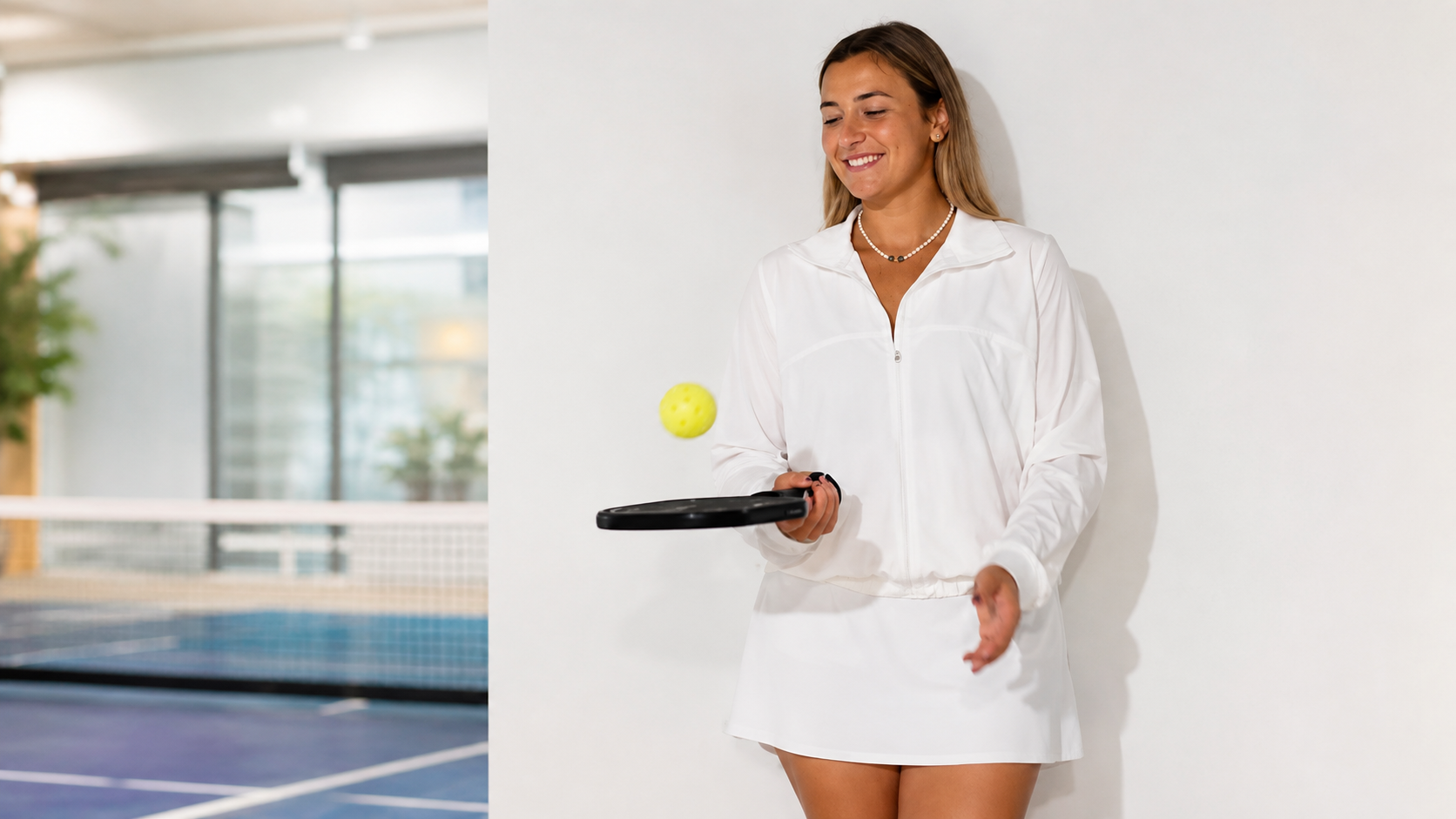
Anne-Sophie Courteau did not arrive at elite sport through an academy or a junior pathway. She arrived with an established career, a working life that could consume almost every available hour and an increasingly difficult question: how good might she become if pickleball was finally given first claim on her time?
Key Takeaways
- Anne-Sophie Courteau left an intense corporate career to discover how far she could take pickleball with the sport given first claim on her time.
- The two-time CNPL champion has already won at PPA Challenger level, but greater competitive opportunity also brings greater financial and personal demands.
- Her journey exposes an awkward reality of elite pickleball: players can reach a professional standard before the sport can necessarily provide them with a sustainable professional living.
Anne-Sophie Courteau already knew what commitment looked like.
At the most extreme end of her previous corporate life, her working weeks could reach 120 hours. Whatever the precise arithmetic of individual days, the important part is what such a number leaves behind. Very little.
Certainly not the sort of time required to discover how far an athlete might go.
Courteau could have kept pickleball in the available spaces. Train when work permitted. Enter tournaments when the calendar cooperated. Become a very good player while maintaining the security of the professional life she had already built.
There was just one problem.
She had become good enough for that compromise to become frustrating.
Courteau is a two-time champion in the Canadian National Pickleball League. She has also won women’s doubles gold at PPA Challenger level and continued testing herself in professional competition in the United States.
Now another marker is approaching, with the Canadian group heading to the Pickleball World Cup in Da Nang, Vietnam, which begins on August 30.
Those achievements do not guarantee that Courteau can build a living from pickleball.
They do something rather more dangerous.
They provide enough evidence to make her wonder what might happen if she really tried.
So she left the corporate world.
Not because pickleball had presented her with a lucrative contract or because a professional team had made the decision financially obvious. She stepped away from an established career to give herself the chance to find out where her ceiling might actually be.
There is a significant difference between those things.
The point where a hobby stops behaving like one
Sport tends to tidy these stories up afterwards.
Once an athlete succeeds, the uncertainty that came before can look inevitable. The difficult decision becomes brave. The risk becomes worthwhile. The sacrifices become part of the origin story.
That is not where Courteau is.
She is still inside the uncertainty.
She has already proved that she can compete at a high level in Canada, but the next level asks for more than ability. It asks for time, travel and money, often before offering much of any of them in return.
Da Nang illustrates the problem particularly well.
The Team Canada Pickleball group travelling to the World Cup is self-funded and distinct from Pickleball Canada’s developing official high-performance programme. WPM has already reported on the consequences of that funding model after Canada’s junior squad was withdrawn from the 2026 World Cup when sufficient financial support could not be secured.
Players pursuing the senior opportunity have been warned that representing the Canadian group in Vietnam could cost between C$3,000 and C$5,000.
For an athlete travelling to compete internationally, selection is supposed to feel like the reward for reaching a standard.
Here, it can also produce an invoice.
Flights and accommodation are only part of the calculation. A player trying to improve quickly needs competition. Competition means entry fees, travel and days that cannot be spent doing something else. Better opposition is rarely conveniently located around the corner.
The oddity is that success can increase the burden.
Become good enough locally and you need stronger opponents. Become good enough nationally and you start looking internationally. Each step that proves you belong also increases what belonging costs.
Courteau has chosen to find out anyway.
Winning does not settle anything
Her CNPL success matters because it changes the nature of the gamble.
This is not somebody abandoning a career because she enjoys pickleball and imagines she might one day become good at it. Courteau has already reached a standard capable of making the question legitimate.
Her results beyond the CNPL strengthen the case. London Smash lists a PPA Challenger women’s doubles title in Rochester among her achievements, while she finished fourth in women’s singles at the Tucson Challenger earlier this year.
But winning in Canada cannot answer how far that standard travels.
That is part of what international competition offers.
The PPA Challenger Tour has become an increasingly difficult proving ground, with deeper international fields and more players trying to turn strong results into opportunities higher up the professional ladder. Courteau’s experience sits directly inside the question the circuit itself is beginning to pose: becoming good enough to compete professionally and building a sustainable professional career are not necessarily the same achievement.
Da Nang will provide another measurement. Different opponents, different styles and a field assembled from countries whose pickleball structures are developing at very different speeds.
There will always be another measurement after that.
This is the uncomfortable thing about searching for an athletic ceiling. You usually do not know you have reached it until repeated evidence begins telling you so.
Until then, improvement keeps the possibility alive.
For Courteau, time is now part of that experiment.
The hours previously claimed by work can become practice, recovery, preparation and competition. She can make decisions around pickleball rather than asking pickleball to survive whatever remains after everything else has been accommodated.
That does not make the outcome predictable.
It simply makes the experiment fairer.
The career she already had matters
There is an important difference between Courteau’s decision and the traditional young athlete’s gamble.
She knows what the alternative looks like because she has lived it.
For a teenager pursuing elite sport, the conventional career is often an abstraction waiting somewhere in the future. For Courteau, it was real. Whatever its demands, it represented an established adult life and a recognisable route forward.
Walking away from something you have built is different from postponing something you have never started.
That gives this story its tension.
Pickleball is unusually open to athletes who arrive late by traditional sporting standards. Its professional game contains converts from tennis and other racket sports, people who discovered the game as adults and competitors whose route bears little resemblance to the academy systems common elsewhere.
That accessibility is one of the sport’s attractions.
But access to elite competition and the ability to sustain an elite career are different questions.
Courteau has reached the first.
The second remains unresolved.
And perhaps that is why her decision is more revealing than a simple story about following a passion. Passion is easy to celebrate from outside. The harder question is what somebody is prepared to rearrange once that passion begins demanding the same seriousness as the rest of their life.
Courteau had already demonstrated that she could work extraordinarily hard.
She changed what the work was for.
Pickleball cannot promise her the ending
There is an obvious temptation to make Da Nang the payoff.
Leave corporate career. Commit to pickleball. Win in Canada. Travel to a World Cup with the Canadian team.
It is a satisfying sequence, but it would impose an ending on a story that has barely reached its interesting part.
The World Cup cannot tell Courteau whether she made the correct decision.
A great week in Vietnam would not guarantee a professional living. A poor one would not invalidate everything that brought her there. One tournament is evidence, not a verdict.
What matters is what comes afterwards.
Does more time produce another substantial jump in her level? Can Canadian success translate consistently against deeper international fields? Can the competitive opportunities keep pace with her development? And, eventually, can the financial side of the sport make the commitment sustainable?
Those questions are not unique to Courteau. Pickleball is producing more players capable of asking them because its competitive standard is rising quickly.
Her circumstances make the questions unusually visible.
There is a space in elite pickleball occupied by players for whom the sport has become too serious to treat casually but not secure enough to remove the risk from treating it professionally.
Courteau has entered that space voluntarily.
Perhaps she will discover that her ceiling sits considerably higher than she imagined. Perhaps international competition will eventually tell her otherwise. Perhaps the sporting progress continues while the financial calculation becomes the more difficult opponent.
None of that can be known yet.
Anne-Sophie Courteau had already built one version of her adult life. What she could no longer comfortably accept was allowing that life to answer a different question for her.
How good could she have been?
She would rather find out.
Further Reading
- The PPA Challenger Tour Is Becoming Harder to Win. That Is the Point
- Canada Junior Team Misses Pickleball World Cup
- CNPL Opens 2026 Draft Registration as Teams Build Season 4 Rosters
- Rankings and player profiles

Chris Beaumont
Founder and Editor-in-ChiefChris Beaumont is the founder and Editor-in-Chief of World Pickleball Magazine. Chris follows the global game closely, reporting on the latest news, developments, stories and tournaments from all five continents. He also hosts the World Pickleball Podcast, interviewing people at…
View All Articles →

