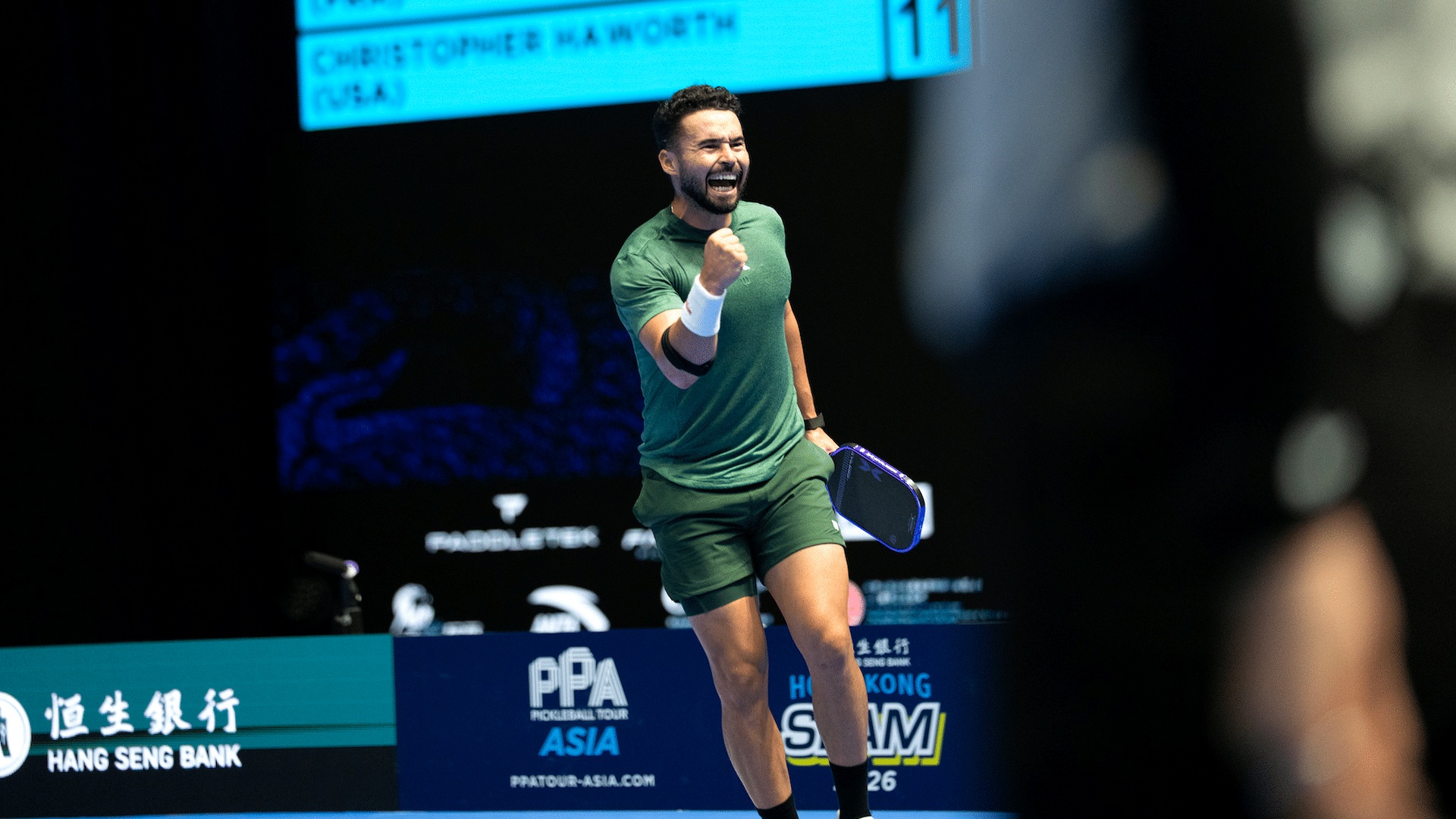
Hunter Johnson came from a game down to beat Federico Staksrud, while Tama Shimabukuro ended Noe Khlif’s run. Judit Castillo and Andie Dikosavljevic completed the women’s singles final, as the top two women’s doubles partnerships advanced by contrasting routes.
Friday’s quarter-finals had removed the leading singles seeds from the Hong Kong Slam. By Saturday afternoon, the players responsible for those upsets had discovered that reaching the final required another level of performance.
Noe Khlif, who had beaten top seed Christopher Haworth for the first time, was stopped emphatically by Tama Shimabukuro. Federico Staksrud, having survived Hong Kit Wong’s extraordinary challenge the previous day, lost to Hunter Johnson after taking the opening game 11-3.
In the women’s draw, Judit Castillo followed her dramatic victory over Kaitlyn Christian by defeating doubles partner Kiora Kunimoto. Andie Dikosavljevic, already responsible for eliminating second seed Chao Yi Wang, conceded just four points against Sahra Dennehy.
The result was a final line-up few would have predicted from the seedings.
Shimabukuro will face Johnson for the men’s singles title. Castillo will meet Dikosavljevic in the women’s championship match.
Both top seeds had disappeared on Friday. Neither second seed survived Saturday.
The women’s doubles competition offered a striking contrast. Anna Leigh Waters and Anna Bright advanced with extraordinary authority, while Tyra Hurricane Black and Jorja Johnson survived another difficult three-game match.
The top two partnerships will meet for the title, delivering the final their seedings had suggested.
Hong Kong’s first PPA 1500 tournament has therefore reached its closing day with two different stories. The singles draws have been transformed, while the leading women’s doubles partnerships have found very different ways to justify their positions.
Key takeaways
- Tama Shimabukuro beat Noe Khlif 11-8, 11-2 to reach the men’s singles final.
- Hunter Johnson recovered from losing the opening game 3-11 to defeat Federico Staksrud 11-8, 11-5 in the next two.
- Judit Castillo defeated Kiora Kunimoto 11-8, 11-7 and will face Andie Dikosavljevic, who beat Sahra Dennehy 11-1, 11-3.
- Anna Bright and Anna Leigh Waters conceded just four points in their women’s doubles semi-final, defeating Sofia Sewing and Catherine Parenteau 11-4, 11-0.
- Tyra Hurricane Black and Jorja Johnson recovered to beat Rachel Rohrabacher and Parris Todd 4-11, 11-9, 11-2.
Shimabukuro ends Khlif’s breakthrough run
Noe Khlif had entered Saturday with good reason to believe Hong Kong might become one of the defining tournaments of his season.
His quarter-final victory over Christopher Haworth was a significant achievement. The Frenchman had lost all four previous encounters with the American before finally defeating him 13-11, 11-3.
The opening game had demanded considerable resilience. Khlif established an early advantage, survived Haworth’s recovery and saved a game point before taking control of the second.
But that breakthrough brought him another opponent with a recent winning record against him.
Tama Shimabukuro had beaten Khlif 11-8, 11-5 in September’s Kuala Lumpur Cup final. Their Hong Kong meeting offered Khlif the chance to reverse another significant result against familiar opposition.
He could not repeat Friday’s success.
Shimabukuro won 11-8, 11-2, completing a victory that became increasingly emphatic as the match progressed.
The opening game was competitive. Khlif remained close enough to make the outcome uncertain until Shimabukuro established the decisive margin.
The second was a different contest on the scoreboard.
Shimabukuro restricted the Frenchman to two points, ending any realistic prospect of another comeback and securing a place in Sunday’s final.
The result illustrates the difference between producing a major upset and sustaining a championship run.
Khlif had shown against Haworth that he could overcome an opponent who had repeatedly frustrated him. Against Shimabukuro, he encountered a player who had already beaten him in an important final and who again found a way to control the result.
The exact tactical reasons require closer match evidence than the scoreline provides. What is established is the decisive nature of Shimabukuro’s second game and his ability to repeat an important victory against the same opponent.
For Shimabukuro, the achievement extends beyond one semi-final.
His success in Kuala Lumpur had already demonstrated his ability to win on the Asian professional circuit. Reaching the final of its first 1500-level event strengthens that record against a deeper international field.
He has now beaten Khlif twice in significant matches within the space of several weeks.
Sunday offers the opportunity to convert that consistency into another title.
Johnson recovers from Staksrud’s commanding start
The other men’s semi-final produced an almost complete reversal of momentum.
Federico Staksrud began against Hunter Johnson by winning the first game 11-3.
It was the kind of opening that suggested the Argentine might move comfortably into the championship match.
Johnson had reached the semi-finals by defeating Connor Garnett 11-9, 11-4, but now found himself facing an opponent who had imposed a much more convincing early advantage.
Staksrud needed one more game to reach the final.
Johnson responded by taking the second 11-8.
That proved to be the turning point in the result. Instead of allowing Staksrud’s emphatic opening to determine the contest, Johnson forced a deciding game and then won it 11-5.
The complete scoreline, 3-11, 11-8, 11-5, captures the scale of his recovery.
Staksrud had controlled the opening game. Johnson won the tightest passage of the match and then established a substantially greater margin in the decider.
It would be speculative to attribute the turnaround to a particular adjustment in court positioning or shot selection without reliable match-level evidence.
The competitive significance is clear enough without that explanation.
Johnson recovered from an eight-point opening-game defeat against one of the strongest players in the field, prevented Staksrud from closing the match in two games and finished decisively.
Staksrud had already survived a demanding quarter-final against Hong Kit Wong, winning 8-11, 11-9, 12-10 after the Hong Kong player held match point. That contest was covered in WPM’s previous Hong Kong Slam report.
Saturday brought no second escape.
Johnson’s victory eliminated the second seed and ensured that neither of the men’s top two singles seeds would contest the final.
Haworth had fallen to Khlif. Staksrud had now fallen to Johnson.
And two players who entered the week outside the expected championship pairing had earned their places in Sunday’s title match.
Two very different routes to the men’s final
Shimabukuro and Johnson have arrived at the championship match through contrasting semi-final performances.
Shimabukuro won a close opening game before taking complete control of the second.
Johnson lost his opener heavily and then recovered to win the next two.
Both results required composure, but under different circumstances.
Shimabukuro’s victory reinforces a developing record of success against Khlif. Johnson’s comeback provides further evidence of his capacity to respond under pressure against established opposition.
There is also a wider question surrounding Shimabukuro.
Hong Kong has attracted considerable attention because of the American professional players who have travelled to the season-ending event. Yet the Asian circuit has also produced players with their own competitive records and ambitions.
Shimabukuro reached this stage having already won an important regional final. His progress shows that success within PPA Tour Asia can carry through into its largest championship.
Johnson, meanwhile, has defeated one of the strongest established singles contenders in the draw.
Their final will not follow the hierarchy suggested by the original seedings.
It will be contested by the two players who handled Saturday’s different challenges better than their opponents.
Castillo makes her Christian upset count
Judit Castillo produced one of the tournament’s most remarkable recoveries in Friday’s quarter-finals.
Facing women’s top seed Kaitlyn Christian, the Spaniard trailed 9-4 in the deciding game and subsequently saved two match points before winning 11-9, 5-11, 12-10.
The result was especially significant because Castillo had also beaten Christian at the Australia Pickleball Cup the previous week.
Two victories in successive tournaments suggested that their head-to-head contest had become more competitive than the Hong Kong seedings alone indicated.
But an extraordinary comeback can mean little to a championship campaign if it is followed by defeat.
Castillo still had to win another match.
Saturday brought a semi-final against Kiora Kunimoto, her women’s doubles partner during the tournament.
That partnership had ended in the quarter-finals against Sofia Sewing and Catherine Parenteau, leaving both players to concentrate on their singles opportunities.
Castillo won 11-8, 11-7.
Unlike Friday, the Spaniard did not need a deciding-game rescue. She took a competitive opening game, then completed the match in straight games.
It was an important demonstration of consistency.
Castillo had beaten Christian under extreme pressure. Against Kunimoto, she produced a more controlled result with a place in the final at stake.
The familiarity between the two players added an interesting personal dimension, although it should not be overstated.
Doubles partners see one another’s preferred patterns and learn how they respond in different situations. Singles presents different demands, particularly in movement, court coverage and the need to manage every rally without support.
That familiarity offered context rather than a reliable prediction.
Castillo’s victory established something more important: her dramatic defeat of Christian was part of a sustained tournament run.
She has now beaten the top seed and followed it with another straight-games victory to reach the championship match.
Dikosavljevic allows Dennehy just four points
Andie Dikosavljevic’s progress has followed an entirely different pattern.
The Australian had eliminated second seed Chao Yi Wang 11-8, 11-6 in Friday’s quarter-finals, completing the removal of the women’s top two seeds.
She had previously beaten Lacy Schneemann 11-3, 11-4.
Saturday’s semi-final against Sahra Dennehy produced her most emphatic performance of the three rounds.
Dikosavljevic won 11-1, 11-3.
Dennehy, who had defeated Rika Fujiwara in three games to reach the final four, managed only four points across the entire contest.
That margin is remarkable for a professional semi-final.
Dikosavljevic had already demonstrated her ability to beat higher-seeded opposition in straight games. Against Dennehy, the gap on the scoreboard widened considerably.
Across her three matches from the Round of 16 through the semi-finals, she has now won six consecutive games and conceded just 25 points.
Her opponents have found progressively less success against her, at least as measured by the scoreboard.
The figures cannot establish precisely which tactics have produced that run, but they make its authority unmistakable.
Dikosavljevic arrives in the final having avoided the extended battles experienced by several other contenders.
She has not been required to survive a deciding game during those three rounds.
Castillo, by contrast, endured one of the most dramatic deciding games of the championship against Christian before winning her semi-final in straight games.
That difference provides Sunday’s women’s final with its central competitive question.
Can Castillo disrupt Dikosavljevic’s control?
Neither finalist entered Hong Kong as one of the women’s top two seeds.
Both have beaten the opponents who were expected to occupy those positions in the closing stages.
But their routes could scarcely have been more different.
Castillo has demonstrated the ability to win under extreme pressure. Her recovery against Christian required her to survive repeated opportunities for the top seed to finish the match.
She then defeated Kunimoto without surrendering a game.
Dikosavljevic has taken a more direct route, removing Schneemann, Wang and Dennehy in straight games while conceding only 25 points.
Her recent results suggest a player in commanding form.
What they cannot tell us is how she will respond if Castillo forces the final into the kind of extended exchanges and difficult scoreboard positions that defined Friday’s quarter-final.
Equally, Castillo has yet to face an opponent in this tournament who has arrived through the same sequence of decisive victories.
The final therefore presents a genuine contest between proven resilience and sustained authority.
Whichever player wins will have completed a championship campaign that substantially exceeded the expectations attached to her seeding.
Waters and Bright concede just four points
While the women’s singles draw produced a final without its top seeds, women’s doubles has delivered the expected championship pairing.
Anna Leigh Waters and Anna Bright reached Sunday’s final with an 11-4, 11-0 victory over Sofia Sewing and Catherine Parenteau.
The top seeds allowed only four points across the semi-final.
It was an exceptional result against a partnership that had reached the final four after a dramatic quarter-final recovery.
Sewing and Parenteau lost the opening game to Castillo and Kunimoto 8-11 before winning the next two 11-1, 11-1.
That emphatic response suggested they could find another level after experiencing early difficulties.
Against Waters and Bright, however, the scoreboard moved decisively in the opposite direction.
The top seeds took the first game 11-4 and completed the second without conceding a point.
Combined with their 11-1, 11-8 quarter-final victory against Dennehy and Danni-Elle Townsend, Waters and Bright have conceded only 13 points across their last two matches.
That is an imposing record against partnerships who had progressed through the earlier rounds of a major event.
It also establishes the scale of the task facing the second seeds.
Black and Johnson survive another test
Tyra Hurricane Black and Jorja Johnson took a considerably more difficult route into the women’s doubles final.
They defeated Rachel Rohrabacher and Parris Todd 4-11, 11-9, 11-2, recovering from a one-sided opening game before taking control of the decider.
Rohrabacher and Todd had established a strong early position.
After winning the first game 11-4, they needed only one more to reach the championship match.
Black and Johnson instead edged the second 11-9 and then won the deciding game 11-2.
The victory continued a notable pattern from Friday.
Against Mari Humberg and Cailyn Campbell, the second seeds had won the first game 11-3, lost the second 7-11 and then completed an 11-0 decider.
On successive days, Black and Johnson have been forced into third games and responded with overwhelming final-game margins.
It is evidence of resilience, but it also raises a question ahead of the final.
Waters and Bright have advanced without dropping a game, while Black and Johnson have needed deciding games in both their quarter-final and semi-final.
The second seeds have demonstrated that they can recover from difficult positions.
Against Waters and Bright, who have conceded only 13 points across four recent games, the challenge may be to avoid falling into those positions in the first place.
The expected final has materialised, but the two partnerships have reached it through very different performances.
Staksrud and Patriquin keep their doubles title hopes alive
Saturday also provided Federico Staksrud with an opportunity to respond to his men’s singles defeat.
Alongside Hayden Patriquin, he defeated Connor Garnett and Dylan Frazier 11-4, 11-7 to reach the men’s doubles final.
The straight-games victory followed their 11-4, 11-2 quarter-final success against Vietnam’s Do Minh Quan and Truong Vinh Hien.
Across those two matches, Staksrud and Patriquin conceded only 17 points.
Their progress contrasts with Staksrud’s singles campaign, which ended against Hunter Johnson despite his commanding opening game.
Men’s doubles now offers another opportunity to leave Hong Kong with a major title.
The other semi-final featured Ben Johns and Gabriel Tardio against Tama Shimabukuro and JW Johnson.
Johns and Tardio had reached that stage by defeating Collin Johns and Len Yang 11-3, 11-3 in a much-anticipated meeting between the brothers.
Shimabukuro and JW Johnson advanced after beating Eric Oncins and Noe Khlif 11-5, 11-1.
The supplied Saturday bracket showed their semi-final in progress, with Shimabukuro and Johnson leading 6-4 in the opening game.
That snapshot does not establish the completed result. The remaining finalist requires confirmation from an updated official bracket.
Mixed doubles adds to the pressure on the finalists
Mixed doubles has brought many of Hong Kong’s leading players into another demanding championship race.
Ben Johns and Anna Leigh Waters advanced through Friday’s quarter-finals against Jonathan Truong and Jessie Irvine, with the bracket recording an 11-1, 11-0 result.
The top seeds moved into a semi-final against Ting Chieh Wei and Hunter Johnson.
Wei and Johnson had recovered from losing the opening game to beat Dylan Frazier and Kaitlyn Christian 5-11, 11-5, 11-9.
That result added another demanding match to Johnson’s Hong Kong campaign, which now includes Sunday’s men’s singles final.
In the opposite half, Anna Bright and Hayden Patriquin advanced with an 11-9, 11-5 win over Sahra Dennehy and Tama Shimabukuro.
They were scheduled to face siblings Jorja and JW Johnson, who had beaten Eric Oncins and Tyra Hurricane Black 9-11, 11-8, 11-2.
Those semi-finals brought together players already carrying substantial commitments elsewhere in the tournament.
Waters, Bright and Jorja Johnson have reached the women’s doubles final. Hunter Johnson and Shimabukuro have reached the men’s singles championship match, while Patriquin remains involved in the men’s doubles final.
The discipline changes require players to adapt to different partners, court coverage and competitive demands during an increasingly compressed final weekend.
The supplied mixed doubles bracket does not establish completed Saturday semi-final results, so the championship pairing cannot yet be confirmed from that evidence.
Hong Kong’s closing day will test two kinds of success
The Hong Kong Slam arrived as the first 1500-level tournament in PPA Tour Asia history, staged at Kai Tak Arena with substantial ranking rewards and an advertised professional prize-money and payout package of up to US$1.1 million.
Bringing established international players to the circuit’s season-ending event created expectations about the strength of the competition.
The results have demonstrated that those expectations cannot be translated automatically into a championship forecast.
Christopher Haworth entered as the leading men’s singles seed and was eliminated by Khlif.
Kaitlyn Christian led the women’s draw and fell to Castillo after holding match points.
Chao Yi Wang was seeded second and lost to Dikosavljevic.
Staksrud survived a dramatic quarter-final against Wong but could not recover from Johnson’s resurgence in the semi-finals.
The resulting singles finals feature Shimabukuro against Johnson and Castillo against Dikosavljevic.
Neither contains either of its draw’s top two seeds.
The women’s doubles final has produced the opposite outcome.
Waters and Bright will meet Black and Jorja Johnson, the two leading partnerships, although their paths have differed considerably.
One pair has reached the championship match through overwhelming results. The other has shown the capacity to recover when matches have turned against them.
That contrast is what makes Hong Kong’s closing day so compelling.
The singles finalists have reached the championship matches by overcoming the players expected to occupy those positions.
The women’s doubles finalists have earned the opportunity to confirm the order established before the tournament began.
Both are legitimate achievements.
For PPA Tour Asia, the tournament has offered something valuable beyond attracting established international names to Hong Kong.
It has produced competitive uncertainty at the highest level of its season-ending event.
Sunday will determine who can convert that uncertainty into a title.
Further Reading
- World Pickleball Magazine: Staksrud survives Wong and the Johns brothers meet in Hong Kong
- World Pickleball Magazine: Hong Kong Slam quarter-final preview
- PPA Tour Asia: Official Hong Kong Slam tournament information
- Hong Kong Slam: Official tournament results and brackets

Chris Beaumont
Founder and Editor-in-ChiefChris Beaumont is the founder and Editor-in-Chief of World Pickleball Magazine. Chris follows the global game closely, reporting on the latest news, developments, stories and tournaments from all five continents. He also hosts the World Pickleball Podcast, interviewing people at…
View All Articles →