
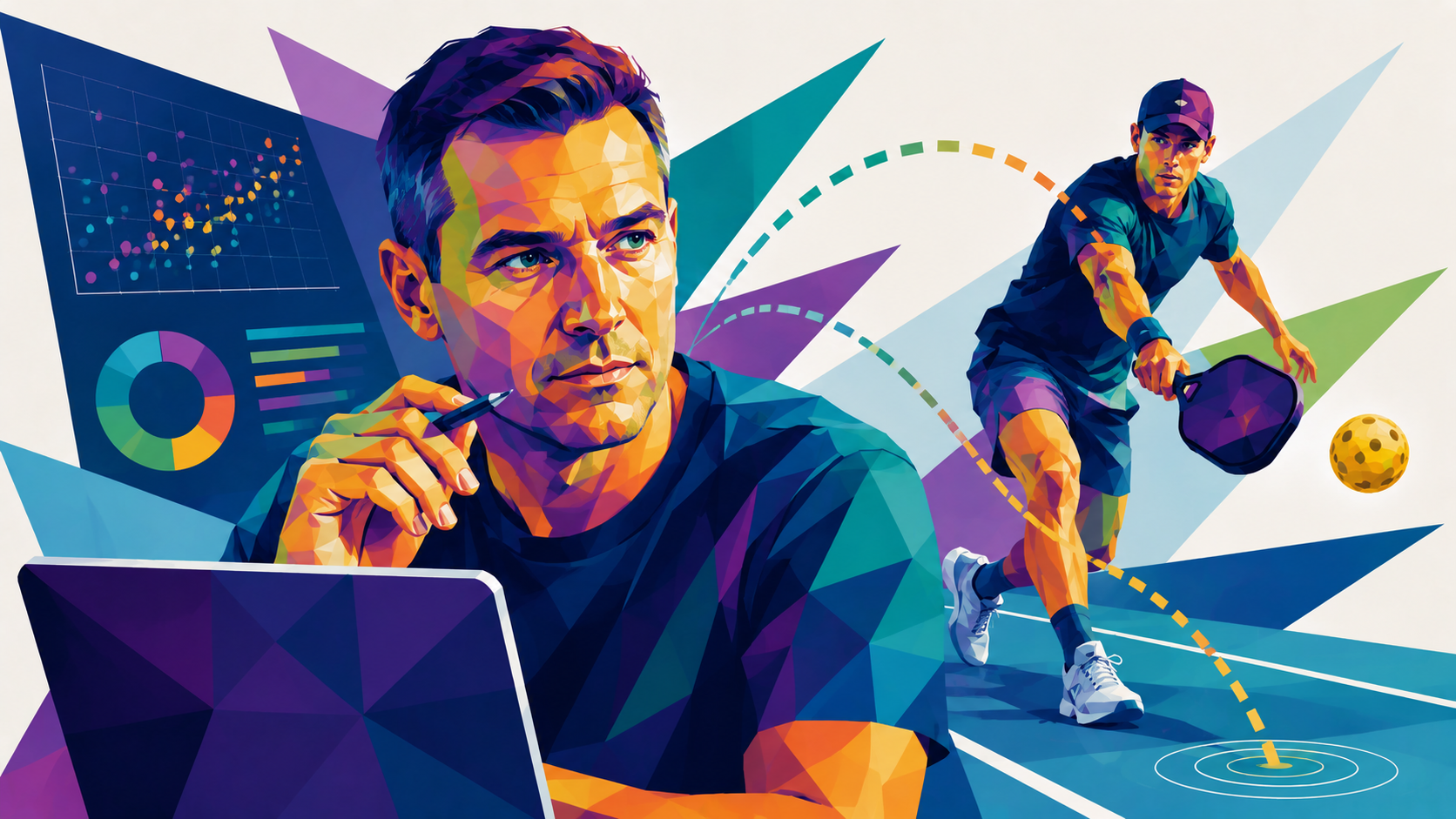
“It’s not stats. It’s what drives winning.”
Key Takeaways
- This story reflects a key shift defining the maturity and expansion of the global pickleball landscape in July 2026.
- Decisions and infrastructure investments made now are establishing the long-term foundations of the sport.
Scott Ross does not start from a spreadsheet., He starts from a question.
What actually contributes to winning a rally?
It sounds simple, almost obvious. But the difficulty is not in asking it. It is in refusing to settle for surface-level answers.
Ross, founder of PewPew Analytics, comes from sports analytics more broadly — baseball projections, fantasy systems, and a background in trying to explain performance in ways that survive contact with reality rather than just theory.
In pickleball, that question becomes more complicated, not less.
Because the sport is small enough to observe every shot, but complex enough that no single shot tells the full story.
That is where his model begins.
Win probability added.
At the shot level.
The idea behind PewPew
The acronym itself is almost disarming.
PewPew stands for:
Player Estimated Win Probability Effect With Shots
The idea is straightforward in principle, even if the execution is not.
Every shot in pickleball changes the probability of winning the rally.
Some shots increase it.
Some reduce it.
Some do very little at all.
The goal is to assign value to those changes, so that over time, every action on court can be traced back to its actual contribution to winning.
Not aesthetically pleasing shots.
Not highlights.
Not even winners in isolation.
But contribution.
That distinction matters.
Because it moves the conversation away from what looks good and toward what actually changes outcomes.
If you're following how the global game is shifting week by week, the World Pickleball Report breaks this down every day in our morning briefing.
The problem with traditional stats
Most sports have gone through this correction already.
Football learned that possession alone does not explain winning.
American football learned that total yards are often a consequence, not a cause.
Baseball learned that batting average misses too much of the picture.
Pickleball is still at the stage where the default language is familiar rather than precise.
Winners and errors.
Percentages.
General impressions of control.
Ross is blunt about the limitation.
A winner, in isolation, is not always the most important shot in a rally.
Sometimes it is just the final punctuation mark on something that was already decided two shots earlier.
The hidden structure of a rally
The key shift in PewPew’s thinking is that not all shots sit on the same level of importance.
Some end rallies directly.
Some increase the likelihood of an opponent error.
Some set up future advantage or failure.
And some, importantly, reshape court position in ways that matter more than the immediate outcome.
Ross describes it in layers rather than categories.
A shot that ends the point outright is rare.
A shot that forces an error is more common.
A shot that changes positioning is more subtle, but often more important over time.
The difficulty is not identifying these moments.
It is weighting them correctly.
Where tennis stops helping
Most analytics frameworks in pickleball, Ross argues, inherit too much from tennis.
And that inheritance is both useful and misleading.
Useful because tennis already solved many of the infrastructure problems: tracking systems, rating structures, data pipelines.
Misleading because tennis is fundamentally an individual sport.
Pickleball is not.
It is doubles-first by design. Which means attribution becomes immediately more complicated.
A shot is never just a shot. It is part of a chain.
And chains create one of the hardest problems in sports analytics: separating individual contribution from shared outcome.
“How much of this is me, and how much is my partner?”
That question, Ross suggests, sits at the centre of modern pickleball analytics.
Not just for professionals. For everyone.
Because once you accept that a rally is a sequence rather than a moment, everything becomes harder to assign cleanly.
A bad speed-up does not just fail. It creates pressure.
That pressure changes the next shot.
And the next shot.
And sometimes the entire rally.
So where does value sit?
On the first mistake?
On the recovery attempt?
On the final outcome?
The answer, in Ross’s model, is that all of it matters.
But not equally.
Context is not optional
A key part of the framework is understanding probability shifts rather than binary outcomes.
A shot does not simply succeed or fail.
If you’re following how the global game is shifting day by day, the World Pickleball Report breaks this down in our daily briefing.
It moves a rally from one state to another.
For example:
A team at the back of the court facing opponents at the kitchen might start at a 30/70 disadvantage.
A successful drop or drive that restores neutral positioning does not just “work”. It shifts the probability closer to 50/50.
That shift has measurable value.
Likewise, forcing opponents into weaker positions increases future probability even if the immediate shot does not end the rally.
This is where the model starts to resemble systems used in other sports, but adapted to pickleball’s specific structure.
The DUPR problem and expectation mismatch
At several points in the conversation, Ross returns to rating systems like DUPR.
Not critically. But carefully.
DUPR, like most rating systems, is predictive. It answers a forward-looking question: what should happen next time?
PewPew is asking something different.
Not what should happen next.
But what just happened, and why.
That distinction creates tension.
Because players often experience matches that feel inconsistent with their rating. Upsets. Close games. Unexpected losses or wins.
The instinct is to treat the rating as wrong.
Ross suggests something more subtle.
The rating may be doing its job.
But it is answering a different question.
Where analytics stops and interpretation begins
The most important point in the conversation is not technical.
It is philosophical.
At some point, analytics must decide what it is for.
Prediction is one function.
Explanation is another.
PewPew sits firmly in the second category.
It is not trying to say who will win next.
It is trying to explain why someone won this time.
That difference matters more than it first appears.
Because explanation changes coaching.
It changes self-perception.
It changes how players interpret failure.
The early stage of something bigger
Ross is clear that this is still early work.
Pickleball does not yet have the depth of data infrastructure seen in older sports. Many of the tools are still being borrowed, adapted, or repurposed from tennis systems.
But the direction of travel is already visible.
Video systems.
Shot tracking.
Automated tagging.
AI-assisted breakdowns.
The question is no longer whether data will enter pickleball.
It already has.
The question is what form it will eventually take when it becomes native rather than imported.
What comes next
If this first stage is about assigning value to shots, the next stage will be about interpretation.
Not just what happened.
But what patterns emerge over time.
Ross hints at this throughout the conversation without fully opening it.
Because the first step is always the same in analytics.
Measure the game as it is.
Only then can you begin to argue about what it means.
Closing thought
Pickleball is still young enough that its language is not fixed.
Players describe what they feel.
Coaches describe what they see.
Analytics now attempts to describe what actually occurred.
Between those three perspectives sits a gap.
PewPew Analytics is one attempt to bridge it.
Not by replacing intuition.
But by attaching weight to it.
One shot at a time.
📖 Read the Full July 2026 Issue
This article appears in Issue #18 of World Pickleball Magazine — download the complete edition free.
Further Reading
- Latest pickleball news from around the world
- Tournament coverage and results
- Rankings and player profiles
- Regional pickleball coverage
For a clearer view of where the sport is heading each week, you can join the World Pickleball Report here.

Chris Beaumont
Founder and Editor-in-ChiefChris Beaumont is the founder and Editor-in-Chief of World Pickleball Magazine. Chris follows the global game closely, reporting on the latest news, developments, stories and tournaments from all five continents. He also hosts the World Pickleball Podcast, interviewing people at…
View All Articles →