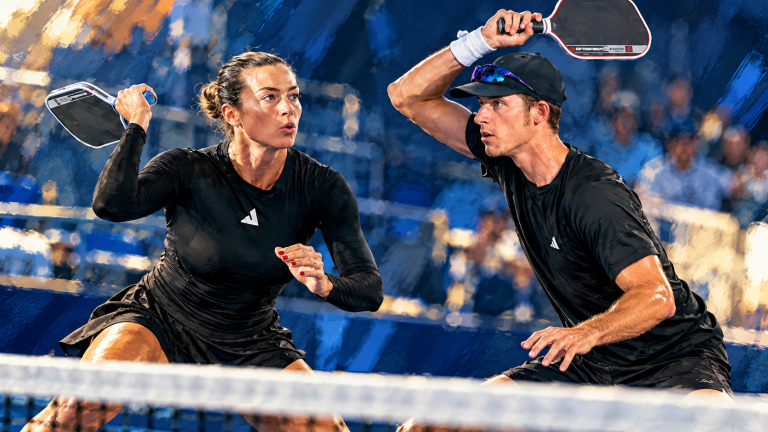

The modern singles game is no longer a variation of tennis with a different bounce. It is becoming its own tactical system, where the first two shots define court reality, weakness is deliberately engineered, and patterns matter more than individual shot quality.
Key Takeaways
- The first two shots now determine the entire structure of a point
- Depth is not neutral control, but a tool for restricting opponent movement options
- Players are beginning to use intentional weakness to manipulate expected responses
The First Two Shots Decide the Court State
For years, singles pickleball was explained through tennis.
Attack the return. Close the net. Finish early. Control space through aggression.
That language still exists, but it no longer describes what actually decides matches at the highest level.
The most important shift is not stylistic. It is structural.
Modern singles is not evolving from tennis logic. It is moving away from it entirely.
And once that becomes clear, almost everything about how the game is taught starts to break down.
When the First Two Shots Define Everything
One of the clearest ideas emerging from elite-level coaching is that singles is effectively decided in the first two exchanges: serve and return.
Not because points end immediately, but because everything that follows is dictated by the geometry those two shots create.
A central serve is not about caution. It is about reducing variance in the opponent’s first contact. A controlled return is not about neutralising the rally. It is about determining whether the point becomes structured or chaotic.
From that moment on, players are no longer playing freely. They are responding to a court state that has already been defined.
This is the first real break from traditional thinking. In tennis logic, the rally develops. In modern singles pickleball, the rally is already partially decided before it begins.
Depth Is Not Neutral — It Is Constraint
Depth is often described as a safe or neutral option. That interpretation no longer holds at elite level.
Depth is not passive control. It is constraint design.
A deep ball does not simply push an opponent back. It limits their ability to access angles, reduces early aggression options, and forces predictable recovery positioning.
This matters because it changes how players think about patience. Depth is not about waiting for error. It is about narrowing the opponent’s available responses until only a small number remain viable.
Once that happens, defence and attack stop being separate ideas. They become phases within a controlled structure.
Intentional Weakness as Tactical Design
The most counterintuitive development in modern singles is the deliberate exposure of weakness.
Players are beginning to position themselves in ways that invite attacks toward a known limitation.
A weaker backhand, for example, is no longer always hidden. It can be presented as a controlled invitation. The opponent is guided into that decision. The return becomes predictable. And predictability allows pre-loaded counter movement.
This is not passive defence. It is behavioural engineering.
The key idea is simple but uncomfortable: if you can influence where your opponent attacks, you can prepare your response before they hit the ball.
This only works because many players are still trained to exploit weakness automatically, rather than recognising when weakness has been structured into the pattern on purpose.
The Middle Has Become a Control Zone
The middle of the court was once treated as transitional space. A neutral area between angles.
That is no longer accurate.
The middle is now a control zone.
Directing play centrally reduces angular volatility and forces linear exchanges. That simplifies decision-making under pressure and reduces the opponent’s ability to create immediate attacking geometry.
The result is not slower play. It is more structured play.
Movement Is No Longer About Recovery
The physical model of singles is also shifting.
Traditional movement prioritises explosive recovery steps: hit, recover, reset.
But elite singles is increasingly built around balance-led movement rather than pure acceleration.
Players are sliding into position instead of sprinting into recovery steps. The goal is not just to reach the ball, but to arrive in a stable enough position to produce a controlled response immediately.
This changes rally rhythm. Movement is no longer about reacting to the previous shot. It is about preparing the next one while still in motion.
The Collapse of Tennis Logic
At this point, the separation is clear.
Tennis logic assumes that advantage is created through acceleration, angle creation, and aggressive positional advancement.
Modern singles pickleball is increasingly based on something different: restriction, prediction, and controlled exposure.
In tennis, weakness is something to eliminate.
In singles pickleball, weakness can be something to design.
In tennis, the serve creates advantage.
In singles pickleball, the serve creates structure.
In tennis, movement is reactive.
In singles pickleball, movement is pre-loaded.
The overlap is shrinking quickly.
What This Really Means
This shift is not cosmetic. It affects how the entire game is understood.
Coaching systems built around traditional racquet sport development begin to misfire at higher levels because they prioritise explosiveness over structural awareness.
Players trained purely for speed and aggression often struggle not because they lack ability, but because they are solving the wrong problem.
At elite level, the question is no longer: how do I hit a better shot?
It is: what pattern am I forcing before the shot is hit?
That is a different form of intelligence.
Closing Line
Singles pickleball is no longer borrowing from tennis.
It is building a system where control is not created by what you do with the ball, but by what you make your opponent believe they are allowed to do next.
Further Reading
- Latest pickleball news from around the world
- Tournament coverage and results
- Rankings and player profiles
- Regional pickleball coverage

Chris Beaumont
Founder and Editor-in-ChiefChris Beaumont is the founder and Editor-in-Chief of World Pickleball Magazine. Chris follows the global game closely, reporting on the latest news, developments, stories and tournaments from all five continents. He also hosts the World Pickleball Podcast, interviewing people at…
View All Articles →