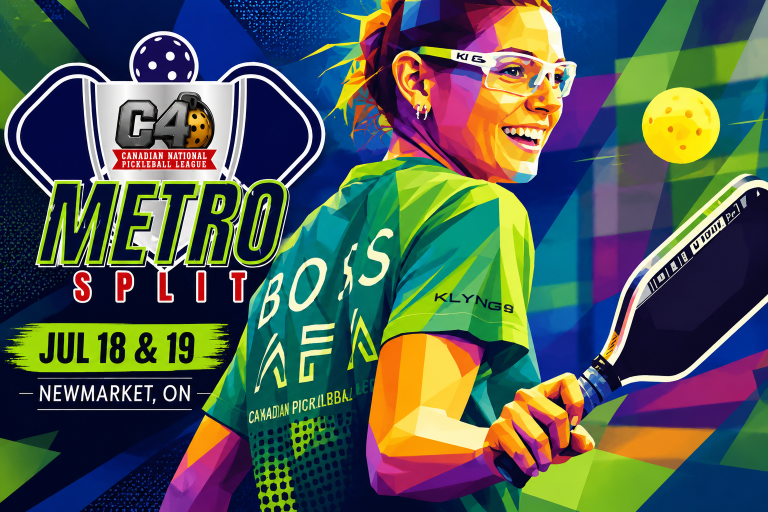

The Montreal Lions emerged from the opening weekend of the 2026 Canadian National Pickleball League season with a perfect record, but the bigger takeaway from Toronto may have been how little separated much of the field. With 10 Dreambreakers across 24 matches, the CNPL opener offered early signs of a league developing genuine depth and competitive balance.
- Montreal Lions opened the 2026 CNPL season with a flawless 6-0 weekend in Toronto.
- Ten of the event’s 24 matches required Dreambreakers, highlighting growing parity across the league.
- Improved broadcasts, statistical tracking, and tighter competition suggest the CNPL is becoming a more mature domestic product.
Dreambreakers define the opening weekend
Ten Dreambreakers in 24 matches is usually a sign that very little is separating a league.
For the Canadian National Pickleball League, that may be exactly what it wants.
The opening weekend of the 2026 CNPL season at The Pickler in Toronto West produced an unbeaten run from the Montreal Lions, standout individual performances, and a tightly packed early standings table.
But beyond the wins and losses, the strongest signal from the event may have been something broader: competitive uncertainty.
That is not a weakness for emerging leagues.
It is often the foundation of sustainability.
Montreal made the strongest start
Montreal finished the weekend with a perfect 6-0 record, establishing themselves immediately as the early team to beat.
Yet even that dominance came within a weekend where few matches felt comfortable for anyone.
The Lions were driven largely by Ariana Rodriguez, who produced one of the most efficient individual weekends of any player in the competition. Rodriguez finished with an 11-1 individual record, delivering consistently across both mixed and women’s doubles combinations.
That versatility mattered.
One of the clearest characteristics of the weekend was how heavily teams relied on players capable of stabilising multiple lineups across different formats. Rodriguez repeatedly became that player for Montreal, giving the Lions flexibility that several rivals struggled to match consistently.
The result was not just victories, but control.
Behind Montreal, the standings quickly compressed. London Smash, Toronto United, and Grand River Rapids all finished the opening weekend tied at 4-2, while several other matches across the event were decided only by Dreambreakers.
The early table already has shape, but not separation.
The Dreambreaker numbers matter
The most revealing statistic from the weekend was not Montreal’s unbeaten record.
It was the fact that nearly half the matches played required Dreambreakers.
Ten tiebreaks in 24 matches suggests a league where roster depth, mixed doubles chemistry, and lineup flexibility are becoming increasingly important. It also creates the kind of week-to-week unpredictability professional leagues need if they want to hold long-term viewer interest.
Predictability can create dynasties.
Uncertainty creates engagement.
For a developing domestic league like the CNPL, that balance matters enormously.
Too much imbalance and results become repetitive. Too much inconsistency and the competition can feel unstable. What the opening weekend suggested instead was a middle ground where several teams appear capable of beating one another depending on matchups and form.
That is usually a healthy sign.
The league product is becoming more polished
The opening event also reflected the league’s continuing investment in presentation and infrastructure.
Broadcasts on Game Plus and YouTube incorporated improved overlays, live scoring graphics, replays, and player interviews throughout the weekend. The CNPL also integrated the Ladder app for deeper statistical tracking while introducing the Owl Ball as the league’s official match ball for the season.
None of those details individually transform a competition.
Together, however, they help shape something increasingly important in professional pickleball: legitimacy.
That matters because one of the biggest long-term challenges facing domestic leagues outside the United States is not simply attracting players. It is convincing audiences, sponsors, and viewers that the product itself feels coherent, credible, and worth following consistently.
The CNPL increasingly looks aware of that.
A league finding its own identity
Canadian pickleball does not need to replicate the scale or spending power of the major American tours to become relevant.
In some ways, trying to do so would probably be a mistake.
What the opening weekend instead hinted at was the possibility of something slightly different: a competitive domestic league built around depth, regional identity, and relatively even roster quality.
That may ultimately become one of the CNPL’s greatest advantages.
Because professional leagues are not sustained purely by star names. They survive when audiences believe outcomes genuinely feel uncertain.
The early signs from Toronto suggest the CNPL may be moving closer to creating exactly that environment.
And in professional sport, competitive balance is often far harder to build than hype.
Further Reading
- Latest pickleball news from around the world
- Tournament coverage and results
- Rankings and player profiles
- Regional pickleball coverage

Chris Beaumont
Founder and Editor-in-ChiefChris Beaumont is the founder and Editor-in-Chief of World Pickleball Magazine. Chris follows the global game closely, reporting on the latest news, developments, stories and tournaments from all five continents. He also hosts the World Pickleball Podcast, interviewing people at…
View All Articles →