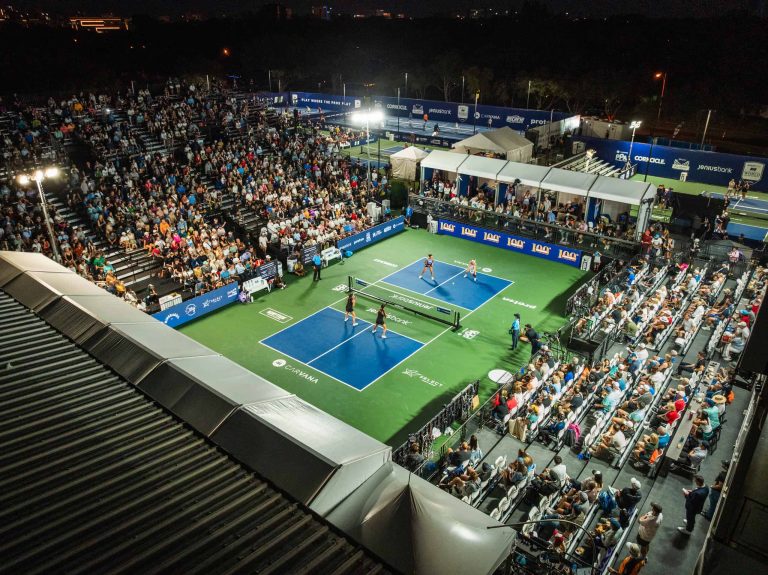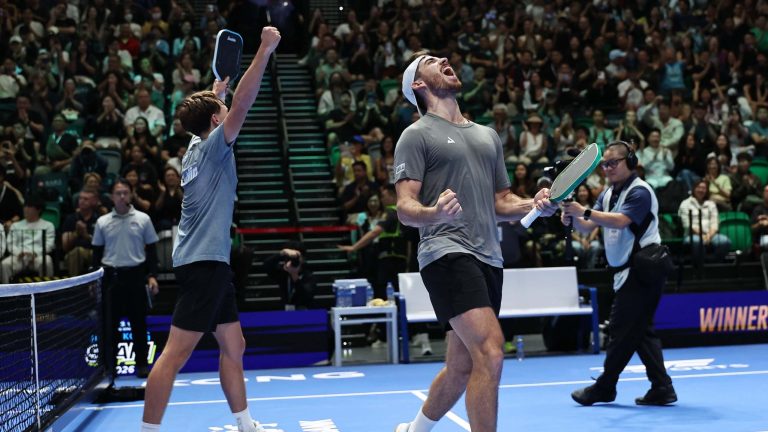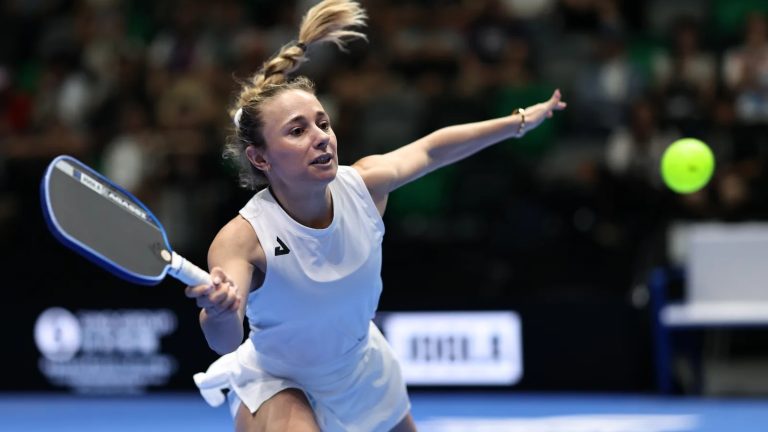
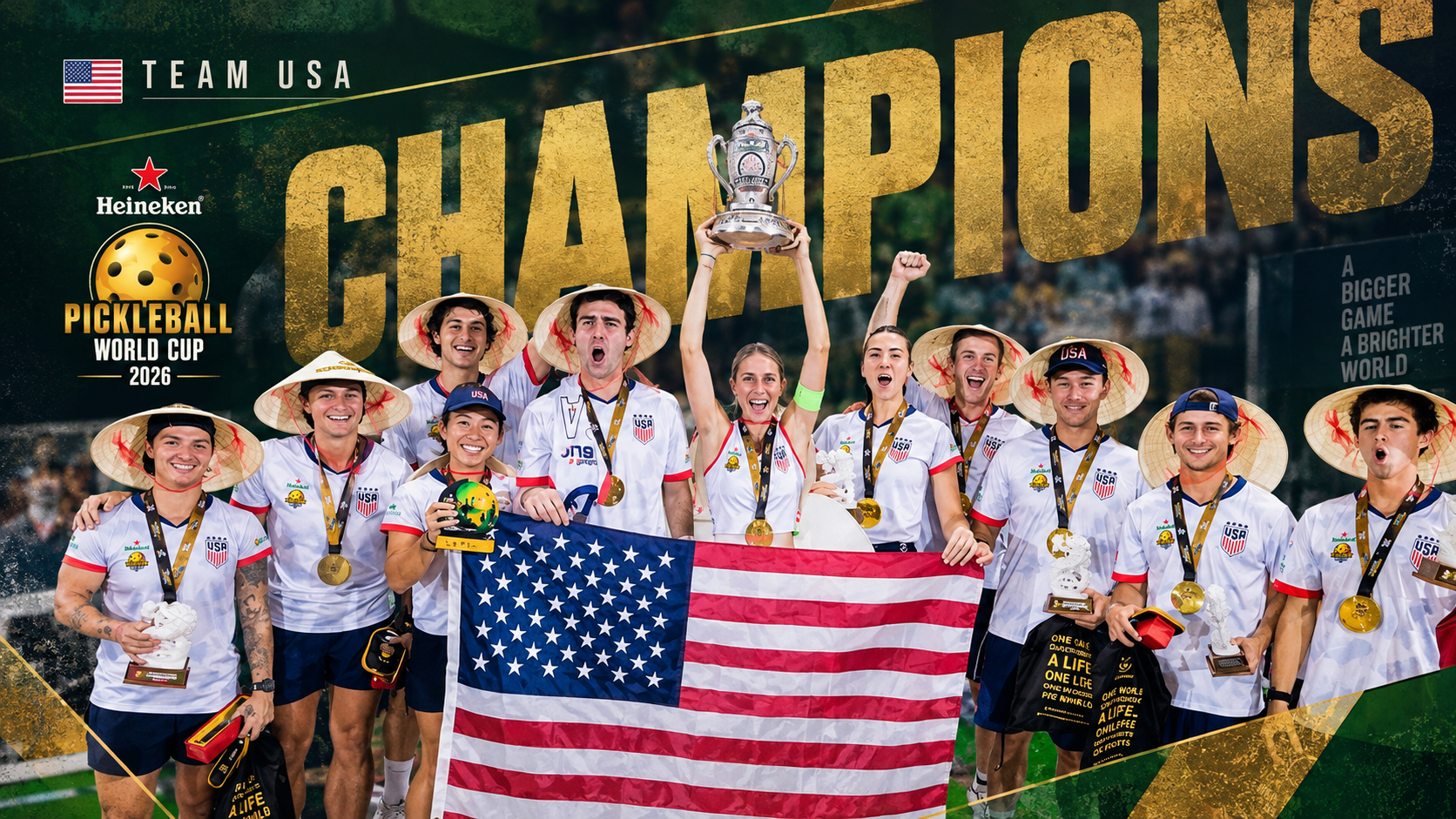
Lý Hoàng Nam won men’s singles gold and three silvers on World Cup finals day in Da Nang, as the USA beat Vietnam 4-0 in the Open team final.
The short answer: On the final day of the 2026 Pickleball World Cup in Da Nang, Lý Hoàng Nam won men’s singles gold by beating Phúc Huỳnh in an all-Vietnamese final. He then lost the mixed doubles final with Roos Van Reek, the men’s doubles final with Nguyễn Ảnh Gia Huy and the Open national-team final, which the United States won 4-0.
By Sunday morning in Da Nang, Lý Hoàng Nam had four separate chances to finish the Pickleball World Cup with gold, and by Sunday night he had converted only one of them, a result that sounds like disappointment until you look more closely at what those hours demanded of him and how much of the tournament’s final day seemed to run through his paddle.
Hoàng Nam came from a game down, and later from behind in the deciding game, to beat Phúc Huỳnh in an all-Vietnamese men’s singles final; he then lost the mixed doubles final with Roos Van Reek, the men’s doubles final with Nguyễn Ảnh Gia Huy, and finally the Open national-team final, where the United States beat Vietnam 4-0 at Tien Son Sports Palace.
The medal line was simple enough: one gold, three silvers.
The day itself was not.
More than anything, Hoàng Nam became the thread running through a finals programme that had spent the week asking how far Vietnam had travelled as a pickleball nation, and Sunday finally supplied an answer that was encouraging without being flattering: far enough to reach almost everything, but not yet far enough to win everything.
Key takeaways
- Lý Hoàng Nam beat Phúc Huỳnh 6-15, 16-14, 15-10 to win the men’s Pro singles title after trailing 8-5 in the deciding game.
- Hoàng Nam then collected silver in mixed doubles, men’s doubles and the Open national-team competition.
- Jack Munro and Nicola Schoeman each finished Sunday with two Pro gold medals.
- Katerina Stewart won women’s singles, while Schoeman and Selina Turulja took women’s doubles.
- The United States beat Vietnam 4-0 in the Open team final after Vietnam had eliminated the Netherlands, Australia and Japan.
Hoàng Nam had to rescue the first one
The first final nearly disappeared before it had properly settled.
Phúc Huỳnh took the opening game 15-6, which immediately forced Hoàng Nam into recovery mode against an opponent who needed no introduction, because this was an all-Vietnamese final between two players who understood each other’s patterns, strengths and pressure points better than most international opponents ever could.
The second game became the hinge, and Hoàng Nam survived it 16-14.
Even then, the match was not his.
Phúc Huỳnh led the deciding game 8-5, meaning Hoàng Nam had spent most of the final reacting rather than dictating, first after being comprehensively beaten in the opener, then after scraping through a second game decided by two points, and now from behind once again with the title only a handful of rallies away.
What followed was the decisive sequence of the match.
After a timeout, Hoàng Nam reeled off six consecutive points to move from 5-8 down to 11-8 ahead, eventually closing out the match 15-10 and winning 10 of the final 12 points from that deficit.
The comeback gave him the men’s singles title and ensured that the day could no longer end without gold.
Three finals still remained.
Munro and Schoeman stop the second attempt
The mixed doubles final brought a very different problem.
Hoàng Nam and Roos Van Reek faced Jack Munro and Nicola Schoeman, and unlike the singles final there was no need for repeated recovery because Munro and Schoeman established control more cleanly and held it, winning 15-11, 15-10.
For Hoàng Nam, that was the first silver of the day.
For Munro and Schoeman, it was the first half of what would become one of the most efficient performances of Championship Sunday.
Both would leave the professional competition with two gold medals, which matters because the final day cannot be reduced to a story of Vietnam falling just short; there were players on the other side actively taking those medals away, and Munro and Schoeman were among the best of them.
Their mixed doubles victory gave them a shared title first, after which they separated into different partnerships and won again.
Stewart gets her gold. Schoeman gets another.
Roos Van Reek’s second final came in women’s singles, where Katerina Stewart did not allow the contest to develop the same tension as Hoàng Nam’s earlier match and instead won 15-4, 15-9 to take gold.
Stewart still had another final ahead.
In women’s doubles, she partnered Domenika Turković against Schoeman and Selina Turulja, but this time Schoeman was the one who left with control of the match and the medal, as she and Turulja won 15-7, 15-8.
The result left Stewart with one gold and one silver, while Schoeman finished two-for-two.
It was an efficient day and, alongside Munro’s results, prevented the professional programme from becoming too neatly tied to one country, because the medal distribution was already showing what the World Cup had suggested throughout the week: the international field was not flat, but it was broad enough to produce champions from several different competitive environments.
Munro makes it two
Hoàng Nam’s third final returned the attention to Vietnam.
He and Nguyễn Ảnh Gia Huy faced Richard Livornese Jr and Jack Munro in men’s doubles, and this time the margins were tighter, with Livornese and Munro taking the first game 15-12 and the second 15-13.
Six points across two games separated gold from silver.
For Hoàng Nam, the day had now shifted to one gold and two silvers.
For Munro, it had become two finals and two victories.
By that point, the physical accumulation around Hoàng Nam was also becoming increasingly difficult to ignore, because he had already played a three-game singles final that included a 16-14 second game, followed that with mixed doubles, then gone through another close doubles contest, and still had the largest competitive obligation of his week waiting ahead in the Open team final.
Vietnam needed him again.
Vietnam earned the right to face the USA
The Open national-team final carried a different kind of weight because of what Vietnam had done to reach it.
In the round of 16, the Netherlands took Vietnam to a Final Battle before the hosts survived 4-3.
Australia then pushed them into another 4-3 contest in the quarter-finals, where Vietnam recovered after the tie had reached 3-3 and again found the decisive answer.
Japan was next.
This time Vietnam won 4-0.
That sequence matters because it strips away any suggestion that the host nation was in the final because the tournament needed a home story.
Vietnam had survived three different kinds of problem: a Final Battle against the Netherlands, another seven-match struggle against Australia, and then a semi-final sweep of Japan.
By the time Vietnam reached the United States, its place in the final had stopped being a novelty and become evidence of something more substantial, namely that the national side had enough competitive depth to survive a difficult international bracket and reach the final on merit.
The United States did not need a final battle
Vietnam had lived on the edge during its route to Sunday, but the United States never allowed the final to get there.
The USA won 4-0, with the four completed matches ending 21-17, 21-10, 21-16 and 21-14.
There is a useful distinction inside those numbers.
Vietnam was not being routinely pickled or removed from rallies altogether, because it reached 17 in one match, 16 in another and 14 in the fourth, but the United States did not surrender one.
That is what elite team depth looks like.
Over a single match, an emerging nation can find a matchup, a player or a tactical route that narrows the difference, but a team competition keeps asking the same question in different forms: can you do it in men’s doubles, can you do it in women’s doubles, can you do it in mixed, can you adjust to different pairings, and can you keep finding answers when the opposition can replace one strong combination with another?
On Sunday, Vietnam could not.
The Americans did not need the Final Battle that had decided other ties during the week, and with the first team to four points winning the contest, the remaining singles matches were not required.
Four completed matches.
Four wins.
World champions.
The 4-0 should not erase Vietnam’s week
There are two easy ways to interpret that result, and neither is particularly useful.
One is to say that Vietnam’s run proves the international game has caught the United States.
It does not.
The other is to say that a 4-0 final proves nothing has changed.
That does not work either.
Vietnam beat the Netherlands, beat Australia, swept Japan and reached the Open World Cup final, after which the United States swept Vietnam, and all of those things can be true at once without contradiction.
The useful conclusion is not parity.
It is depth.
The layer beneath the strongest established nations is getting better, and Vietnam now has both individual players capable of reaching professional finals and a team capable of navigating a serious international knockout bracket, but what it does not yet appear to have is the same concentration of high-level answers across an entire tie as the United States.
That gap matters precisely because the rest of the gap has narrowed.
One gold from four does not describe Hoàng Nam’s Sunday
Hoàng Nam’s medal count is easy to read.
Gold in men’s singles.
Silver in mixed doubles.
Silver in men’s doubles.
Silver in the Open team competition.
What those medals do not show is the workload compressed into the same day.
His singles final required him to recover from a 15-6 opening-game defeat, win a 16-14 second game and overturn an 8-5 deficit in the third; mixed doubles followed, then a men’s doubles final decided by margins of three points and two, and finally the national-team final.
Those are four different competitive demands.
Singles asks a player to own every decision and absorb every mistake, mixed changes the geometry of the court and the distribution of responsibility, men’s doubles changes it again, and team competition adds something none of them carry alone: the weight of everybody else’s matches and the knowledge that your own result sits inside a larger scoreline.
By the time Hoàng Nam reached the last of those four finals, his Sunday had become less about whether he could complete some kind of perfect sweep and more about how much competitive load one player could realistically carry at the end of a week-long tournament.
The answer was one gold and three silvers.
That is not the four-gold ending Vietnam might have imagined on Sunday morning.
It is still an extraordinary tournament.
Munro and Schoeman had the Sunday Hoàng Nam was chasing
If Hoàng Nam owned the volume of finals, Jack Munro and Nicola Schoeman owned the efficiency.
Munro won mixed doubles with Schoeman and men’s doubles with Livornese, while Schoeman won mixed doubles with Munro and women’s doubles with Turulja.
Two finals each.
Two golds each.
Their success matters for another reason, because the professional finals did not produce a clean national hierarchy even though the Open team competition ended with a decisive American champion.
Stewart won women’s singles, Hoàng Nam won men’s singles, Munro and Schoeman won mixed, Munro and Livornese took men’s doubles, and Schoeman and Turulja took women’s doubles.
Different partnerships, different backgrounds, different routes into the international game.
That is a healthier picture than one country simply swallowing the entire professional programme.
What Da Nang actually told us
The obvious headline from the Heineken Pickleball World Cup is that the United States won the Open team championship.
That should be recorded.
It should not be mistaken for the whole story.
For WPM, the more useful question throughout the week has been what the tournament tells us about the international competitive order, and Sunday supplied the clearest evidence yet because the United States remained capable of separating itself from an emerging nation across the depth of a team contest while Vietnam, crucially, was now capable of reaching that contest.
Those statements are complementary, not contradictory.
Below the team event, the professional finals were much more dispersed, with Hoàng Nam winning singles, Munro and Schoeman winning twice, Stewart winning singles, and Livornese and Turulja collecting doubles golds.
The picture is messy.
Good.
International sport becomes interesting when its hierarchy requires explanation, and Da Nang did not show us a world in which everyone has caught everyone else; it showed us something more believable, where some gaps are closing faster than others, some players can already cross them, and some teams cannot yet do so four times inside the same tie.
The last lesson from Da Nang
On Sunday morning, Hoàng Nam could still imagine four gold medals, while Vietnam could still imagine winning a home World Cup.
By Sunday night, Hoàng Nam had one gold and three silvers, and Vietnam had another silver after the United States closed the Open final 4-0.
Those outcomes could make the final day sound like a story about falling short, but it was more useful than that.
Hoàng Nam won the men’s singles title after twice finding himself in trouble, Munro and Schoeman each produced perfect two-final Sundays, Vietnam proved it could survive the Netherlands, Australia and Japan, and then the United States showed exactly where the next line remains.
For a week, Da Nang had been about possibility.
By Sunday night, possibility had become hierarchy.
The United States stood at the top of the Open team competition, Vietnam stood one step below, and around them the professional medals travelled in several different directions.
The world has not caught up evenly.
It is catching up differently.
That is a much more interesting sport to follow.
Frequently asked questions
Lý Hoàng Nam beat fellow Vietnamese player Phúc Huỳnh in the final, coming from a game down.
The United States beat Vietnam 4-0 at Tien Son Sports Palace.
He won one gold and three silvers, in men’s singles, mixed doubles, men’s doubles and the team event.
Further reading
- Lý Hoàng Nam Reaches Four World Cup Finals as Vietnam’s Sunday Takes Shape
- Vietnam Survives Australia and Sweeps Japan to Reach the World Cup Final
- World Cup Day Two: How the Doubles Draws Took Shape in Da Nang
- World Cup Day One: Vietnam Sets the Early Standard in Da Nang

Chris Beaumont
Founder and Editor-in-ChiefChris Beaumont is the founder and Editor-in-Chief of World Pickleball Magazine, published by World Pickleball Media Ltd. He follows the global game closely, reporting on news, developments, stories and tournaments from all five continents. He also hosts the World Pickleball…
View All Articles →