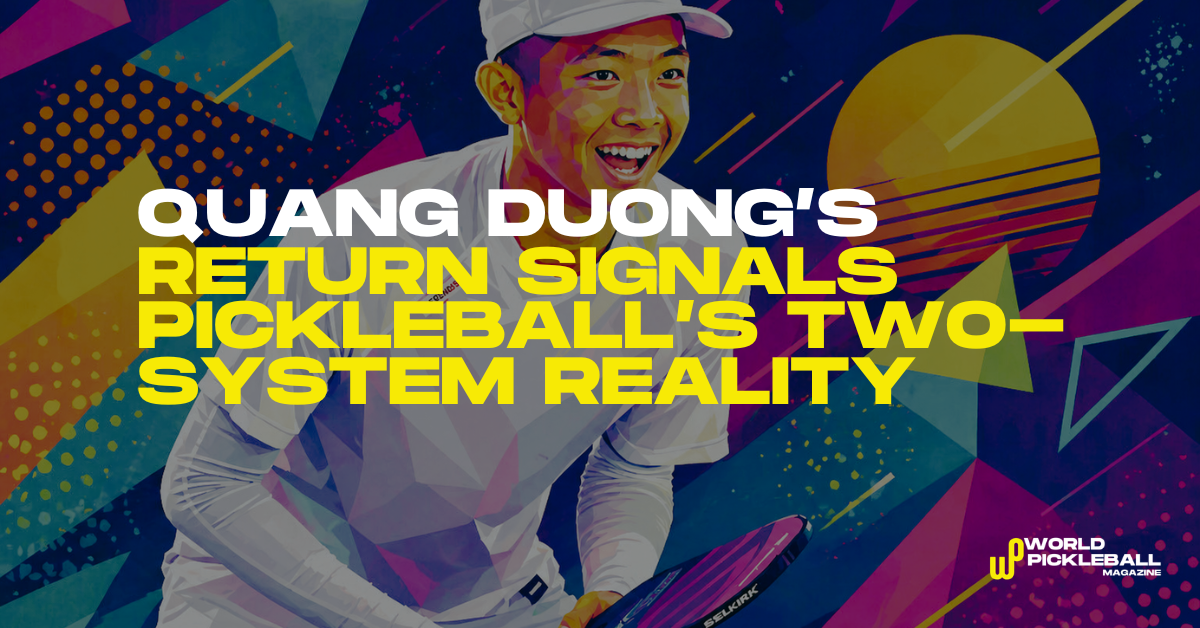
After a year away from the American circuit, Quang Duong returns at the APP Sacramento Open. His path back says as much about the structure of professional pickleball as it does about his own career.
- Quang Duong’s return follows his removal from the PPA and MLP system in 2025
- The APP has secured 28 players, targeting international and available talent
- A second pathway is emerging for players outside the dominant US structure
A year away from the system
For most of the past year, Quang Duong has not been part of the American pro circuit where he made his name.
Not through injury. Not through loss of form. Through absence.
The 19-year-old, once ranked inside the PPA Tour’s top tier, was removed from both the PPA and Major League Pickleball system in 2025 following a contract dispute. From that point, his route through the sport changed completely.
He continued to play. Continued to compete. But not within the structure that defines elite pickleball in the United States.
This week in Sacramento, he returns.
But not to the same system.
A different route back
Duong’s reappearance at the APP Sacramento Open sits alongside a wider shift.
On 30 April, the APP confirmed multi-year agreements with 28 professional players. The names span England, the Netherlands, India, Australia, and the United States. On the surface, it reads as expansion.
In reality, it reads as selection.
The APP is not drawing from the same locked pool as the PPA. It is building around players who are available, international, or still emerging. That includes players like Duong, who sit outside the dominant system but still operate at a high level.
This is not accidental. It is structural.
Where the PPA and Major League Pickleball concentrate the top tier, the APP is shaping the layer beneath it. Not by replicating the same model, but by working within a different set of constraints.
Duong’s position over the past year makes that visible.
His absence was not about level. It was about access. Once removed from the primary system, he had to build elsewhere. Now, his return comes through a tour that is actively creating space for players in that position.
He has already appeared in Sacramento in an exhibition match alongside Casey Diamond, losing to Jack Munro and Richard Livornese Jr.. The result is secondary. The context is not.
He is back competing across singles, doubles, and mixed, in a structure that is designed to include him.
If you’re following how the global game is shifting week by week, the World Pickleball Report breaks this down every Wednesday.
The system beneath the system
Professional pickleball now operates across two layers.
At the top, the system is defined. The PPA Tour and Major League Pickleball control the highest-ranked players, the biggest events, and the clearest pathway to visibility.
Beneath that, the picture is less fixed.
International players are emerging from outside the US structure. Younger players are developing without guaranteed access to the main tour. Others, like Duong, have stepped out of the system and need a route back.
The APP is positioning itself within that space.
Not as a direct mirror, but as an alternative pathway. A place where players can compete, rebuild, and, in some cases, re-enter the wider conversation.
This is where its recruitment strategy becomes clearer.
It is not just about signing talent. It is about identifying who is not fully captured by the dominant system and building around them.
Control, access, and what comes next
In any professional sport, control of players shapes the structure of the game.
In pickleball, that control is now split.
The PPA holds the top tier. The APP is beginning to shape the layer beneath it. That layer is not secondary in importance. It is where players develop, return, and position themselves for the next step.
Duong is one of the clearest examples of that movement.
If he performs in Sacramento, the question will not just be about his level. It will be about where that level fits, and which system ultimately benefits from it.
That is where this story extends beyond one player.
It becomes a question of access. Of pathways. Of how players move through the sport at a time when those routes are becoming more defined, but not necessarily more open.
For a clearer view of where the sport is heading each week, you can join the World Pickleball Report here.
Further Reading
- Latest pickleball news from around the world
- Tournament coverage and results
- Rankings and player profiles
- Regional pickleball coverage

Chris Beaumont
Founder and Editor-in-ChiefChris Beaumont is the founder and Editor-in-Chief of World Pickleball Magazine. Chris follows the global game closely, reporting on the latest news, developments, stories and tournaments from all five continents. He also hosts the World Pickleball Podcast, interviewing people at…
View All Articles →