
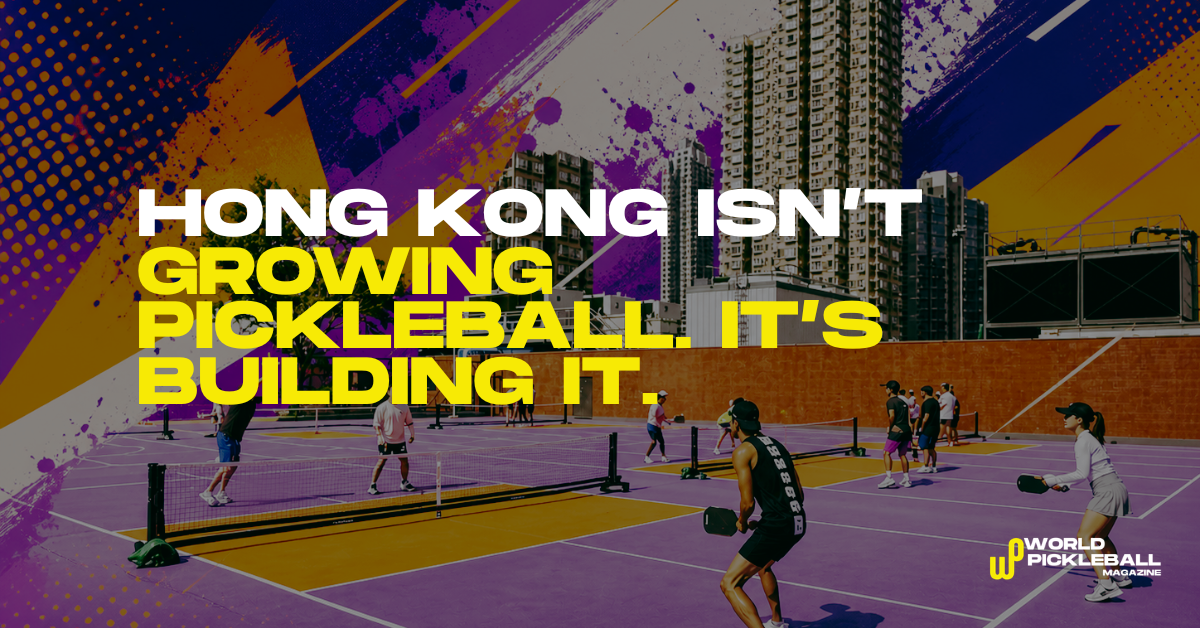
A new partnership between Sino Group and the Hong Kong, China Tennis Association signals a shift from scattered expansion to controlled development. That changes what the sport becomes next.
- Hong Kong has moved from fragmented courts to a coordinated pickleball development system
- Real estate investment is now becoming a serious driver of long-term sports infrastructure
- The next phase of pickleball will be defined less by participation and more by structure
The end of improvised growth
For years, pickleball has expanded wherever it could find a few spare metres of space.
A tennis court with temporary lines. A converted warehouse. A shopping centre floor turned, briefly, into a sports venue.
That looseness helped the sport spread. It was easy to set up, easy to learn, and easy to share.
Hong Kong is now moving beyond that phase.
From scattered courts to a system
The launch of the Hong Kong Pickleball Elite Development and Community Promotion programme is not another simple growth story. It is a structural one.
Sino Group and the Pickleball Committee of the Hong Kong, China Tennis Association have aligned to create something the city did not previously have. A connected system.
Training bases are now fixed inside Sino Group properties. Community access points are defined through organised sessions. A formal selection process leads towards international competition.
That matters more than adding courts.
Previously, pickleball in Hong Kong existed in fragments. Courts appeared where space allowed. Players developed without a consistent route to elite level. The sport was visible, but not fully organised.
This programme changes that.
It replaces availability with intention.
If you’re following how the global game is shifting week by week, the World Pickleball Report breaks this down every Wednesday.
Why space is power
The involvement of Sino Group is not a side detail. It is the mechanism.
In dense cities, space decides what a sport can become. Without reliable venues, there is no proper pathway. With controlled space, the people who own or manage that space help decide who progresses.
That is the real significance here.
By anchoring pickleball inside a major property network, Hong Kong has removed one of the sport’s biggest limitations: temporary access.
That allows something more ambitious.
Coaching can become consistent. Competition can be structured. Performance pathways can be sustained rather than improvised.
It also brings pickleball closer to how established sports operate.
Facilities first. Systems second. Players third.
That order matters.
The shift from participation to performance
Hong Kong’s silver medal at the 2025 Pickleball World Cup was the signal.
This programme is the response.
It introduces a full pathway. School outreach identifies new players. Community sessions widen the base. A centralised selection tournament builds towards international competition in Vietnam.
That is not expansion. It is progression.
The difference is subtle, but important.
Expansion asks how many people play. Progression asks how good those players can become.
Hong Kong has moved from one question to the other.
What this means for pickleball
Pickleball is reaching a point where growth alone is no longer enough.
In many regions, participation has already arrived. Courts are busy. Demand is visible. The next step is not more exposure. It is better structure.
Hong Kong is one of the clearest examples of that shift.
And it will not be the last.
Tennis federations are beginning to absorb pickleball into their systems. Commercial partners are investing not only in events, but in infrastructure. The sport is becoming something that can be planned, not just something that appears.
That changes who shapes it.
Not just players and organisers, but institutions.
The question that follows
The move towards structure brings a different kind of pressure.
Once a system is built, it defines access. It determines who enters, who progresses, and who stays outside it.
Pickleball has, until now, been unusually open. That openness is part of why it spread so quickly.
Hong Kong’s model is efficient. It is scalable. It is likely to be copied.
The question is whether the sport can become more organised without losing the looseness that made it work in the first place.
Pickleball did not reach this point by being controlled. Its next test is whether control makes it stronger, or smaller.
For a clearer view of where the sport is heading each week, you can join the World Pickleball Report here.
Further Reading
- Latest pickleball news from around the world
- Tournament coverage and results
- Rankings and player profiles
- Regional pickleball coverage

Chris Beaumont is the founder and Editor-in-Chief of World Pickleball Magazine. Chris follows the global game closely, reporting on the latest news, developments, stories and tournaments from all five continents. He also hosts the World Pickleball Podcast, interviewing people at all levels of pickleball. Chris is also an avid player, currently struggling to make the breakthrough from 4.0 to 4.5.